SAP Clean Core? Yes, Please! But What Does That Mean from a Technical Point of View?
September 1, 2026 | Reading time: Approx. 11 Minuten

Experts from the FIS Group
Everyone is talking about this term, which is flanked by techniques such as side-by-side extensibility, key user extensibility and embedded steampunk. In this context, however, one often only thinks of SAP Business AI Platform (SAP BAIP) and SAP S/4HANA Public Cloud Edition. Are software solutions really to be developed “exclusively” on SAP BAIP in the future or are there also any other options? What does clean core mean from a technical point of view?
Why should you pursue the clean core strategy?
“Clean core” is often mentioned together with the innovative capability and innovation speed of software systems. However, there are also other reasons that speak in favor of the clean core standard: First of all, custom code costs a lot of money in contrast to standardization! It must be created, tested and maintained.
Did you know that one line of custom code causes costs of about 1€/year for maintenance? With an average of 100,000 lines of code, the annual expenses exceed the initial implementation costs after a short time already.
In addition, all developments must be checked and tested against their compatibility with the target release in case of an upgrade and unfortunately, this dependency and complexity are frequently underestimated. However, the upgrade efforts strongly depend on the way add-ons and custom code were implemented in SAP systems. Here, things have changed a lot during the last few years.
What is the problem caused by too many modifications within the SAP system?
For many customers, modifications were or are the “icing on the SAP cake”. This technology enabled them to strongly individualize the behavior of the core system and completely adjust it to their own individual processes. Here, there were no limits to the companies’ creativity and they were hoping for competition potentials by using this technology.
Moreover, technical modifications were no problem for an upgrade as SAP provides proven tools and processes for handling such further developments. However, each modification has to be “remixed” with every new upgrade, which costs time and money and involves a substantial error risk.
Moreover, it ties down user staff for testing the ERP functionalities after the upgrade. In the future, the technical progress to be expected and continuous innovations will be the reasons for a strongly increasing number of upgrades and the associated challenges.
What happens to the modifications during an upgrade?
In a nutshell, the old code including all modifications will be overwritten by the upgrade. Afterwards, the modifications have to be inserted into the new source code again. This is no problem in most of the cases. But what will happen if the new source code has been changed at exactly this position or does no longer exist? Now, things become tricky and you might have to:
Most of the SAP operators have long recognized that modifications are problematic. However, access to other development objects, such as elements of the ABAP dictionary, is problematic as well. Users, for instance, often access SAP tables while reading in the custom code. But what will happen if these tables are no longer available after the upgrade due to a data model modification or include different data?
Many other enhancement techniques, such as BAdIs or explicit enhancements, are far less complicated today.
How can we establish an upgrade- and future-proof system?
The clean core approach pursues the aim of keeping the ERP core close to the standard system, upgradeable and free from non-supported modifications. Individual requirements are implemented via released enhancement mechanisms, APIs as well as side-by-side or on-stack enhancements to ensure that innovations and updates can be adopted faster. As a consequence, technical debts are reduced, maintenance and upgrade efforts decreased in the long run and the bases for a future-proof cloud transformation created.
How can SAP S/4HANA systems be extended in the future?
In the future, systems should be extended using the SAP S/4HANA Cloud Extensibility Model. It ensures more upgrade efficiency and opens the doors for the cloud transformation. Besides the well-known extensibility by developers, it also provides for an extension of applications by business experts.
In spring 2025, SAP renamed its cloud ERP products:
The solution previously known as SAP S/4HANA Cloud Public Edition has been called SAP Cloud ERP since then, whereas SAP S/4HANA Cloud Private Edition is now described as SAP Cloud ERP Private. In this specialist article, however, the old names remain unchanged.
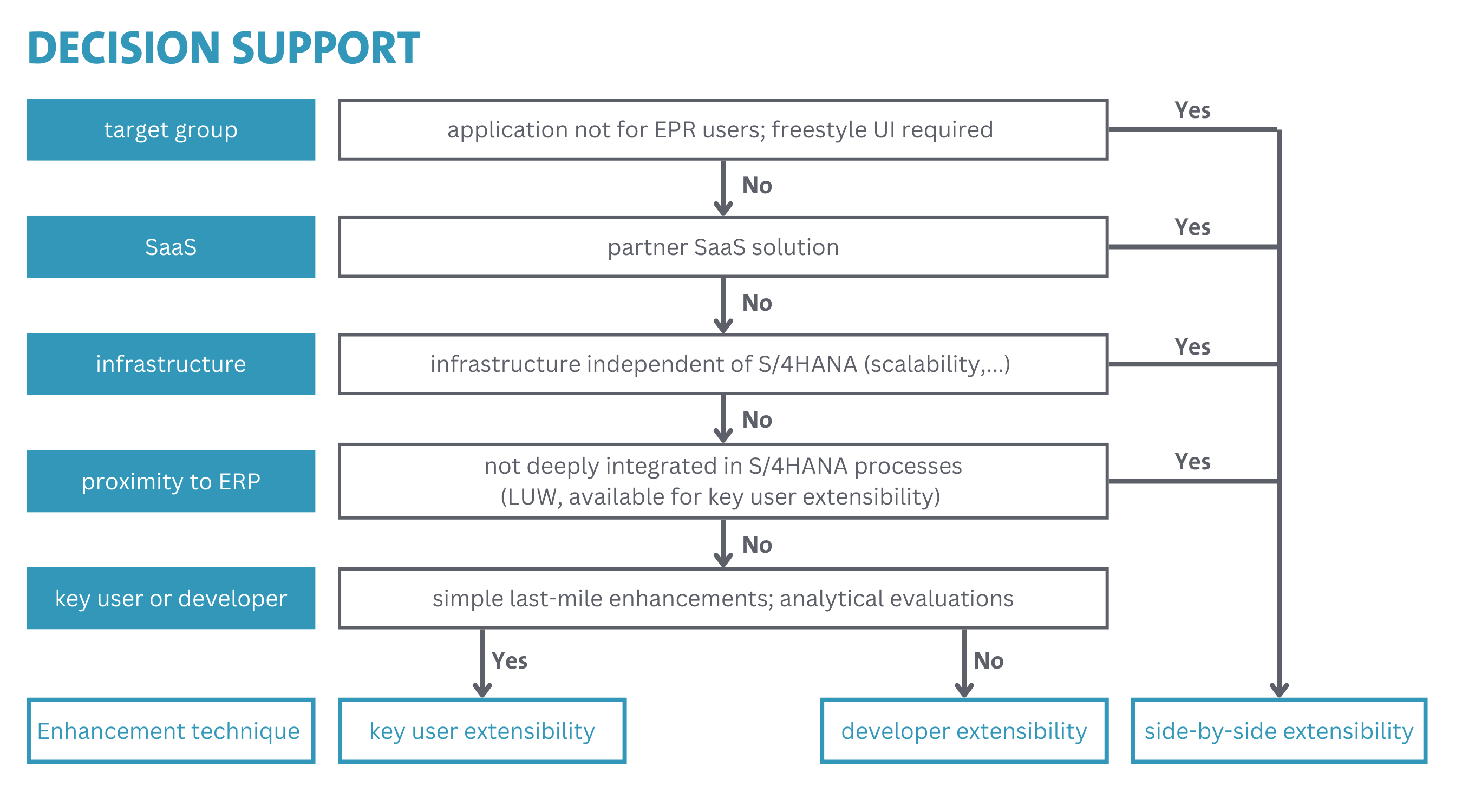
The key user extensibility enables enterprises to implement numerous individual requirements independently and without support of developers. In addition to adjustments of the user interface, even technical extensions can be implemented via BAdIs.
For more complex extensions of applications and processes, developer extensibility is used. It follows the default specifications of the SAP Cloud Extensibility Model and consistently relies on released technologies and extension points. In this way, extensions remain maintainable, upgradeable and compatible with future further SAP developments.
If the options within the ERP system are not sufficient or new applications are to be developed irrespectively of the SAP core, the side-by-side extensibility will provide another approach. Here, developments are implemented outside SAP S/4HANA, e.g. on SAP Business AI Platform, and integrated via standardized interfaces.
What options are provided by side-by-side extensions?
It is advantageous in many cases not to operate applications “on-stack” in the SAP S/4HANA system but provide them via SAP Business AI Platform. The advantages are, for instance, scalability and the availability of services. In this way, ERP data is consumed by SAP BAIP via the public API of the SAP S/4HANA system and provided to the user if required.
SAP BAIP offers a multitude of services (mobile services, identity authentication service, Cloud Foundry runtime, Integration Suite, AI services, …) that can be consumed by the application if required and help optimize the efficiency of software developments. Key users can even create applications or AI agents themselves via “by-side” using the “SAP Build Apps” no-code platform and Joule Studio.
Different enhancement techniques and when they are used
The question concerning the selection of enhancement and development techniques depends on different factors and there is no general answer to it. However, a first tendency can be deducted using the following matrix:
Excursion: How does the wholesale sector benefit from the clean core approach?
The named enhancement techniques are the key to more efficient processes along the entire value chain – especially for the wholesale sector. With FIS Wholesale Distribution Suite, we have developed a solution that is consistently oriented towards the clean core principles. Consequently, industry-specific requirements can be implemented without having to compromise on function depth or flexibility.
During the development of FIS Wholesale Distribution Suite, we have specifically relied on all three extension levels of the SAP S/4HANA Cloud Extensibility Model:
Wholesalers obtain a future-proof, upgradeable system that intelligently supports industry-specific processes from purchasing and MRP to sales and distribution and completely remains within the scope of the clean core model. Technical debts belong to the past and the way into the public cloud remains open at any time.
What will happen to the old code of the ERP system?
The decision is all yours! It depends on the strategy you seek with your IT landscape. If, in the future, you would like to pursue a public cloud approach, you can only operate software that was developed according to the principles of the Cloud Extensibility model – without any exception! No modifications, reports or new dynpro programs and only released enhancement points.
However, the decisive question is not which code will remain but which added business value it still provides nowadays. Numerous customer developments have evolved over the years and meet important requirements. At the same time, they increase efforts for maintenance, tests and future updates.
A clean core approach enables a systematic valuation of these developments. With tools such as the SAP Readiness Check, the Custom Code Migration app, ABAP Test Cockpit as well as the SAP Clean Core Measurement Framework, enterprises can provide transparency on usage, technical complexity, dependencies and modernization needs.
Based on this analysis, enhancements can be prioritized according to business impact, frequency of use and technical risk. Business-critical developments are specifically modernized and transferred into a clean core-compliant architecture, whereas solutions that are no longer required or have become redundant can be replaced step by step. In this way, an individual transformation roadmap is created that enables immediate cleansing as well as a controlled transition to a maintainable and upgradeable ERP landscape.
As a consequence, clean core is not an end in itself but a strategic approach for reducing technical debts. Enterprises create the basis for faster innovations, plannable updates and lower operation and maintenance costs in the long run.
Is ABAP standing in the second row in the future?
The development in the SAP environment has considerably changed in the last few years. It is not just Fiori or SAP BAIP that confront the developer community with new frameworks, tools and programming languages. The ABAP Roadmap as well has strongly been further developed and offers numerous new methods.
Technologies such as the ABAP RESTful Application Programming model are establishing themselves on the market and simplify the development of applications in clean core. But don’t worry: ABAP will certainly not stand in the second row in the future as it has some new colleagues in the team.
Conclusion
The costs for creating custom code and the licenses required are an important decision criterion for each company. However, the costs for support and maintenance of the custom code are frequently neglected in practice. These costs depend, for instance, on the selected enhancement technique for modernization. Here, we are talking about “technical debts” accumulated during the development.
To optimize your processes, it goes without saying that you can and should spice your SAP soup with custom code as usual. However, future maintenance costs, stability and governance should also be considered for your IT strategy. It might make sense to accept higher development costs for IT transformations and prefer them to higher technical debts in the ERP core.

Questions about this topic? Our team will be happy to assist you personally.

Read, take a look, inform yourself
In our download section, you will find a large number of SAP contents worth knowing – expert talks, white papers and flyers. To find right away what you are looking for, please use the filter function for topics and content type.
