Composable Commerce & Headless Commerce
How do you manage to constantly further develop an online store and still keep it running solidly? The headless commerce approach provides an answer to this question. And how is it possible to unite specialized suppliers of shop functions in one application? Taking a look at composable commerce will be worthwhile.

Consultant & Developer at FIS
What is the difference between composable e-commerce and headless commerce?
The main feature of the headless commerce approach is the separation of the visible part of an e-commerce shop and the technology in the background. Composable commerce divides the e-commerce platform into separate exchangeable modules.
What is headless commerce?
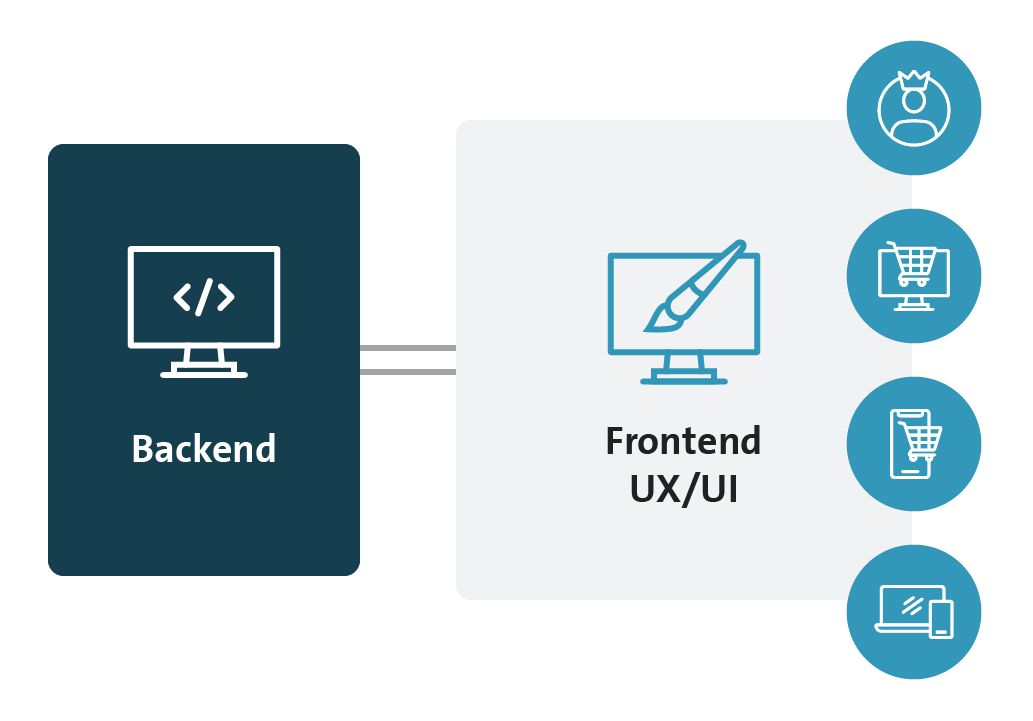
Headless commerce describes an e-commerce architecture with the online shop display (storefront) being separated from the technical platform for business logic (back end). This separation enables greater flexibility, scalability and an improved performance of the entire e-commerce system.
Challenges making the use of headless commerce necessary
For the first time, the term “headless commerce” was used by Dirk Hoerig, founder of “commercetools”, in 2013. Before this concept was introduced, business logic, database and shop display had been delivered in a monolithic suite. This led to multiple challenges:
How does headless commerce work?
To circumvent these problems, an architecture was introduced that uses independent technologies for shop display (storefront) and business logic (back end). The communication between these two system areas takes place via Web services or APIs (Application Programming Interfaces), which entails several advantages:
Example: price layout adjustment during the Christmas season
A vivid example of the use of headless commerce is the seasonal adjustment of an online store. If a trader wishes to change the layout of the price displays during the Christmas season, this can be implemented directly in the e-commerce storefront without developers being involved for the business logic. This leads to a substantial saving of time by using headless commerce and an improved responsiveness to market trends.
What does composable commerce mean?
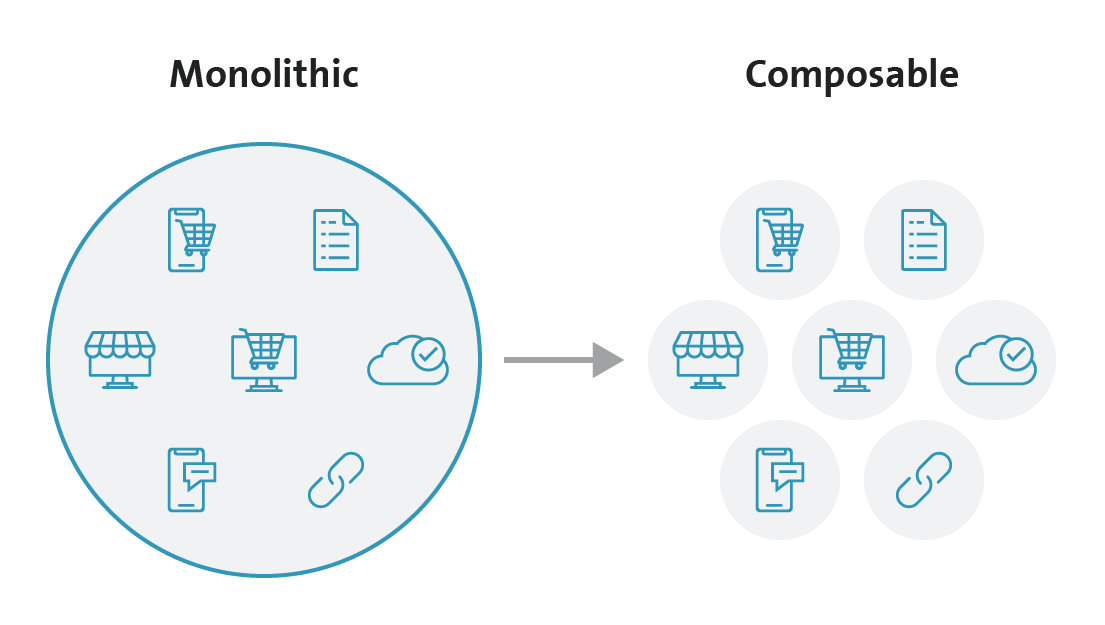
Composable commerce is a further development of the headless commerce approach, which is not only restricted to the decoupling of front end and back end but also organizes the back-end business logics in modular components. Individual functionalities, such as price calculation or order processing, are treated as independent packages and loosely coupled to each other via API interfaces. Therefore, enterprises can flexibly respond to new e-commerce requirements and exchange or extend specific functions according to their needs.
How are composable commerce and headless commerce related to each other?
If you follow this logic, the storefront is only a module and could be exchanged. The back end would remain unchanged in the scenarios. As a consequence, headless commerce works as a concrete specification of the composable commerce approach.
How long has composable commerce been available?
For the first time, the term “composable commerce”, was mentioned in a study by Gartner entitled “Composable Commerce Must Be Adopted for the Future of Applications” in 2020. Here, the concept of business capabilities is defined as a central component enabling enterprises to achieve their individual business objectives.
Example: replacement of a price service
A practical example is the replacement of the price calculation service. Instead of carrying out the price calculation in the back end, it is read from an ERP system. Development and testings can take place in a separate area, while the e-commerce storefront continues to run solidly. After implementing the new price service, it can be displayed faster and even customer-specifically in the storefront without having to adjust the entire system.
How can a company respond faster to market changes by using composable commerce?
An example of this is a company that operates online stores in several countries with each country having individual business processes or logistics partners. In a classic monolithic e-commerce architecture, the entire shop software of all countries would have to be tested before each release to ensure that the shops in all countries continue to work smoothly. This leads to high reconciliation efforts and slows down the release cycles.
By using composable commerce, it is possible to update specific back-end services only for individual countries or business areas without affecting the rest of the system. If, for instance, logistics provider B is replaced by C in country A, the back end will assume communication with the new provider without impairing the shops in other countries. In this way, the entire shop remains stable and continuously available.
What are the benefits of composable commerce?
Challenges of composable commerce
Conclusion
Composable commerce and headless commerce provide innovative technological approaches for the architecture of complex online stores. Due to the decoupling of front end and back end, headless commerce enables more flexibility and scalability. Composable commerce goes even farther than this and allows a modular, API-controlled system design.
Although these concepts are highly effective, they are no panacea for every online store. The implementation requires technical competence, cost control and orchestration of the e-commerce components. Particularly for enterprises with complex requirements, they provide a future-proof alternative to monolithic systems. The appropriate use decides on success, and not every shop architecture automatically benefits from it.