FIS/hrd SRA Schema and Rule Analyzer
This specialist article describes how this FIS/hrd tool enables an audit-proof development of schemas, rules and Customizing in SAP HCM systems.

Product Manager at FIS
What is the FIS/hrd SAP optimization?
The FIS/hrd tool set – consisting of FIS/hrd Schema and Rule Analyzer (SRA) and the FIS/hrd CCC Copy and Comparison Tool – are enhancements optimizing SAP HCM and SAP HCM for the S/4HANA (H4S4) standard version. These enhancements are suitable for all industries and can be used in HR user departments working with SAP systems to increase the quality and security in SAP payroll. FIS/hrd has been designed for anything to do with security and auditable development and is used for the special protection of sensitive HR data in SAP. This specialist article specifically explains the SRA component.
What are the challenges of HR core functions payroll and time management?
Security and reliability are paramount in HR core functions payroll and time management. The challenge lies in the dependence on countless influences. They include legal changes, new tariff bases or individual company agreements that mostly have to be implemented until the next payroll run – in a time-critical and, simultaneously, error-free manner since one payroll run will quickly be followed by the next. New work models, such as home office and hybrid working, are influencing time management, among other things.
Furthermore, different persons as well as external service providers work in the system since enterprises partially outsource payroll. This requires clear transfers but rather a documented and clear traceability of all changes. What is more, knowledge frequently and only exists in the heads of longtime employees – and you can hardly imagine what will happen if these employees leave the enterprise. This means that there is no traceability of changes, versionings respectively. If errors occur, they cannot be traced. Error handling might become tedious and endangers an error-free and punctual payroll run.
Even small changes may have far-reaching effects in the SAP HCM system. Tailor-made optimizations and intelligent tools provided by SRA with SAP Human Capital Management reduce the workload of persons responsible in HR and IT departments because these optimizations and tools ensure payroll correctness. In addition, requirements concerning audit compliance and data protection can be easily implemented.
What is the FIS/hrd Schema and Rule Analyzer (SRA)?
The schema and rule analyzer complements the SAP HCM and SAP H4S4 standard versions by relevant functionalities. It supports employees of HR IT in their daily work. The HR core functions, such as payroll or time management, are designed to be efficient, transparent and audit-compliant. SAP HCM rules are used to calculate and valuate wage types and working times in payroll and time management. SAP HCM schemas map the structure of payroll and time evaluation.
FIS/hrd SRA can be used to version rules and schemas in SAP HCM and H4S4, but also any other table sections. In this way, deltas of the original versions can also be determined across system boundaries. FIS/hrd SRA provides important requirements for the compliance with legal standards and is indispensable in the HR system landscape.
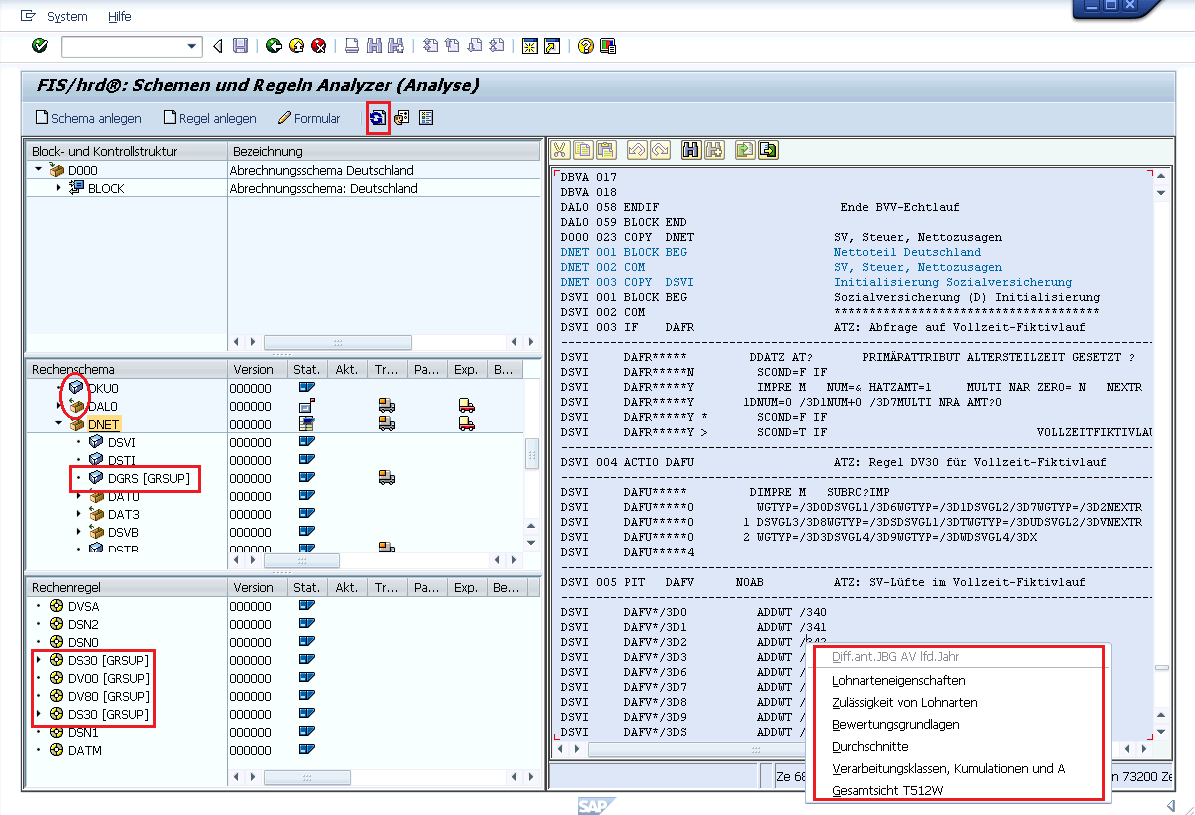
The FIS/hrd Schema and Rule Analyzer (SRA) enables an audit-proof development of rules and schemas as well as Customizing in SAP HCM systems. This tool ensures the traceability of changes by versioning the changes in the schema and rule set. Moreover, changes can be documented directly in the system via the maintenance interface.
This enables efficient processes, e.g. in SAP Time Management PT and Payroll PY, from version comparisons and troubleshooting, matching support during the import of Support Packages to transparent documentation directly in the HCM system.
What are SAP Support Packages?
The import of Support Packages, particularly in the area of Human Resources, is an important process to ensure that the system complies with the current statutory requirements, i.e. that new legal requirements as well as legal changes are considered in the system.
The updates are used to adjust affected objects in the SAP system in order to maintain the necessary prerequisites for lawful processes. In the HR area, the Support Packages particularly include changes to the schemas and rules in SAP HCM in addition to adjustments to the source code of ABAP programs (reports) and updated table entries.
What are the benefits of the FIS/hrd Schema and Rule Analyzer (SRA)?
How does the FIS/hrd Schema and Rule Analyzer (SRA) ensure traceability and audit compliance?
In the HCM environment, development processes in running IT systems are particularly frequent. However, every change in Customizing affects the processes and results in payroll and time management – even small changes can have a big impact.
In response to requests by auditors or user departments, correct information cannot be guaranteed as the status of the schema and rule set cannot be traced at a specific point in time.
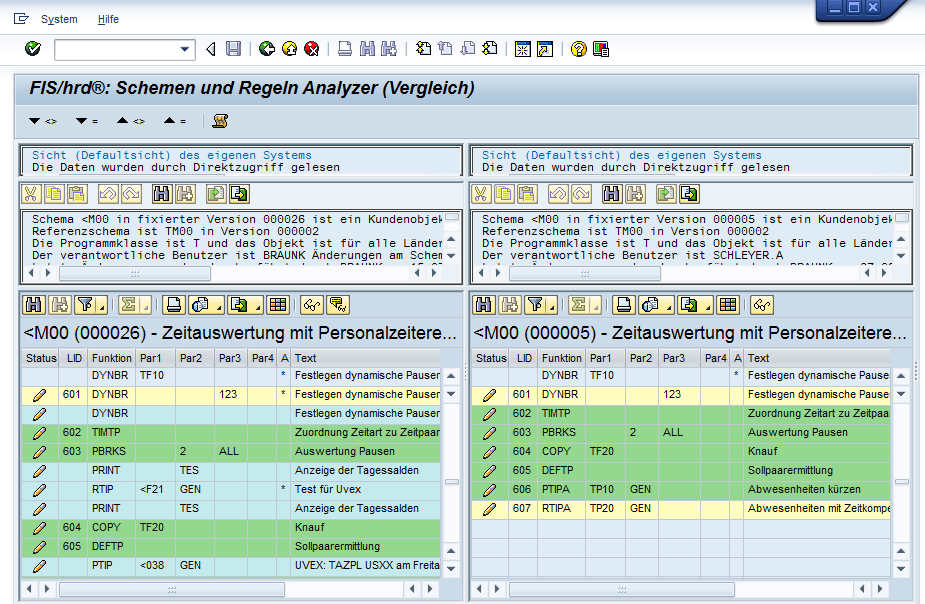
FIS/hrd SRA ensures a traceable and audit-proof development of the SAP HR core processes, such as payroll and time management. This tool can be used to version payroll schemas and rules but also any other table section. In this way, you can always have an eye on all changes and determine deltas of the original versions fast and easily. Versioning allows payroll error sources to be reliably identified and eliminated.
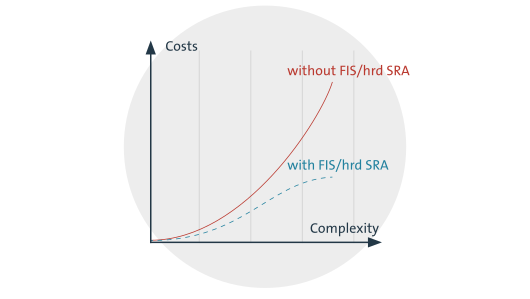
With the increasing complexity of HR laws, agreements and instruments, costs for payroll systems also increase exponentially because the necessary changes generate comparison and implementation efforts. By using FIS/hrd SRA, these efforts can be considerably reduced, even in complex HCM systems.
What are the most important FIS/hrd SRA functionalities?
How do I manage to keep my schema and rule set compact?
The Operational Relevance Check (ORC) is an additional component of the FIS/hrd Schema and Rule Analyzer (SRA). ORC extends the SRA to include an operational relevance check for schemas and rules in SAP HCM Time Management and Payroll.
Rules and logic in SAP HCM have evolved over many years. Changes in legislation, collective bargaining agreements, company agreements, and organizational adjustments mean that new logic is constantly being added. At the same time, historical rules must be retained as long as they are still needed for retroactive calculations.
The challenge: Schemas and rules do not have a clear expiration date. As a result, it is often difficult to determine which components are still relevant and which can safely be removed. Out of an abundance of caution, outdated structures often remain in the system. ORC provides a solid basis for decision-making and helps keep the rule set organized without removing necessary historical logic.
A streamlined system, no outdated data
ORC can analyze the rulebook in two ways
Period-Based Review
For a defined retroactive calculation period, the system checks which schemas, rules, or rule components are still relevant. Components that are no longer needed can then be gradually commented out and removed later.
Analysis of Specific Employee Cases
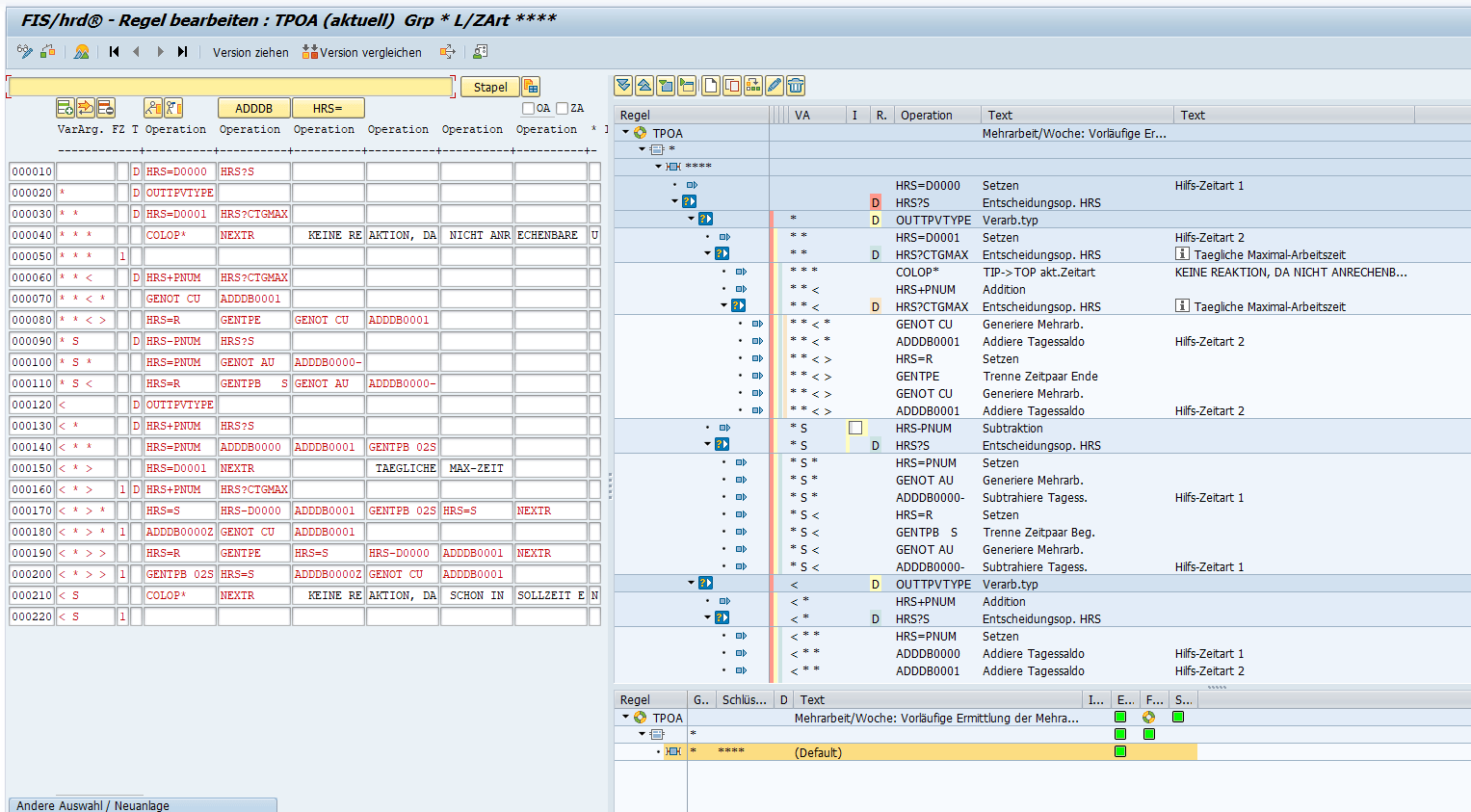
In addition, a personnel number can be analyzed over a specific time period. ORC then shows which branches of the ruleset are processed for that case. This is particularly helpful for troubleshooting and further developing Customizing. A specific payroll result is not calculated in this process.
In addition, ORC provides support during organizational changes, such as when HR areas, company codes, or employee groups are modified. Existing references can be located specifically and adjusted as needed. ORC is particularly useful during SAP transitions, major restructuring efforts, the regular streamlining of accumulated rules and regulations, and the analysis of specific problem cases.
How can digital documentation and versioning help new employees work productively more quickly?
The persistent skills shortage means that enterprises increasingly rely on lateral entrants or reactivate job returnees. For these persons, longer initial job training phases are incurred. In payroll accounting, they frequently cannot work independently over several payroll runs because they lack the up-to-date knowledge required.
Digital documentation and versioning in the HR software help these persons work productively more quickly – irrespective of the expert knowledge required for payroll accounting. The reason is that this software enables access to the required information at any time and it is possible that it contains a professional documentation in addition to the technical documentation. The technical documentation shows which data has been changed by what employee and when. The professional documentation provides additional information, such as: Why has this change been made? What request is this change based on? What other operations are affected?
Conclusion
The FIS/hrd Schema and Rule Analyzer (SRA) is an indispensable tool for audit-proof development and maintenance of SAP HCM systems. It ensures transparency, traceability and efficiency in the management of schemas, rules and Customizing objects. Due to versioning and documentation, the SRA supports error prevention, simplifies error handling and helps keep systems lean and clear. As a consequence, it significantly improves the quality of payroll accounting and time management, protects sensitive HR data and facilitates the initial job training of new employees. As a whole, the SRA is a valuable module for a safe, efficient and lawful HR system landscape.