Precise Time Slot Booking during Goods Delivery in SAP
FIS/TimeSlot is a cloud-based time slot management app integrated in SAP, which can be used by enterprises to precisely schedule goods deliveries, reduce wait times, optimize loading ramp management and better control goods receipts. This specialist article explains the structure, functionality, features and benefits of FIS/TimeSlot as well as typical challenges without digital time slot planning.

Product Manager at FIS
What is FIS/TimeSlot?
FIS/TimeSlot is a cloud-based time slot management app for precise and convenient planning of goods deliveries. It enables the booking of fixed time slots, reduces wait times at loading ramps and increases efficiency in goods receipt through seamless calendar integration in SAP ERP. It is a logistics application based on SAP Business Technology Platform.
FIS/TimeSlot offers shippers and vendors the opportunity to plan and reserve inbound deliveries in advance in bookable time slots. Delivery companies, such as freight forwarders or vendors, can use a mobile app to select and book an available slot. This makes it possible for the warehouse operator – typically a wholesaler or manufacturing company – to plan goods receipts: both the time of arrival and the expected quantity of goods are known in advance.
As an SAP-integrated solution, FIS/TimeSlot integrates seamlessly into existing logistics processes. The application communicates with SAP ERP in the background allowing users to go directly from an appointment booking to the corresponding purchasing document in SAP for instance. This means that you can see at any time which purchase order is behind a planned delivery and which items will be arriving soon. This integration eliminates duplicate data entry and ensures that departments – from purchasing to shipping – work with the same information.
FIS/TimeSlot was designed to reduce wait times and prevent traffic jams on the factory premises. By smoothing out peaks, the satisfaction of the delivering truck drivers increases significantly. No driver has to spend unnecessary time waiting anymore. Instead, they can drive directly to the ramp at the booked delivery time and will be unloaded promptly. This also takes the pressure off warehouse workers, who can concentrate more on value-adding activities such as picking and goods issue instead of reacting frantically to unscheduled deliveries. Overall, the use of FIS/TimeSlot leads to a smooth and more resource-saving process in goods receipt.
How does FIS/TimeSlot work in practice?
FIS/TimeSlot consists of three apps that together enable optimal time slot control:
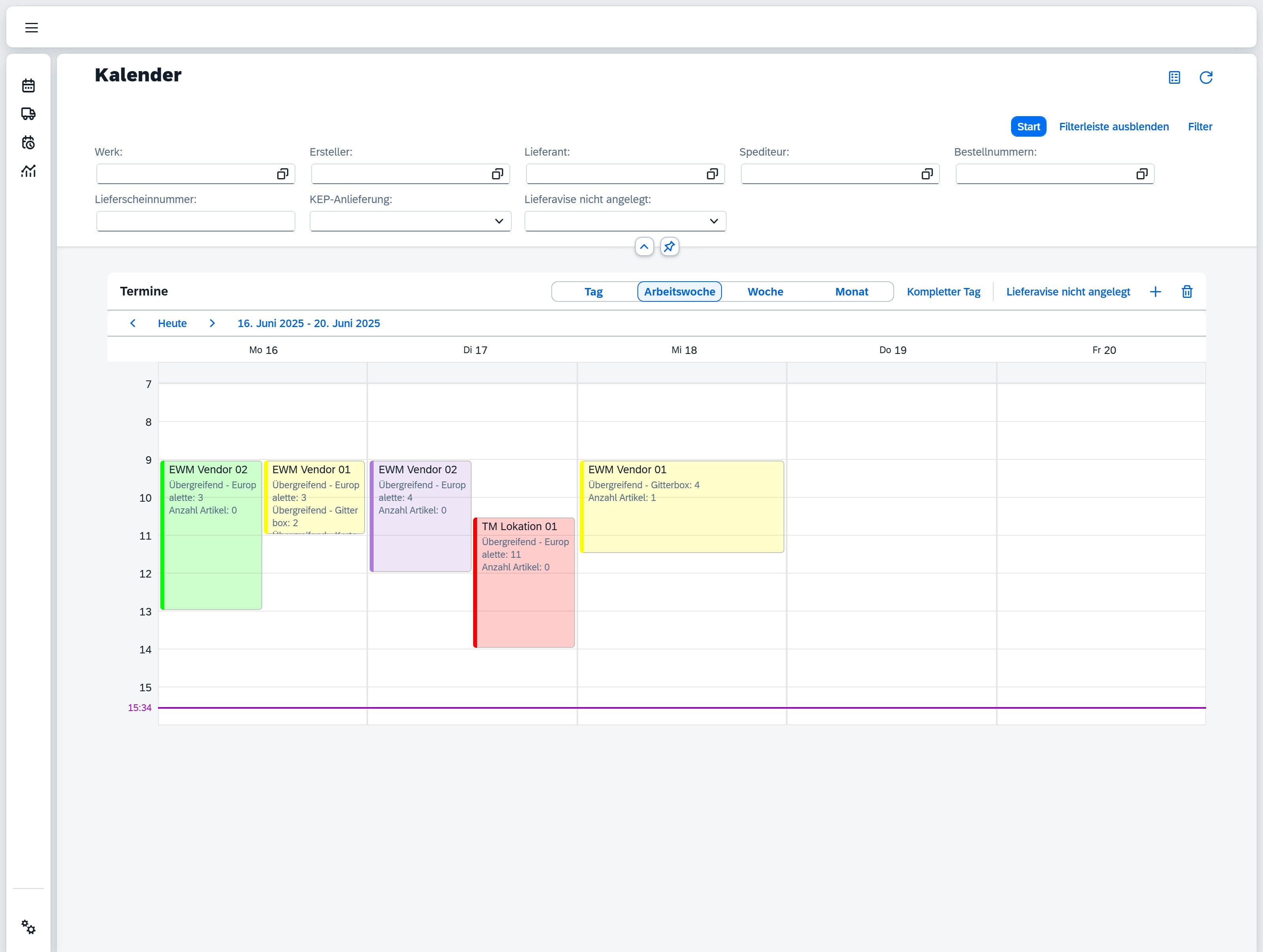
This component is intended for warehouse and logistics personnel. Relevant vendors and their user accounts are created and managed here so that only authorized partners can book time slots. The administration app offers a calendar view in which booked time slots are clearly displayed. The warehouse team can view bookings and edit or cancel them if necessary. Seamless SAP ERP integration allows you to go directly from this view to the corresponding purchase order in ERP to call details about the expected inbound delivery (e.g. articles, quantities).
The available time slots can be defined and configured using a separate module. Here, you can specify when inbound deliveries are generally possible – for example, Monday to Friday between 6 a.m. and 6 p.m., divided into 30-minute slots, with a maximum number of trucks per slot. The software also allows location-specific settings: Different time slot schedules can be stored for different warehouse locations or plants depending on local conditions and available skilled labor. For a large central warehouse, for instance, more parallel slots can be activated than for a smaller external warehouse with fewer ramps.
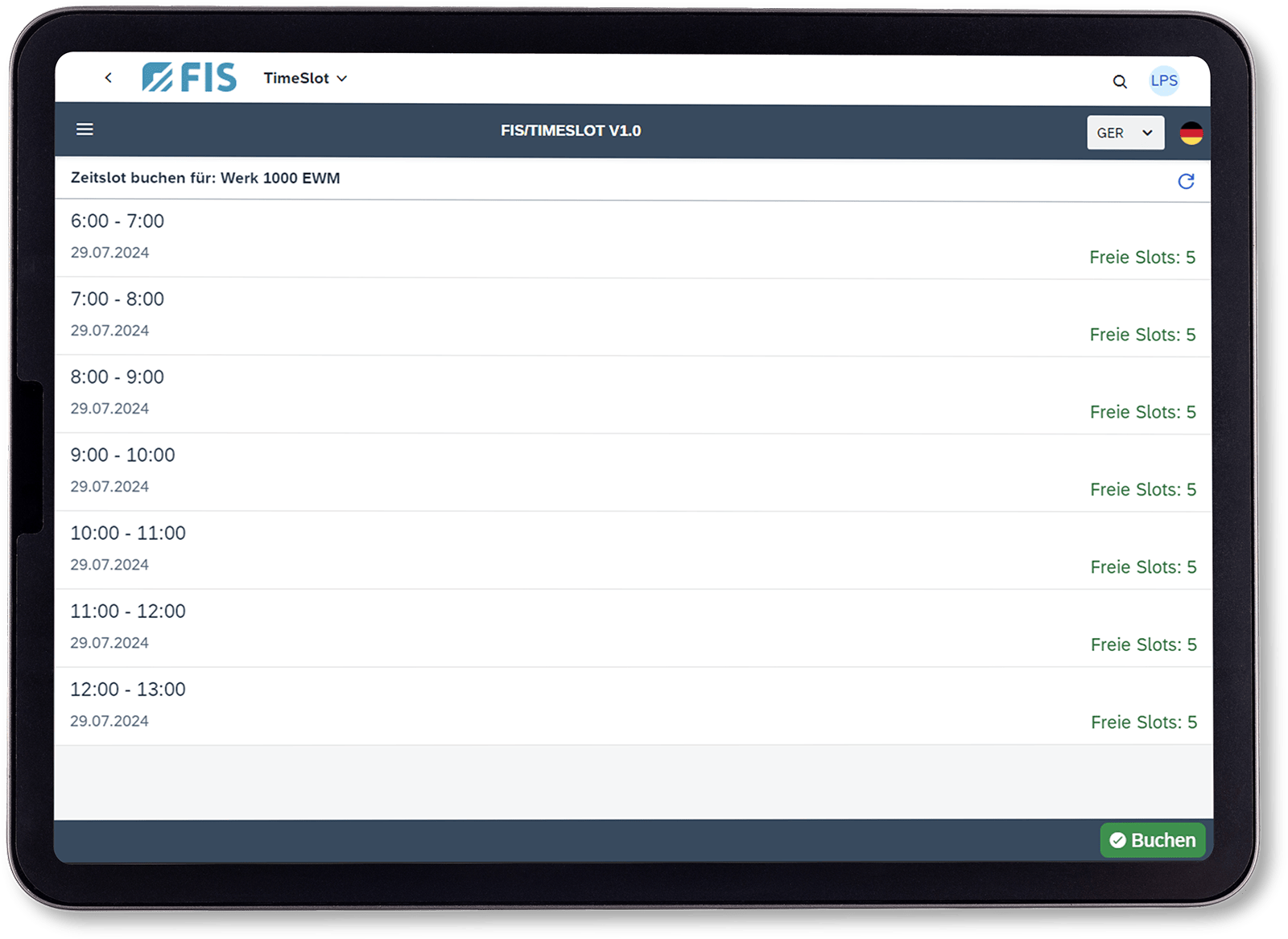
This allows vendors or freight forwarders to book their own time slots independently. It displays the free and occupied slots and allows you to make a reservation for a planned inbound delivery with just a few clicks. Only predefined slots can be booked – this ensures that the delivery can also be scheduled by the appropriate employee. After booking, the persons involved get full transparency: the warehouse can see who is coming and when and the vendor gets a confirmation. This transparency eliminates tedious queries – everyone can view the information in the app at any time. E-mails and phone calls are also significantly reduced as the booking process is fully system-aided. For drivers, this means significantly shorter wait times, which increases efficiency and is a major advantage, especially in times of driver shortages.
These components work hand in hand. FIS/TimeSlot therefore covers the entire goods delivery process: from defining possible slots and booking by the vendor to monitoring and adjustment. In doing so, the user interface is deliberately kept simple and intuitive. The app provides ergonomic dialogs and a responsive design making it easy to use it on various devices. The responsive design gives users flexibility in their choice of device, be it a PC, stacker terminal or cell phone.
What are the core functions of FIS/TimeSlot at a glance?
What benefits are provided by FIS/TimeSlot?
The implementation of FIS/TimeSlot offers a number of concrete advantages in terms of delivery:
The precise assignment of arrival times significantly reduces or completely eliminates wait times for truck drivers, which directly increases the satisfaction of delivery companies. Drivers spend less time in the yard and can continue their route more quickly. This improves cooperation with freight forwarders in the long term as wait times and the associated hassle are eliminated.
Warehouse and yard employees as well as MRP teams benefit from system-aided planning. Communication is made easier because everyone can look things up in the system instead of having to make phone calls. Automated bookings replace manual coordination, which significantly reduces the workload for staff. Peak times can be managed more effectively; overtime hours and stress are reduced.
FIS/TimeSlot provides a complete overview of upcoming inbound deliveries. This allows the workload associated with goods receipts to be spread evenly throughout the day. Resources in goods receipt (employees, gates, industrial trucks) are optimally planned and not overloaded by sudden queues of trucks. At the same time, idle speed during goods delivery is avoided – the ramp is utilized more evenly, which increases efficiency.
Less traffic jams in the yard also mean more security. When trucks no longer wait in long lines in front of the gate, the risk of accidents on the factory premises or traffic jams on public roads is reduced. Planned procedures enable organized traffic on the company premises.
As an SAP-based solution, FIS/TimeSlot integrates into the existing system landscape. The ERP integration allows, for instance, direct access from the TimeSlot app to the corresponding purchasing document in SAP. This ensures data consistency: every booked slot is immediately stored in the system, eliminating duplicate appointment management (e.g. separately in SAP and externally).
The app can be used easily and intuitively. Thanks to clear user interfaces both internal users and external vendors can quickly find their way around. The barrier to using the tool is low – which is important so that as many delivery partners as possible get on board. In addition, FIS/TimeSlot can be used on any device thanks to its responsive design – whether on the desktop in the office or mobile on a tablet/smartphone in a truck. This flexibility promotes user acceptance.
Overall, FIS/TimeSlot leads to more efficient logistics processes. Improved planning allows for cost savings, for instance by largely eliminating demurrage charges. Overtime hours in the warehouse and truck processing times can be reduced. In addition, productivity increases: Employees can organize their working time more efficiently instead of having to cope with unforeseen peaks and trucks are loaded or unloaded more quickly, which increases load transfer speed.
Digitally supported time slot management improves the cooperation with partners in the supply chain. Freight forwarders, vendors, warehouse workers and MRP controllers work on the same platform with the same data, which creates trust and transparency. The stress levels for internal and external persons involved are reduced because processes are more predictable and run more smoothly. The increased reliability ultimately leads to greater satisfaction among both customers and employees.
Why is time slot management important in logistics?
In logistics – especially when goods are delivered by truck – time slot planning is a key component of logistics. A company’s supply chain depends on goods being put away and removed from stock on time and without problems to ensure that production and customers are supplied. Here, time slot management means that delivery and collection trucks are assigned fixed arrival times at the loading dock in advance, at which loading or unloading is to take place. Why is that so important? Without such a system, there are often uncoordinated arrivals of several trucks at the same time, while at other times there is idle speed. Results: bottlenecks, wait and idle times: Congestions occur in front of the ramp, drivers have to wait a long time and warehouse workers are periodically overloaded.
The aim of time slot management is to minimize wait times at the loading ramp, make shipment completion more efficient and achieve consistent utilization – in other words, to optimize ramp management. If each freight forwarder reserves a defined time slot in advance, inbound deliveries can be distributed in such a way that no permanent congestion occurs and the available resources – warehouse workers, forklifts, loading zones – are used optimally. As a consequence, providing time slots optimizes loading and unloading processes: Truck processing is quick, wait times (wait times of vehicles before or during unloading) are reduced and this also lowers costs. Companies that use a time slot management software solution have been able to reduce costs in goods receipt and goods issue processes by up to 30%. These savings are achieved, for instance, by reducing demurrage charges and making better use of storage capacities. In addition, it increases predictability for the persons involved, which leads to more efficient overall transport and logistics processes. Ultimately, professional time slot management helps to make supply chains more stable as it proactively prevents surprises and bottlenecks.
What challenges arise without time slot management software?
In practice, traditional and manually organized time slot management often reaches its limits and causes problems. Many companies still coordinate inbound deliveries by e-mail, telephone or fax, which is very time-consuming and prone to errors. Typical problems and disadvantages of a purely manual approach are:
Without a central system, delivery dates have to be laboriously coordinated between MRP controllers, freight forwarders and warehouse workers. This takes time and ties up staff who could be more productive elsewhere.
If a vehicle arrives later or earlier, those involved often do not find out immediately. A lack of real-time information means that delays have to be rescheduled manually and even if you arrive early, you often still have to wait. Without a digital platform, there is no automatic update mechanism.
It often happens that not all relevant shipping information is available in time. Warehouse teams, for instance, do not always know exactly what a truck is loaded with or which loading point is required. Missing or incomplete shipping information can lead to additional wait times or delays because it must be clarified on site where the goods are to be delivered or whether there is sufficient space available.
If too many trucks arrive at once, bottlenecks occur at the ramp. During peak times, congestions can occur, unloading processes do not run smoothly, employees are under high pressure and the risk of accidents in the yard increases. In quieter times, on the other hand, resources remain unused. This back-and-forth is inefficient and puts a strain on the persons involved.
Without time slot management software, new times must be found and communicated manually if something changes at short notice – e.g. if a truck is delayed. This can easily lead to errors or double bookings. Overall, manual rescheduling is very error-prone and does not allow for proactive optimization.
Nowadays, many customers and business partners expect just-in-time deliveries and transparent information. The demands for precise and punctual deliveries are high. Without advanced time slot management, companies come under pressure here as they can hardly guarantee this precision and flexibility using purely traditional means.
All these challenges show that digital solutions offer significant added value in logistics when it comes to time slot management and greatly simplify the control of delivery processes. Software allows communication to be centralized, real-time data to be made available to everyone and changes to be automatically forwarded by the system to all relevant persons. In this way, queries and obscurities are reduced, which, as a consequence, leads to less stress: If clear schedules exist and everyone is aware of the latest changes, time pressure decreases and satisfaction among all parties involved increases.
Conclusion
FIS/TimeSlot clearly demonstrates the difference that a structured and system-aided control of the inbound delivery planning can make in everyday logistics practice. If time slots are clearly defined, transparently communicated and directly linked to SAP, a reliably functioning logistics process is created regardless of fluctuations in day-to-day business.
For logistics companies that want to stabilize their goods receipt processes, reduce bottlenecks and make more targeted use of existing resources, FIS/TimeSlot offers a precise framework and optimal time slot control. This transforms what is often an unpredictable area into a predictable process step that makes a measurable contribution to the overall performance of logistics.