Skip to content

Sales orders in SAP

Sales orders in SAP

This specialist article describes what is behind FIS/edc, the SAP optimization for sales orders, how it works and the advantages it provides.

Florian Mahlmeister

Product Manager at FIS

What is FIS/edc for sales orders?

FIS/edc for sales orders is used for optimizing inside sales processes and thereby releases valuable resources. The solution enables the content-related and technical entry and processing of all inbound (purchase) orders – irrespective of whether they are entered as paper documents via OCR (document recognition) in SAP or transmitted electronically as PDF files via EDI or e-mail. Erroneous EDI orders can directly be postprocessed by sales employees, which provides for a reduced workload within the IT department. 

Comprehensive check and matching routines enable an automated processing of the sales orders received. This means that for correct customer purchase orders with or without reference to preceding documents (e.g. quotations, contracts), the document is created by the system. Manual processing is completely omitted here. Subsequently, the supply chain is triggered automatically. With the FIS solution for sales orders, you will always keep an overview of all customer-relevant data and documents at a central place. Furthermore, FIS/edc for sales orders is available for the user on premise as well as in the form of a cloud solution. 
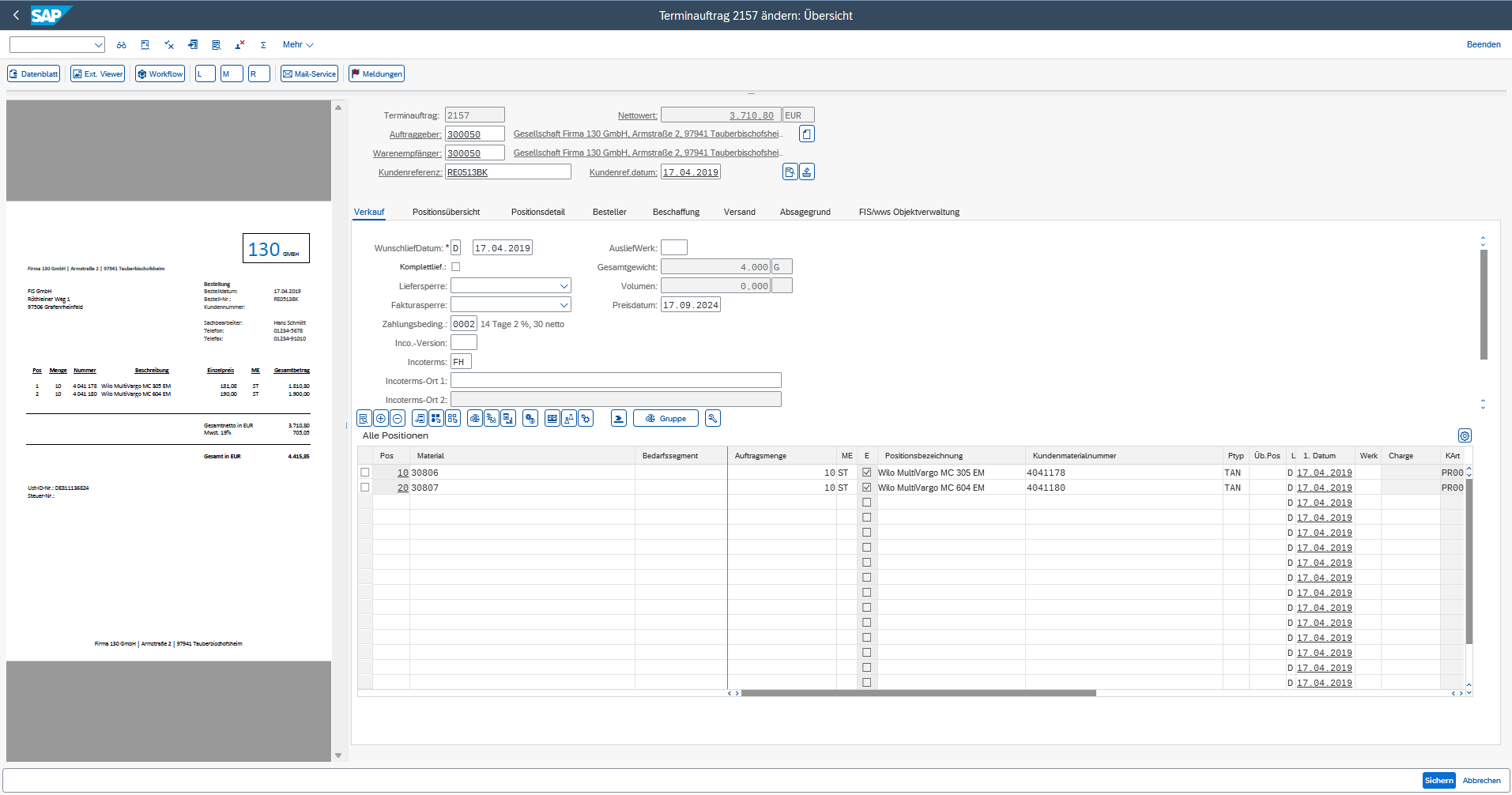
SAP-Oberfläche zur Bearbeitung eines Terminauftrags im Kontext von FIS/edc. Links ist das eingescannte Kundenauftragsschreiben mit Artikelliste, Preisen und Gesamtsumme sichtbar. Rechts werden Auftragsinformationen wie Auftragsnummer, Warenempfänger, Kundendaten, Liefer- und Zahlungsbedingungen angezeigt. Unten rechts ist eine tabellarische Übersicht aller Auftragspositionen mit Materialnummern, Auftragsmengen, Positionsbezeichnungen und Kundendaten eingeblendet. Zwei Positionen mit je 10 Stück der Artikel „Wilo MultiVargo MC 305 EM“ und „Wilo MultiVargo MC 604 EM“ sind aufgeführt. Optionen zum Speichern oder Abbrechen befinden sich unten rechts.
FIS/edc for sales orders

What functions does the FIS solution for sales orders include?

FIS/edc for sales orders provides numerous functions that support the entire process of order processing: 

  • Automatic entry of sales orders: Purchase orders from diverse entry channels (paper, PDF, EDI, e-mail) are entered and processed automatically. 
  • Check and matching routines: The software matches purchase order data with existing SAP data and identifies deviations. 
  • Automatic assignment: If preceding documents (e.q. quotations or contracts) are available, the purchase order is assigned automatically. 
  • Correction of erroneous EDI orders: Sales employees can postprocess erroneous EDI orders directly in the monitor without burdening the IT department. 
  • Supply chain triggering: After entry, the order is automatically transferred to the subsequent processes. 
  • Central overview: All relevant customer and document data can be viewed at a central place. 

What are the benefits of FIS/edc for sales orders?

  • Time saving and reduced manual efforts: Automated order processing reduces manual efforts and accelerates the processing times. This leads to a more efficient use of resources and fewer errors. 
  • Process optimization for inside sales: Automatic order entry improves accuracy and reduces entry errors. Sales employees can concentrate on value-adding tasks. 
  • Higher customer satisfaction: Faster order processing leads to shorter processing times and faster delivery. Customers receive their orders faster and more reliably. 
  • Uniform process for all entry channels: The sales order monitor processes orders irrespective of the entry channel (OCR, e-mail, EDI), which ensures consistent und error-free processing. 
  • Central customer file for real-time information: All customer information is available in real time enabling fast and precise answers to queries, which improves communication and service. 
  • Direct communication through integrated mailing system: The integrated mailing system ensures efficient communication with customers and internal employees. Order responses and status updates are sent automatically. 

How can automation be successful?

Automation is based on intelligent OCR and EDI interfaces that recognize incoming orders and transfer them directly to the SAP system. Check and matching routines ensure that orders are automatically assigned and processed further without manual intervention if they match. If deviations occur, these are marked in the solution so that the sales employee can intervene directly. 

What enterprises is the solution suitable for?

FIS/edc for sales orders is ideal for enterprises with a high order volume as well as for SAP users who want to further automate and optimize their processes. The following industries particularly benefit from the solution: 

  • Industry & production: High order frequencies and complex order structures 
  • Wholesale & trade: Efficient processing of customer purchase orders from diverse channels 
  • Logistics & service: Automated and fast processing of order documents 

Learn here how we at FIS implement FIS/edc for sales orders. 

Conclusion

FIS/edc for sales orders provides companies with a high-performance SAP extension for automating and optimizing order processing. The solution reduces manual efforts, accelerates processes in inside sales and increases data quality. The central overview and processing of incoming sales orders without media changes – regardless of the entry channel – makes the entire process chain more efficient and transparent. Companies benefit not only from faster response times and greater customer satisfaction, but also from a significant reduction in the workload of IT and user departments. This makes FIS/edc a crucial component for modern, digital and future-proof sales processes. 

FAQ – frequently asked questions

FIS/edc is an SAP optimisation for accounting, purchasing and sales. With the Electronic Document Centre for SAP, users can automatically capture, process and archive documents (e.g. invoices, delivery notes, orders) and electronic formats (e.g. ZUGFeRD, EDI, XRechnung). This ensures a high degree of process automation and a consistent flow of information.

  • Increased productivity through automated processes
  • Fully integrable into the SAP system
  • Improved cash management
  • Shorter payment cycles
  • Increased transparency in invoice verification
  • Integrated mobile approval procedures for invoice verification
  • Automated customer order processing