SAP Business Data Cloud (SAP BDC)
This specialist article explains what is behind Business Data Cloud, which components and functions it provides and how enterprises can use it to optimize their data strategy.

Product Manager at FIS
What is SAP Business Data Cloud (SAP BDC)?
SAP Business Data Cloud (BDC) is a completely managed Software-as-a-Service (SaaS) solution by SAP that centrally merges all SAP data of an enterprise and, at the same time, seamlessly connects it with non-SAP data. Wit SAP Business Data Cloud, SAP creates a uniform data basis for buiness decisions: All business data is harmonized in a platform, made available along with its full business context (semantics) and provided for analyses, planning and AI applications.
The objective is to turn data into valuable insights and concrete business decisions much faster than it used to be possible by applying traditional isolated solutions. Instead of unconnected data silos and complex data extractions, SAP BDC provides a joint platform where company data from all areas – from ERP transactions to external data sources – is consistently integrated. In this way, data will keep its original meaning (semantics), which is enormously important to enable well-founded decisions. Enterprises will practically get a 360 degree view of their data in real time and can use it for Business Intelligence, advanced analyses and artificial intelligence.
In short: SAP Business Data Cloud is a data platform of the next generation that is used as a central basis for data-driven working. It combines data, applications and AI in an innovative way to ensure that user departments reach the best decisions and achieve improved business results.
Why is SAP Business Data Cloud more than just a new SAP product?
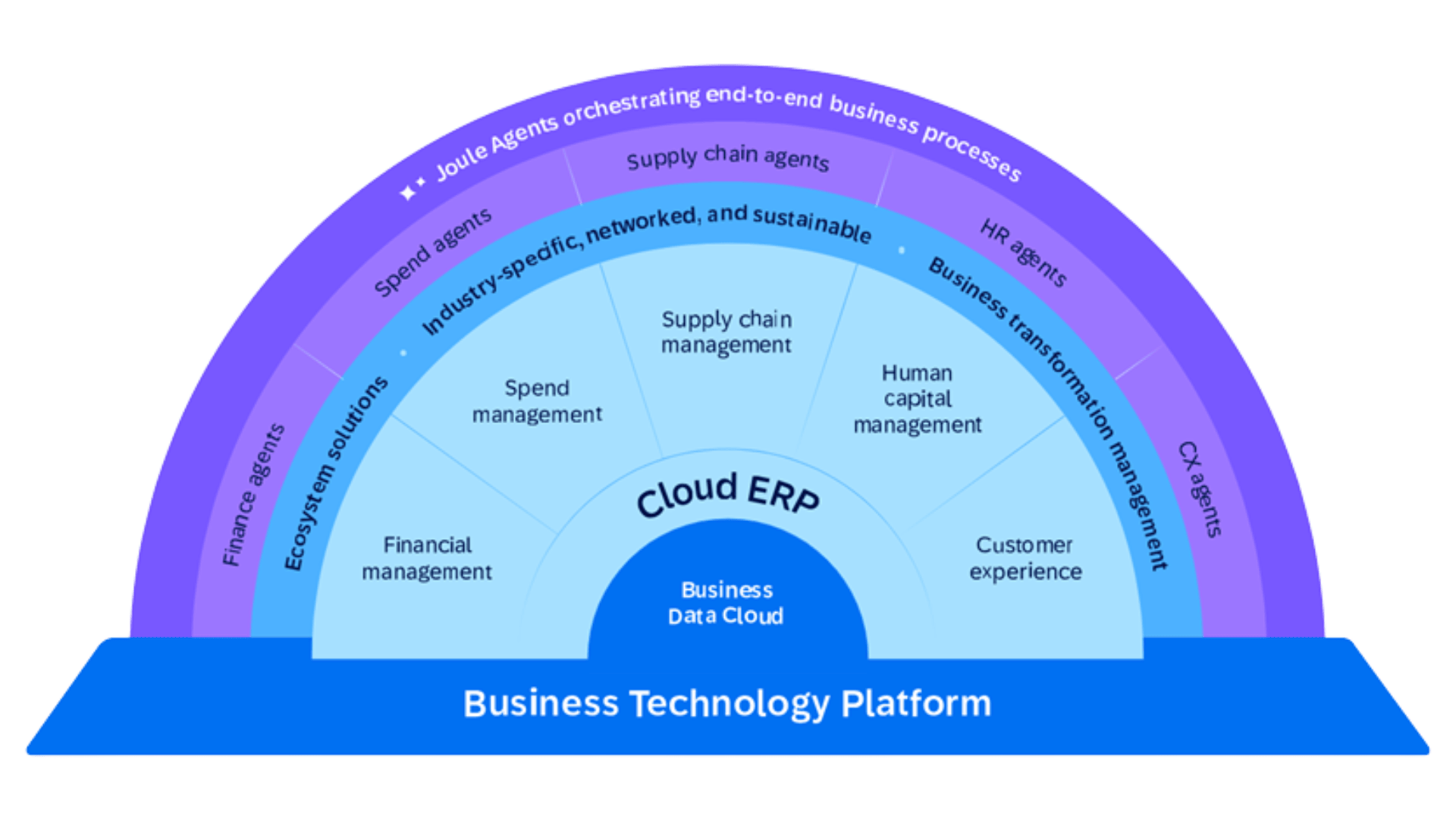
SAP does not position Business Data Cloud as an isolated tool but as a strategic milestone for the entire SAP product landscape. This product is more than just an upgrade or another cloud solution – SAP rather pursues a comprehensive vision with BDC: a completely integrated data and AI platform for the digital enterprise of the future.
In the past, customers frequently had to combine different single solutions to achieve similar results: data warehouse for SAP data, a data lake for big data, separate BI tools (Business Intelligence Tools) for evalutations and maybe external tools for AI models. This fragmenting lead to data silos, high efforts for data integration and frequently to inconsistencies. With Business Data Cloud, SAP deliberately breaks new ground (a breach with tradition in data architecture): For the first time, operational business applications and analytics/AI are so closely linked that the line between them blurs. All data – no matter whether it comes from SAP S/4HANA, SAP SuccessFactors, SAP Customer Experience or any other kind of external sources – is collected in a joint semantics layer. This “Business Data Fabric” creates a kind of joint language for all data. As a consequence, business processes and data analysis are virtually delivered from a single source.
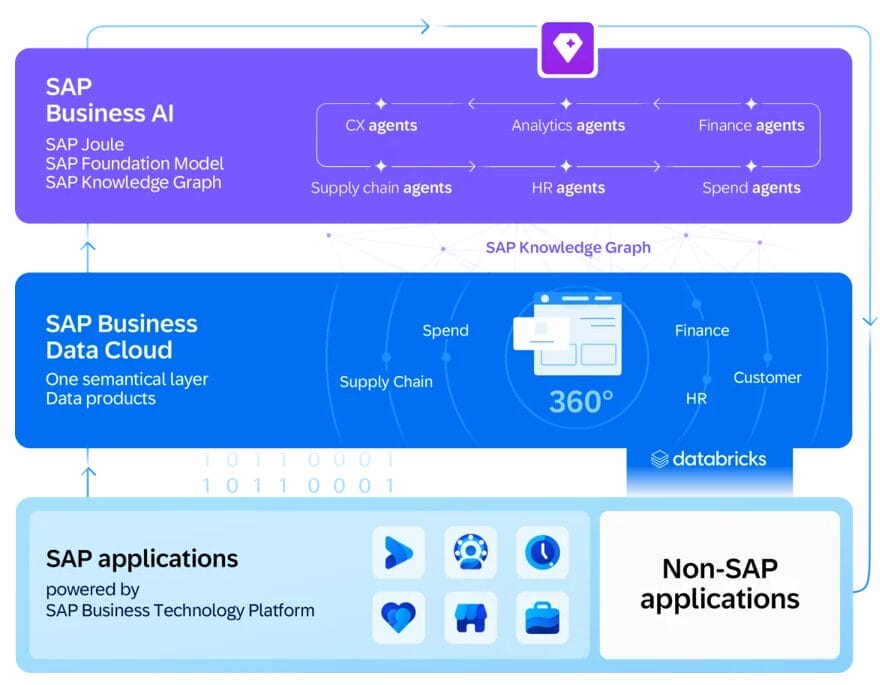
Furthermore, BDC is a core component of SAP Business Technology Platform (BTP) and closely linked with SAP Business AI – the central framework for AI functions in the SAP portfolio. SAP has recognized that artificial intelligence can only be as good as the data it is based on. With Business Data Cloud, SAP lays the foundation for reliable high-quality data that AI applications are based on. SAP Joule is an example here: a digital AI assistent (a kind of AI agent) by SAP: Joule is to be able to give context-related recommendations to users. Without a platform like BDC in the background – which keeps all relevant company data ready for use – such AI agents would not be able to work reliably.
Therefore, SAP BDC and SAP Business AI go hand in hand: Business Data Cloud provides the data fuel, AI systems (such as Joule) draw intelligent insights therefrom.
After all, SAP BDC is also a response to market trends. Other providers refer to Data Fabric or have integrated data and analytics platforms (e.g. Microsoft Fabric). Here, SAP pursues the principle of “suite first”: Instead of numerous single products, customers are to obtain a holistic suite, where all functions optimally work together – from transaction processing to analysis. The partnership with Databricks also emphasizes that SAP is open for cooperation to provide the best functions from both worlds: SAP’s strength in business-critical processes and semantics combined with Databricks’ strengths in the areas of big data and AI. All theses features make Business Data Cloud more than just another software – it is the central hub of an advanced data ecosystem in the cloud that future applications, innovations and business decisions are based on.
What benefits does SAP Business Data Cloud provide for enterprises?
For enterprises, the implementation of SAP Business Data Cloud provides a number of tangible benefits. The greatest advantages at a glance:
In sum, SAP Business Data Cloud helps enterprises use data in a value-adding way: They save time and costs in data formatting, make faster and better founded decisions and lay the foundation for innovative business models in the age of AI. All of this provides them with a competitive advantage, because they can act in a more agiil and more data-supported way.
What are the central components of SAP Business Data Cloud?
SAP Business Data Cloud consists of several closely linked components and services that are summarized in a uniform platform. In its core, two central BDC areas can be found: the Business Data Fabric and insight apps.
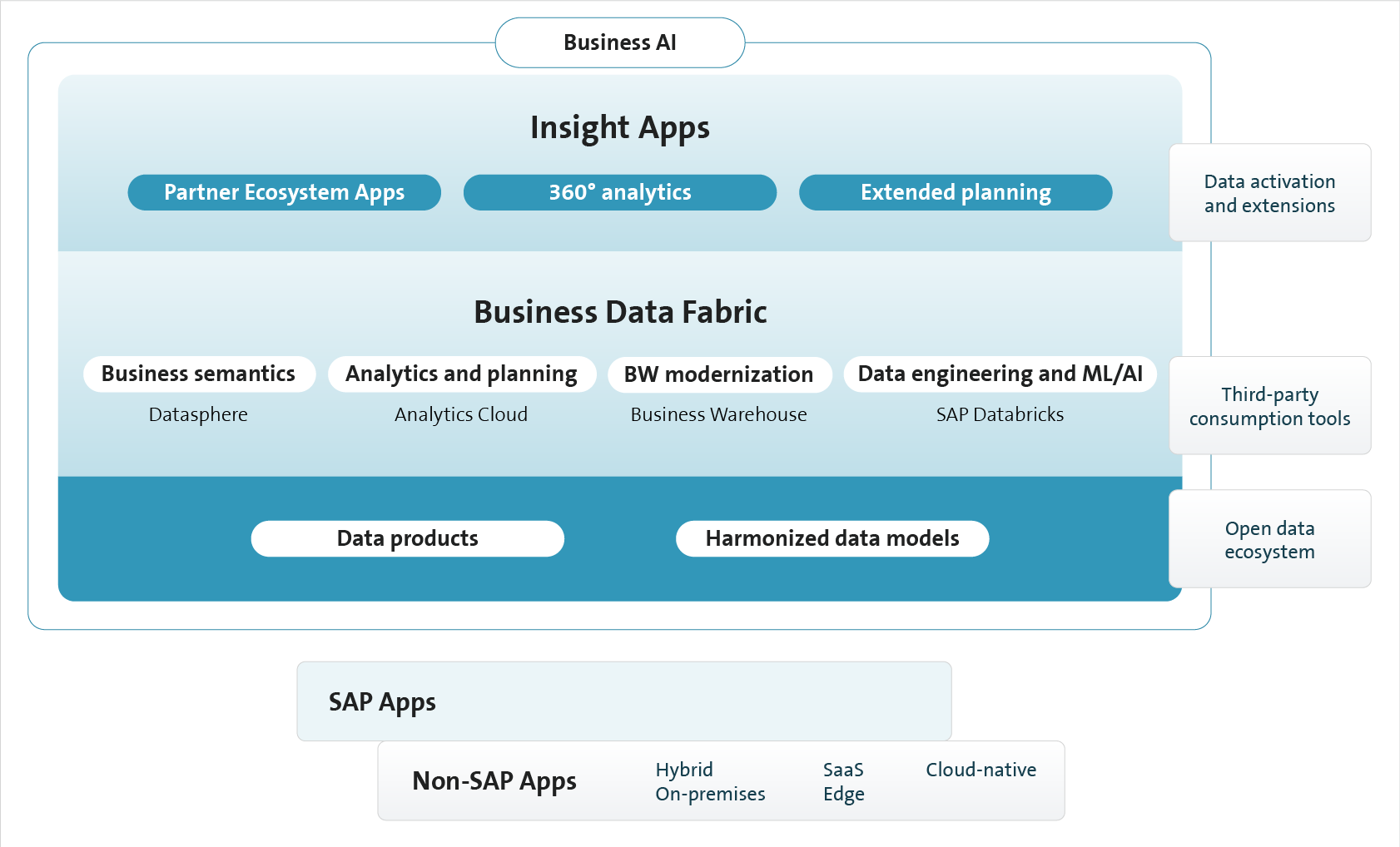
SAP BDC architecture (source: SAP)
The Business Data Fabric forms the technological foundation of SAP BDC. It ensures the harmonization of business data across different sources and guarantees that data is integrated, consistent and can be well governed.
A key concept here are data products:
Data products are curated, immediately usable data records with intact business semantics. In contrast to conventional data warehouses or data lakes, no business logics will be lost for these data products – the data basis remains comprehensible and reusable. The Business Data Fabric includes existing SAP data management technologies, such as SAP Datasphere (former Data Warehouse Cloud) and connections to SAP Business Warehouse (including the BW bridge for integrating BW/4HANA data).
Furthermore, it opens the platform for external data sources: By means of open interfaces and a close partnership with Databricks, even large data lake environments and third-party data can be integrated. This bidirectional integration with Databricks allows the processing of IoT data, mass data or unstructured data along with SAP data – without having to extract the SAP data from its environment. The Business Data Fabric links the entire data landscape of an enterprise and provides a uniform and commercially comprehensible data model. Via a central cockpit, users will get an overview of their data ecosystems, can publish data products and control data integration.
Insight apps – predefined analysis applications
The second pillar of SAP BDC is the newly launched insight apps. These apps are preconfigured analysis and planning applications helping enterprises turn data into insights relevant for acting in a faster way.
In a sense, insight apps are the turbo for data-driven decisions:
They include predefined metrics, integrated AI models (e.g. for forecasts) and planning functions for different business areas. Instead of having to develop complexe reports or dashboards first, solutions immediately ready for use are available for users – including standard dashboards, 360 degree analyses and intelligent recommendations. Insight apps cover typical application cases in the core areas of an enterprise. Examples are financial analytics (e.g. for faster financial statements and more precise forecasts), supply chain analyses (for improved transparency and risk management within the supply chain) or sales and customer analyses.
By integrating SAP Analytics Cloud as an analytic component and SAP planning functions, insight apps also enable company-wide planning scenarios (keyword: Extended Planning and Analysis, xP&A).
Important: Insight apps have been designed in such a way that they directly access the harmonized data products of the Business Data Fabric. As a consequence, all user departments – be it finance, sales and distribution, HR or production – access the same uniform data basis and obtain consistent results. This drastically reduces reconciliation efforts, sources of error and costs in data formatting.
How do insight apps support data-driven decisions?
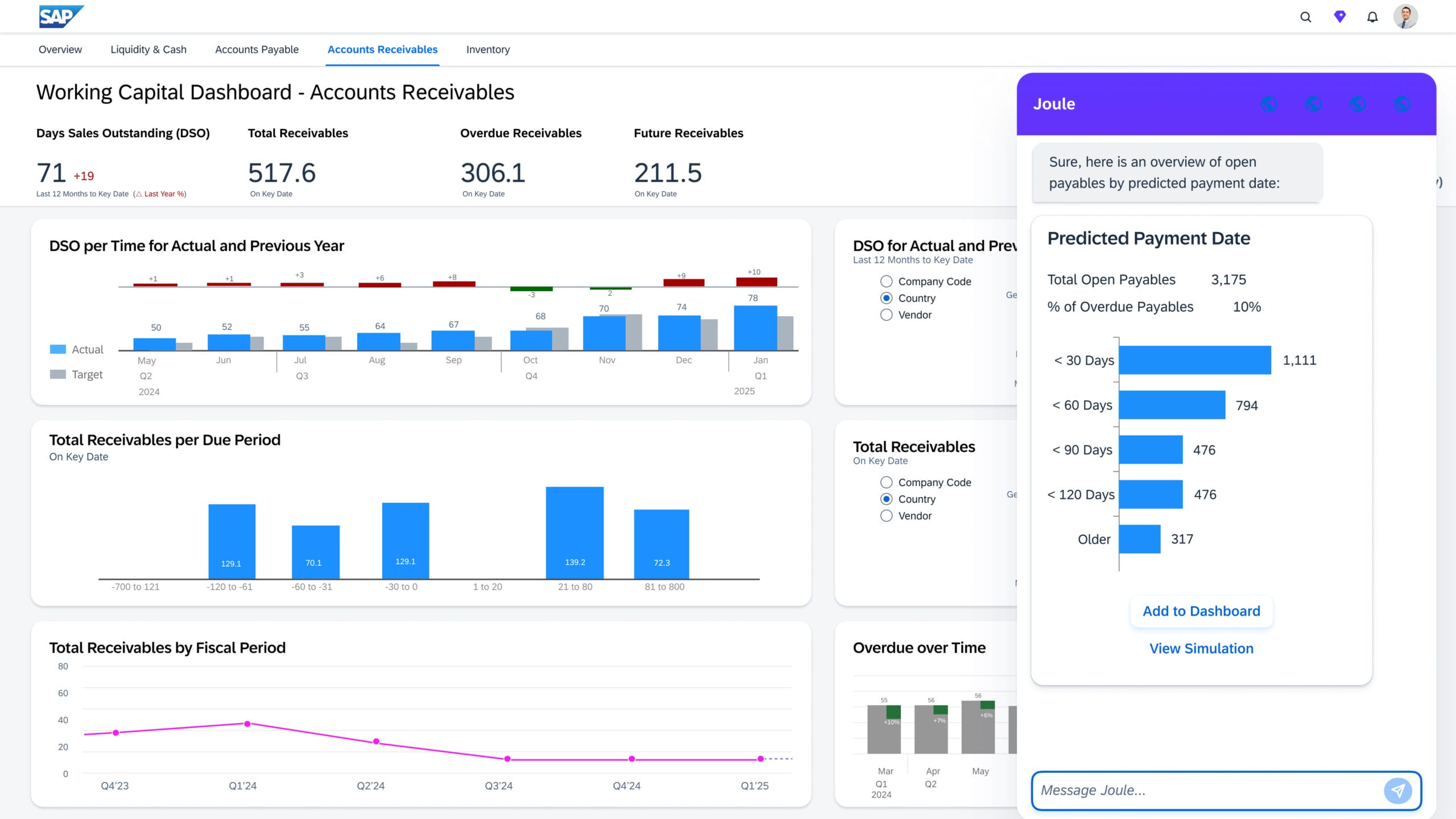
As already mentioned, insight apps provide predefined contents and intelligent functions accelerating data-driven decisions. But how exactly do they support enterprises? Imagine the following scenario: An enterprise wishes to modernize its planning and analysis processes. Traditionally, the IT department or a team of experts would have to collect data from different systems (e.g. ERP, CRM, external market files), create a data model, define key figures and eventually develop dashboards or reports. This process is time-consuming and error-prone – and the situation might have changed already until everybody can see the result. This is where insight apps come into play: They make finished analysis applications available, which provide best-practice contents for frequently asked questions. A finance department, for instance, could use an insight app providing cashflow forecasts with AI support. This app accesses the centrally harmonized financial and sales data (via Business Data Cloud), uses an AI model for forecasts and visualizes the results in a clear dashboard. As a consequence, the persons responsible for finances can create faster and more precise forecasts without having to develop a machine learning model themselves. In a similar way, an insight app could support the sales and distribution department in creating a 360 degree customer profile. All relevant customer data – from previous purchase orders to payment history – is merged to ensure that sales employees are able to do personalized upselling or identify risks at an early stage.
Insight apps have been designed to simplify complex data processes. They provide dashboards ready for use and AI-supported analyses enabling decisions directly based on current data. Enterprises benefit by spending less time on data preparation and having more time for actual added value gained from data. By using standardized metrics and cross-sector benchmarking data (that SAP derives from anonymized customer data), users will additionally obtain a benchmark showing where their own enterprise is standing.
As a whole, insight apps promote a data-driven decision culture: Users rely less on their gut feeling but on well-founded analyses and AI-supported insights. This improves the quality of decisions and ultimately the business results in all areas – from faster response times to optimized processes.
Conclusion
SAP Business Data Cloud marks an important step towards data-driven enterprise management. As a central hub for business-critical data, it enables enterprises to merge their scattered data sources in a harmonized whole. The greatest benefit is that data is available with context and in real time – the basis for improved decisions at all levels. Thanks to preconfigured insight apps and integrated AI functions, even users without data science background can gain deeper insights and use the power of artificial intelligence.
For enterprises, this means in concrete terms: faster analyses, proactive decisions and a higher added value gained from data. SAP BDC supports enterprises in breaking data silos open and establish a modern data culture, where facts form the basis for enterprise management. In a time when data and AI play a decisive role in business success, Business Data Cloud provides the best possible basis for mastering this development. Enterprises aligning their data strategy with farsightedness can use BDC as a fundamental component – for more efficient processes, new data-based business opportunities and improved business results in the end.