eInvoicing with SAP
This specialist article describes how FIS covers the eInvoicing requirements, how the FIS/edc SAP optimization works and the advantages it provides.

Product Manager at FIS
What is the FIS Invoice Management solution?
Manually complicated tasks in finance and accounting are processed efficiently and sustainably through electronic business processes. Invoices are not sent analogously by mail or fax and passed on through the departments but transferred and processed as digital documents in structured form. Paperless communication enables you to accelerate processing times and use cash discounts, for instance, more effectively. Moreover, you avoid input errors that might occur when manually entering invoice data. Any information required is always available and transferred correctly. At the same time, digitized processes form the basis for the use of artificial intelligence in invoice processing. This enables the automation of further process steps.
Worldwide coverage of eInvoicing regulations with the FIS solutions for your invoice management and SAP DRC
The FIS solutions for your invoice management and SAP’s Document and Reporting Compliance (DRC) enable the receipt of e-invoices as well as the uncomplicated creation and fully automated transmission of e-invoices worldwide.
No matter the format and the transfer method: classical EDI (Electronic Data Interchange), invoice formats such as XRechnung, Factur-X, ZUGFeRD , InvoicePA/FatturaPA etc. or the communication via e-mail or PEPPOL platform. Even paper invoices can still be processed: The recognition service by FIS digitizes the relevant data and converts it into the required format.
Using the FIS software solution, individual requirements can be taken into account and implemented in the system if required. Seamless integration into the SAP standard processes is possible as well. In addition, the invoice process can be further automated by AI and machine learning. FI invoices, for instance, are independently classified and assigned to an account, the responsible approver is identified and the release process triggered.
Automating invoice receipt
For invoice receipt, the SAP DRC solution covers a large number of country-specific invoice formats and processes. Therefore, the solution can optimally be used for inbound invoices from different countries. The FIS solution for invoice management can also be used for domestic invoice formats as it particularly specializes in German standards and provisions and is able to map them cost-neutrally.
Automating outgoing invoices
Both solutions can also be used in combination for outbound invoices. Here as well, SAP DRC provides a large number of country-specific invoice formats. The FIS solution for outgoing invoices, however, specializes in domestic standards and provisions. Depending on the invoice recipient, a suitable format and possible legal processes of the respective country can be mapped. Parallel to invoice receipt, companies with a high number of domestic German business customers also benefit from using the FIS solution as it can cover the process much more cost-effectively. In this way, the benefits of both solutions are ideally combined.
What functions does the FIS Invoice Management solution include?
What are the benefits of the FIS Invoice Management solution?
What processes can be automated?
Digital processing of incoming invoices – procure-to-pay process

Automated SAP process for invoice receipt
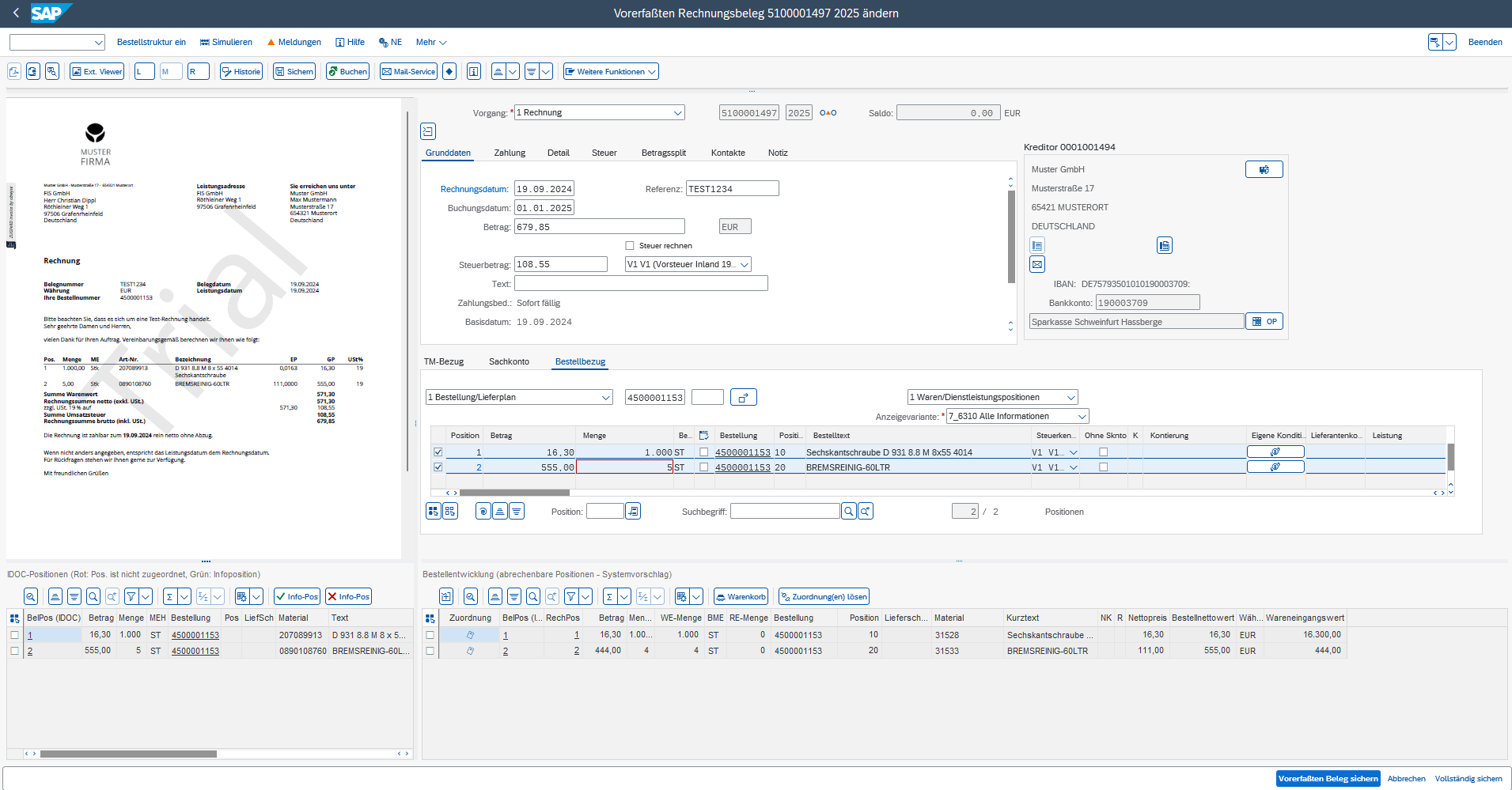
Our holistic best practice approach for invoice management can be used to process incoming invoices in a fully digitized procure-to-pay process: from the receipt of digital invoice formats and entry of incoming invoices to their final posting. Vendor invoice data, for instance, is automatically compared with the associated purchase requisition in the SAP system. If all details on invoice and purchase order are identical, it will be posted and paid automatically – without manual interference by the accounting clerks. Here, SAP users can achieve “no touch” quotas of over 90 percent.
Often, just the automated matching of partial information can help accelerate the process. Important invoice characteristics, for instance, are read, invoices verified formally and arithmetically or compared with SAP master data. Even a simple release workflow, i.e. the automatic assignment of the invoice to the releasing person, clearly simplifies daily business, even if the volume of invoices is low.
The FIS solution package compares incoming invoices with existing purchase orders in the ERP system and controls the check and release processes – completely independent of the invoice format. This helps you accelerate the processing times of your invoices and make processing statuses more transparent. According to its format, the invoice is converted into a format that can be read by the user (visualization).
The seamless integration of the eInvoicing features into the existing solution enables the accounting clerk in the company to verify invoices for electronically transferred documents in the same way as the procedure focused on paper documents they are familiar with. Consequently, you implement a consistent and completed process of invoice receipt and outgoing invoices.
Automated invoicing – order-to-cash process

In case of a digitized order-to-cash process, the vendor invoices are directly created in digital form in the central SAP system. Invoices no longer need to be printed, sent and manually entered and posted by the recipient. Our all-in-one SAP solution for invoice management automatically selects the appropriate invoice format and transmission method for the business partner.
There are numerous formats and methods a company can use to transmit invoices to customers and business partners. Our invoice management solution recognizes all formats and can transmit them correctly.
The eInvoicing solution also enables the monitoring of sent e-invoices. Status messages, such as “sent”, “received” or “error handling”, provide send transparency and response options in case of an error.
For outgoing invoices, the application automatically selects the right format for each invoice recipient without the user having to intervene manually. The FIS Invoice Management solution is the ideal combination to be perfectly prepared for the different legal requirements of the various countries.
How can automation be successful?
Automation is achieved by using advanced technologies and integrations:
What enterprise is the FIS Invoice Management solution suitable for?
The FIS Invoice Management solution is aimed at the finance department in a company with a high volume of incoming and outgoing invoices. With the combination of the invoice management solution and SAP DRC, all country-specific requirements can be implemented. Especially due to its legally compliant archiving and adherence to legal requirements, it is particularly suitable for companies that have to meet high compliance standards. Learn here how we at FIS implement projects concerning the eInvoicing solution.
Conclusion
With the invoice management solution by FIS in combination with SAP Document and Reporting Compliance (DRC), companies receive a powerful solution for the digital transformation of their invoice processes. The automated processing of incoming and outgoing invoices not only enables considerable cost and time savings, but also meets the highest requirements for compliance, transparency and international standards. Thanks to the seamless integration into existing SAP processes and the use of modern technologies such as AI and OCR, companies are optimally prepared for the legal requirements for electronic invoicing – both nationally and internationally. This makes eInvoicing a strategic success factor for future-oriented financial management.