Skip to content

SAP Logistics Management (SAP LGM)

SAP Logistics Management (SAP LGM)

This specialist article describes how SAP Logistics Management unites all logistics processes in one central and cloud-based platform: from warehouse management and transportation planning to the cooperation with freight forwarders. You get an overview of functions, benefits and target groups of the solution and learn how companies can use AI-based tools and integrated best practices to make their supply chains more efficient, transparent and future-proof.

Beatrix Niklaus

Product Manager at FIS

What is SAP Logistics Management (SAP LGM)?

SAP Logistics Management is an end-to-end logistics solution. It is designed to centralize all logistics processes – from warehouse management and transportation planning to the cooperation with freight forwarders and partners – on one standardized platform and controlling them efficiently. The solution based on cloud and SAP Business Technology Platform is seamlessly integrated into SAP Cloud ERP Private and offers an AI-supported and user-friendly work environment.

Ein Dashboard der SAP-Anwendung „Logistics Management“ zeigt verschiedene Kacheln und Diagramme zur Lager- und Transportabwicklung: links ein Balkendiagramm zu „Outbound Warehouse Requests by Status“, darunter Kennzahlen zu ausgeführten Lagertätigkeiten; in der Mitte eine Liste von Tendering-Anfragen mit Statusmeldungen wie „No Suitable Carriers Found“, „Quote Received“ oder „Open“; rechts Schnellzugriffe sowie ein Kreisdiagramm zu Bestandsarten. Darunter Tabellen zu „Open Inbound Warehouse Requests“ und eine Kachel zu anstehenden Anlieferungen.
©SAP: SAP Logistics Management (SAP LGM)

What scope of functions is covered by SAP Logistics Management?

The new SAP Logistics Management (SAP LGM) logistics solution unites central functions of warehouse, transport and network logistics in an integrated SAP Business Network. The solution provides companies with all tools to holistically control their logistics processes, automate them and map them transparently – from planning to execution.

Detailed scope of functions
  • End-to-end process execution: integration with SAP Cloud ERP Private for consistent control from goods receipt to outbound delivery
  • Warehouse logistics: warehouse management functions such as inventory management, picking, packing, shipping, warehouse layout, grouping of tasks as well as warehouse execution to efficiently control and prioritize operational warehouse processes
  • Transport logistics: planning, freight tendering, carrier selection, tracking, shipment cost calculation
  • Network logistics: cooperation with freight forwarders, scheduling for loading ramps, gate management, status tracking
  • Mobile app: native app for Android and iOS for mobile controlling and data entry.
  • AI support and Joule integration: intelligent assistance functions for decision making, process automation and a dialog-based user interface.
  • Cloud architecture: scalable, modular, future-proof and easy to integrate 
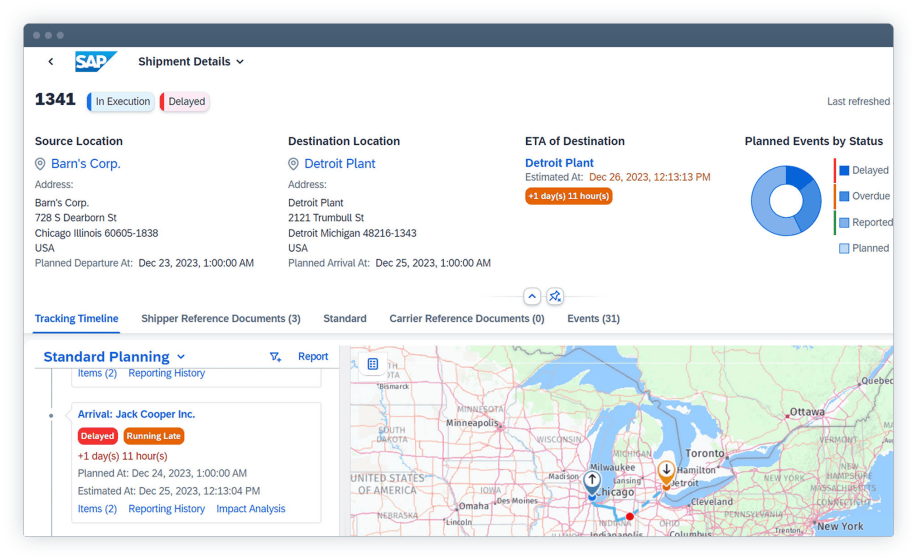
Ein Dashboard der SAP-Ansicht „Shipment Details“ zeigt Informationen zu einer laufenden und verspäteten Lieferung: links die Quelladresse „Barn’s Corp.“ in Chicago, rechts die Zieladresse „Detroit Plant“ mit geplanter und geschätzter Ankunftszeit, inklusive deutlicher Verspätungskennzeichnung. Rechts oben befindet sich ein Kreisdiagramm, das den Status geplanter Ereignisse (geplant, gemeldet, überfällig, verspätet) visualisiert. Unterhalb der Adressdaten erscheint ein Zeitachsen-Bereich mit „Standard Planning“, in dem ein als „Delayed“ markiertes Ankunftsereignis angezeigt wird. Im unteren Bereich ist eine Karte des US-Mittleren Westens mit markierten Transportpunkten abgebildet.
©SAP: AI-supported logistics

What benefits are provided by SAP Logistics Management?

With SAP Logistics Management, companies benefit from intelligently networked logistics that improve efficiency, transparency and cooperation along the entire supply chain. The solution forms the basis for automated processes, lower costs and a fast and scalable implementation.

Improved efficiency

Synchronized processes reduce delays and increase productivity

Transparency

Real-time transparency is given along the entire supply chain

Scalability

Easy integration of new partners and locations through future-proof cloud solution

Cost reduction

Operating costs are reduced through the automation and optimization of processes

Improved cooperation

Networked platform for all those involved (vendors, freight forwarders, customers)

Faster implementation

Predefined best practices and automation tools enable rapid implementation

Reduction of complexity

The centralization of all logistics processes on one system minimizes interfaces, media changes and manual coordination – for clearly structured tasks and a simplified process landscape

Who is SAP Logistics Management suitable for?

SAP Logistics Management mainly addresses companies with small or medium-sized warehouse and shipping locations that would like to digitize and optimize their logistics processes. It also addresses those who already use SAP Cloud ERP Private and wish a seamless integration of their logistics processes.

Conclusion

SAP Logistics Management (SAP LGM) offers companies a central platform to control their entire logistics digitally, transparently and efficiently. Network, warehouse and transport processes can be linked intelligently and optimized in real time through the close integration into SAP Cloud ERP Private and the use of advanced technologies such as AI and automation. In this way, SAP LGM forms the base for scalable logistics that adjust flexibly to new requirements, reduce costs, accelerate processes and sustainably improve the cooperation with partners.

Due to advanced cloud architecture and AI innovations, SAP Logistics Management offers you a high-performance and future-oriented solution that continuously improves logistics processes and prepares companies for the requirements of a networked supply chain.

FAQ – frequently asked questions

SAP Logistics Management bundles functions from warehouse management, transportation management and network logistics on one shared platform. While SAP Extended Warehouse Management (SAP EWM) and SAP Transportation Management (SAP TM) are specialized individual solutions, SAP LGM offers an integrated environment for all logistics processes, which is ideal for companies with small and medium process complexity that prefer a central cloud solution.

Yes, SAP Logistics Management is a cloud-based SaaS solution on SAP Business Technology Platform. First of all, it is designed for the integration into SAP S/4HANA Cloud Private Edition and therefore enables rapid implementation, easy scaling and automatic updates. It is also planned for 2026 to make SAP LGM available for SAP Cloud ERP.

The AI and Joule functions integrated in SAP LGM support users in decision-making processes, routine tasks and risk minimization through, for instance, an optimized shipping confirmation process or an accelerated tendering process. This reduces manual intervention and improves responsiveness along the supply chain.

It strongly depends on the extent of existing logistics processes and integration requirements. It also varies according to the complexity of warehouse and shipment structures as well as the number of partners or distribution centers to be integrated. Compared to classical on-premise systems, the efforts are much smaller. The close integration eliminates a large part of the technical interface work, which further accelerates the implementation.

New functions are currently being made available in a two-week release cycle. This means that further developments of SAP Logistics Management are available immediately.

No, it is a complementary product and is suitable for small to medium-sized companies with less complex processes.