Understanding Embedding Models: From Theory to Practical Applications
November 19, 2025 | Reading time: Approx. 8 minutes

AI Solution Engineer at Medienwerft
Be it product recommendations in online trading or anomaly recognition in the manufacturing process: embedding models translate data into tangible added value. But how does this work in practice? In our blog, you will find out more about the chances for your company and what makes the FIS Group model so particular.
Why are embedding models so important?
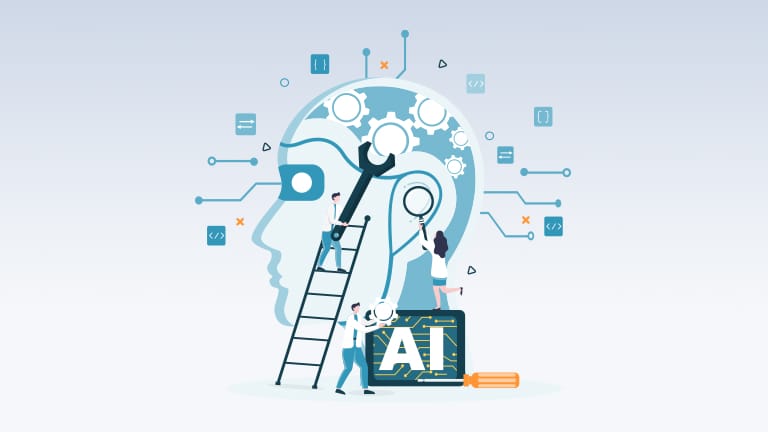
Artificial intelligence thrives on data and on how well machines can understand and process this data. However, data exists in many different forms: texts, images, tables or sensor data.
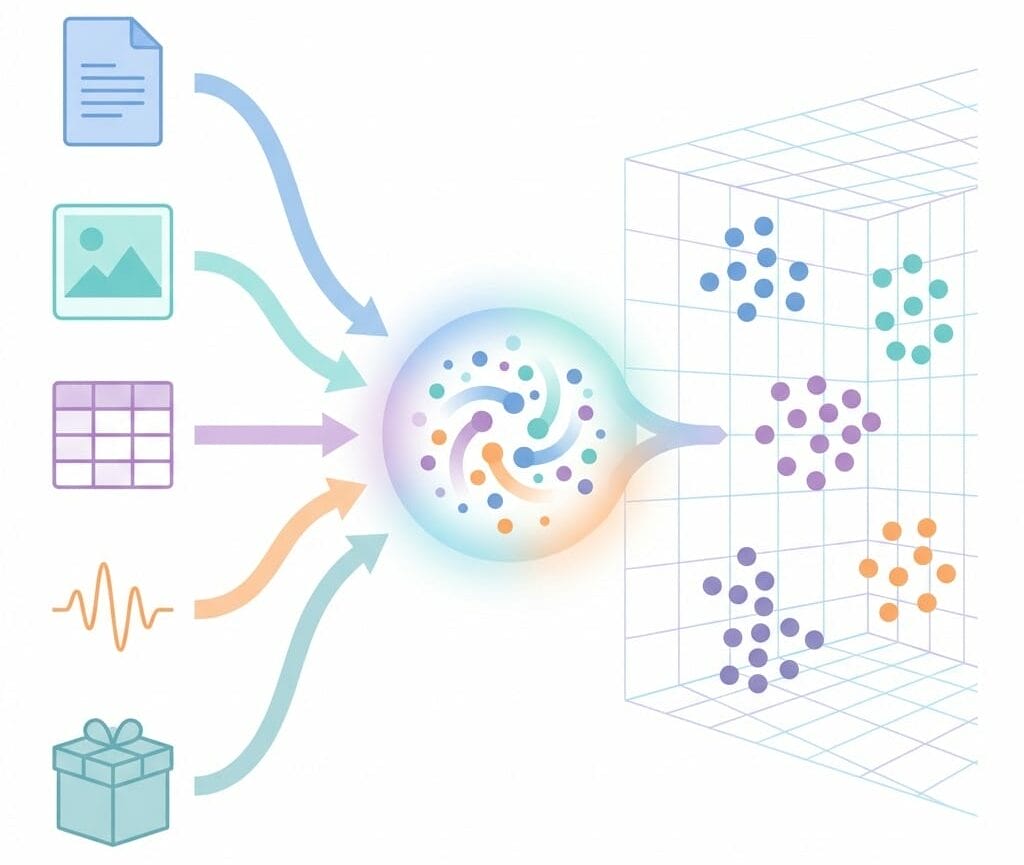
To make it comparable, it is necessary to translate it into one joint format. This is exactly where embedding models come into play. They are the heart of AI applications because they translate data into mathematical vectors and, therefore, make its meanings and contexts visible. In this way, data that has so far been isolated from one another is now related to each other and used in a meaningful way.
Consequently, numerous possibilities open up for companies, from personalized product recommendations in e-commerce to the recognition of variances in complex production processes.
What is an embedding model?
An embedding model is an AI model that converts data into vector displays, i.e. into numerical series mapping characteristics and properties. The aim is that data points with semantic similarity should be close to each other in the embedding vector space whereas dissimilar data should be farther away from each other.
Example: Imagine an office where objects such as desk, chair, keyboard and mouse have their fixed place. Content-related elements belonging together are located close to each other – just like keyboard and mouse on the desk. The positioning of data points in the “embedding space” can be compared with the useful arrangement of furniture.
In this way, a mathematical landscape is created that makes similarities and differences between data visible and electronically usable.
Why are individual embedding models developed?
Today, many standard models, such as pure text embedding, are freely available. However, they do not cover all scenarios that are relevant in the practice of different areas. Especially when it comes to combining different data types, such as words, sentences, numbers and images, or mapping very specific use cases, general models will reach their limits.
This is why research institutes and companies rely more and more on individual embedding models optimized for their requirements. They can include data sources otherwise remaining unused and adjust models to individual framework conditions, such as legal provisions or industry particularities.
We at the FIS Group as well have come to realize that and started to develop our own embedding model for numerous use cases.
FISMWASP Multi: What makes our own model special?
The peculiarity of FISMWASP Multi is its ability to process almost all machine-readable data. Texts, images, tables, documents, tracking data or also sensor data – everything finds its place in the embedding space and can be related with each other. This enables the linking of information that has been viewed in an isolated way before. This is how the model differs from classical embeddings that are mostly restricted to one data type.
E-commerce is a scenario where this benefit is applied. Here, tracking data is permanently collected through users, i.e. clicks, purchases, length of customer stay. In the majority of cases, most of the data remains unused.
Through the implementation of an embedding model such as FISMWASP Multi, data can be evaluated efficiently to generate personalized product recommendations in real time. This does not only increase the relevance for customers but also improves efficiency in online trading.
Moreover, the calculations in the embedding space are so streamlined that even applications are possible in real time. As a result, recommendations can be displayed immediately without users having to wait. In the end, the underlying mathematics is reduced to the distance calculation between vectors: what seems obvious is suggested.
However, the scope of application goes far beyond online trading.
What are typical fields of application for embedding models?
In manufacturing, embedding models such as FISMWASP Multi can recognize anomalies for instance. They analyze sensor data and show deviations from the normal state before production errors or failures occur.
They also play a central role in search activities: Images, texts and tables can be searched through at the same time using “visual search” approaches – a significant improvement of classical search functions.
Embedding models can also support service activities. Relationships between words, for instance, can also be analyzed and converted into code so that answers to questions can be provided more rapidly. This technique, for instance, is used by ChatGPT but also by other LLMs and language models to deliver precise answers to queries.
Perspectives are even opened up in the medical environment. Sensitive patient data can be analyzed in compliance with data protection, e.g. for symptom checkers or the support of medical diagnoses.
How can data protection and data security be ensured?
A central argument for FISMWASP Multi is the handling of sensitive data. While many AI models are trained and operated in external cloud environments, this embedding model is entirely operated in data centers of the FIS Group.
In this way, companies can be sure that their data is not transferred to third parties. This is a decisive advantage especially in view of GDPR, which also enables the use of particularly sensitive information.
How efficient and sustainable are embedding models in reality?
In the area of artificial intelligence, embedding models are considered to be a prime example of efficiency. Their small model size and the underlying vector similarity search provide a significant advantage compared to other AI approaches. A particularly high-performing architecture is created through the combination with advanced vector databases.
Instead of the complex processing of huge datasets, embedding models reduce complex information to dense numeric vectors. As a result, data can be analyzed, compared and queried at high speed. At the same time, the system load is clearly reduced.
The reason for this is that many of these compact embedding models can be efficiently operated on standard CPUs. Expensive and highly specialized GPU servers are therefore not required. This hardware frugality results in an energy-efficient and, therefore, more climate-friendly operation of AI applications. This enables the application in price-sensitive scenarios.
This combination of low costs, speed and sustainability opens new possibilities for the economic use of AI. This efficiency plays a central role especially in the development of intelligent assistants. There are also advantages for the users: applications become quicker, more sustainable and more economically viable. Especially in scenarios where large and resource-intensive models have so far been considered to be unprofitable, compact embedding models can now create real added value.
Generative embedding models: a look into the future of AI technology
Current embedding models are primarily designed to analyze data and relate it with each other. However, the development goes further: future models might also get generative abilities. This means that they would not only be able to map existing data but also to create new contents.
For companies, this would open up even more fields of application from automated content creation and intelligent analysis tools to innovative products based on generative data. In the FIS Group as well, a possible FISMWASP V3 is already being developed which is to map this next development level.
Conclusion: embedding models as a central tool of advanced AI systems
Embedding models are a central tool of advanced AI. They make data sets comparable, link different sources in a kind of network and, therefore, create the basis for the provision of new tools. Be it e-commerce, manufacturing or healthcare – the range of possibilities is broad.
Models such as FISMWASP Multi show the potential lying in the further development of services: from real-time recommendations to the secure processing of sensitive data. Looking ahead shows that the journey is far from being over: generative embedding models might open completely new scenarios in the near future.

Questions about this topic? Our team will be happy to assist you personally.

Read, take a look, inform yourself
In our download section, you will find a large number of SAP contents worth knowing – expert talks, white papers and flyers. To find right away what you are looking for, please use the filter function for topics and content type.