Seamless Integration of SAP EWM and SAP TM with Advanced Shipping & Receiving in the Order Processing Process
September 30, 2024 | Reading time: Approx. 9 Minuten

Team leader Warehouse & Transport Solutions at FIS
Today, the smooth processing of sales orders and the seamless integration of warehouse management and transportation planning requires more than just system support. Instead, SAP EWM and SAP TM have to work synchronously in order to ensure swift order processing from a logistics point of view. We describe in this article how such interactions work and what benefits arise for your company.
“The whole is more than the sum of its parts” – this quote can be perfectly used for the processing of sales orders. There are many individual steps between incoming order and invoicing that form the “big picture”.
The same applies in particular to the interaction of the SAP Extended Warehouse Management (SAP EWM) and SAP Transportation Management (SAP TM) solutions. Only when these two components work in a perfectly synchronized way will the order processing process be smooth from a logistics point of view.
The consequences of missing synchronization of transportation planning and warehouse management
An order processing process in SAP can be described in simplified terms with the following document chain: sales order – delivery – picking – packing – transportation planning – transportation execution – billing. However, “delivery” here does not mean the physical delivery process but the SAP subsequent document of the sales order forming the basis for further process steps.
If transportation planning does not communicate with warehouse management now, the following (exemplary) constellations may arise:
Transportation planning and warehouse management without SAP integration
Transportation planning is always based on a freight unit, which is the smallest indivisible unit to be transported. These freight units are displayed in a simplified way and created either from sales order items (order-based planning) or delivery items (delivery-based planning) in SAP TM.
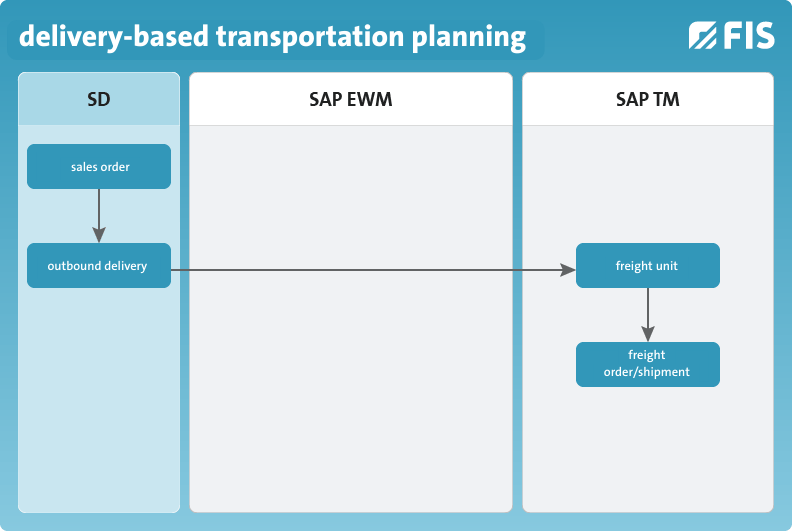
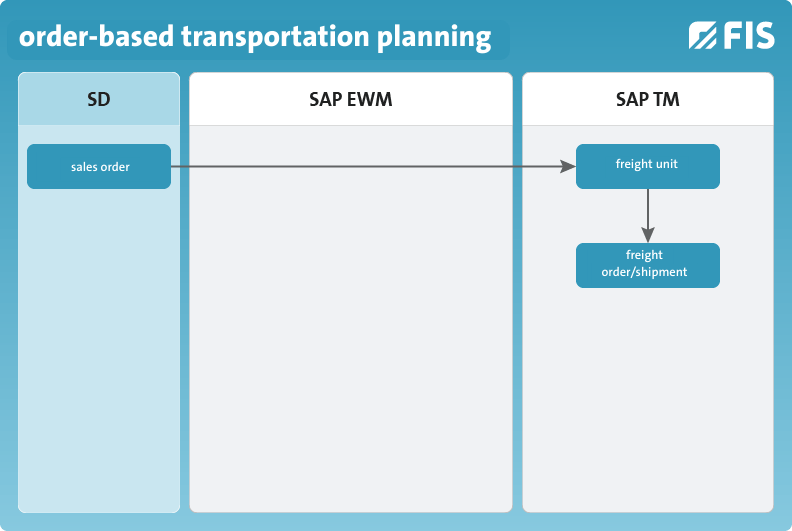
The MRP controller then plans exactly these freight units for a freight order. Consequently, the freight order is the total of all freight units that are transported together – either by an individual vehicle fleet or a forwarding agent.
It is optional to form “shipments” within a freight order. These can be used to group transportation requests according to diverse criteria. Prior to the S/4HANA 2022 Release, this was only possible via a freight order.
The shipment is assigned to the freight order in a similar way as a freight unit. It is helpful from a cost calculation and billing point of view that costs are now calculated on the basis of the freight order or shipment.
Billing via shipment will offer advantages particularly in the field of unit and grouped loads as it creates a distinction from physical transports, which are still represented by a freight order.
In warehouse management, however, an outbound delivery is the only basis for the picking process. The outbound delivery order is a copy of the outbound delivery. It is processed by the warehouse worker and finally updated at ERP level in the form of a goods issue posting and handling units.
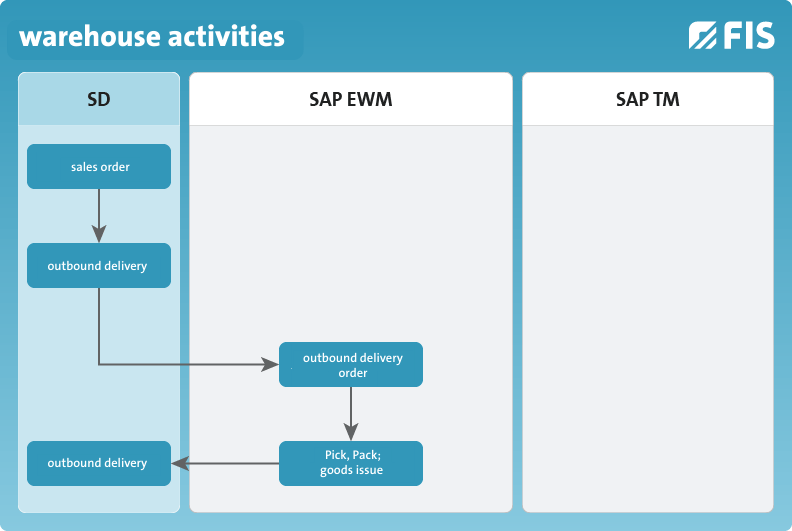
Figure 2 shows that – without integration – warehouse management and transportation planning can represent two completely independent variants of logistics planning, which may even contradict each other in extreme cases.
The “old” solution: integration via transportation units
The original solution approach connected SAP TM with SAP EWM using SAP EWM object “transportation unit (TU)”. This is the smallest loadable unit used for transporting goods. A transportation unit can be a truck, a trailer, a sea freight container or also a railway wagon.
The integration process is as follows: Either the sales order or the outbound delivery creates freight units, which are then planned for a freight order. Next, transportation units are created in SAP EWM via the LDAP interface (LDAP = Loading Appointment), i.e. the EWM counterpart of the freight order.
The warehouse tasks for picking are confirmed and the packages are updated in the transportation unit and replicated into the freight order via LDAP interface.
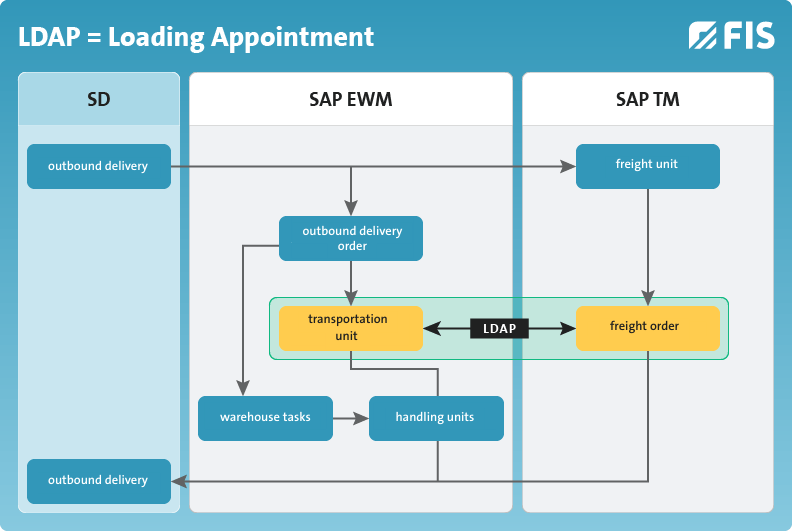
In practice, this approach was only partially successful. On the one hand, integration via transportation units is not very flexible and adjustable to customer requests. On the other hand, users complained about the asynchronous and not always stable interface as well as the challenging operation.
The “new” solution: integration via “Advanced Shipping & Receiving” (ASR)
The ASR integration (extended goods receipt and shipping process) is the latest SAP integration variant between SAP TM and SAP EWM. This scenario is based on “background RFCs” (bgRFC) and offers a real-time exchange between SAP TM and SAP EWM.
One advantage of this integration is that no redundant business objects are required, which means that the respective object from SAP TM, i.e. the freight order, is directly used. The transportation unit can be ignored completely as the integration process takes place by directly using the freight order.
In addition, this integration variant via the “Load and unload freight orders” app enables SAP EWM activities from SAP TM, such as goods issue posting. It also enables the planning and execution of assignments and the corresponding loading activities at warehouse gates.
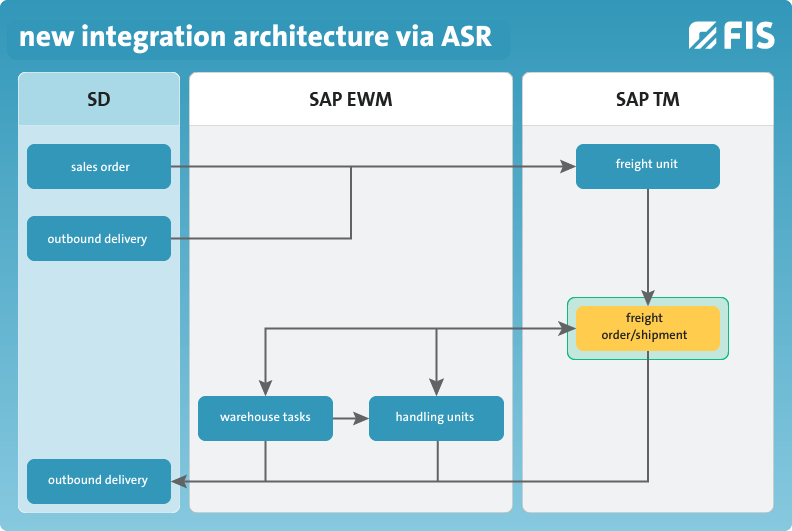
This new integration architecture now enables alternative ways of working.
At first, warehousing is not blocked in the warehouse-based scenario and transportation planning takes place in parallel to warehousing or afterwards. This scenario can be used if, for instance, a technical wholesaler receives orders every day that are sent within the next 24 hours. Here, warehouse activity dominates over transportation planning as the short time range between incoming order and outbound delivery does not permit long-term transportation planning.
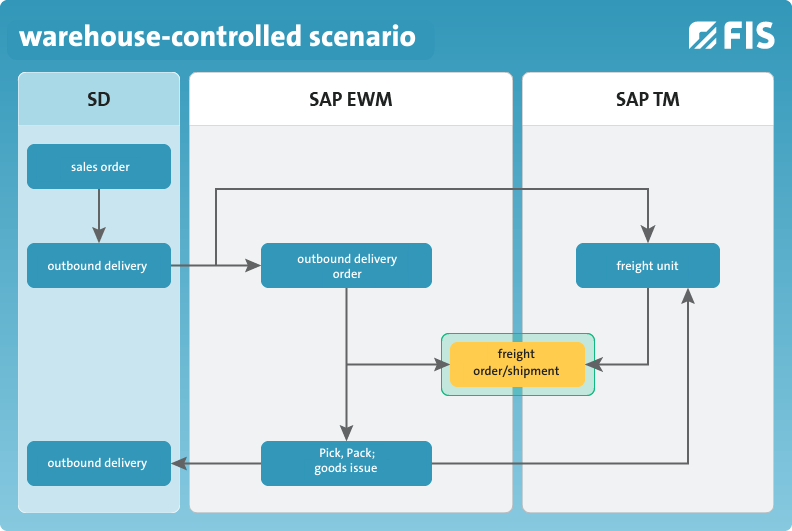
At the same time as the creation of an outbound delivery, a freight unit will be created in SAP TM as well as an outbound delivery order in SAP EWM. Once the picking warehouse tasks have been confirmed, the goods can be packed in shipping handling units (shipping HU) in EWM.
According to the system configuration, a delivery update is already made here. Once the shipping HUs have been finished and provided for loading, the readiness for shipment status in SAP EWM can be set to “9 – ready”. With the packed HUs, the system then updates the freight unit in SAP TM via the ASR interface.
These HUs are used to create a freight order in TM and the freight units ready for shipment are planned for this order. If some of the freight units are not assigned to the freight order, an outbound delivery order split may be triggered.
The following steps are no longer displayed graphically: Once the freight order has been created, its status is “ready for transportation execution” and the status of the outbound delivery orders is “ready for shipment”, loading can be executed in SAP EWM using the “Load or unload freight orders” app or a mobile terminal. Once loading has been completed, the information on warehouse activities will be transferred to the freight order in TM with a corresponding status change.
In the transportation-based scenario, however, warehousing is blocked at first and transportation planning takes place in full or in part prior to starting warehousing. This procedure is particularly suitable for companies where the period of time for transportation planning is sufficiently long between order entry and physical outbound delivery. This means that the warehouse activities are controlled by transport.
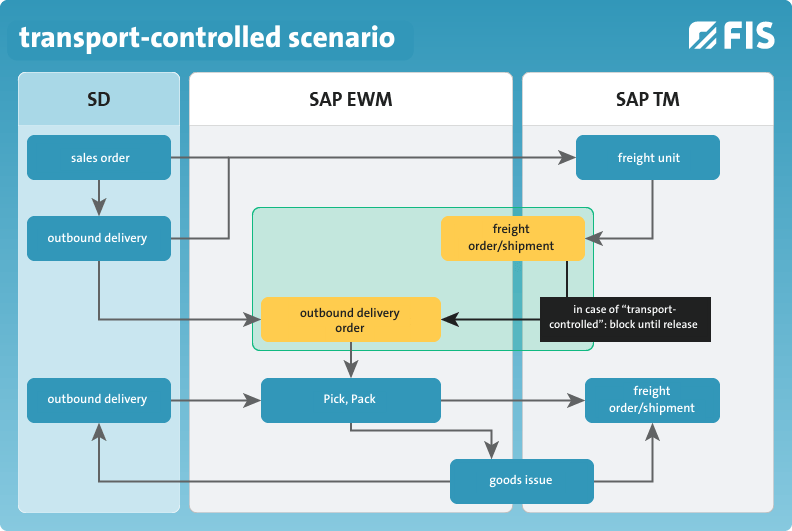
The process may be as follows: Here as well, transportation planning is based on freight units that are created, for instance, from sales order items.
Alternatively, they could also be created from delivery items. These freight units are planned for freight orders and – optionally – shipments. Once transportation planning is completed, delivery creation can be triggered by setting a status in the freight order. These deliveries are transferred to SAP EWM as outbound delivery orders. However, they will be blocked for processing until they are released in SAP TM.
This ensures that transportation planning is completed prior to picking and packing. The results are updated in outbound delivery and freight order. The subsequent process sequence corresponds to the previous variant of warehouse-based execution.
Restrictions of ASR integration
ASR integration is currently available if
A hybrid scenario where one of the two components is operated as embedded component and the other one as local component is not supported. It should be noted that cross-delivery packing often requested by customers is not yet supported. TU integration, however, enables this packing variant.

Questions about this topic? Our team will be happy to assist you personally.

Read, take a look, inform yourself
In our download section, you will find a large number of SAP contents worth knowing – expert talks, white papers and flyers. To find right away what you are looking for, please use the filter function for topics and content type.
