Machine Learning Meets Master Data Governance: How AI Can Improve the Quality of Master Data
July 2, 2025 | Reading time: Approx. 7 minutes

Consulting Manager FIS/mpm at FIS
Poor data, poor AI: Without clean master data, the potential of AI applications remains unreached. Learn how machine learning helps to improve data quality in the long term, detect errors at an early stage and take data governance to a new level.
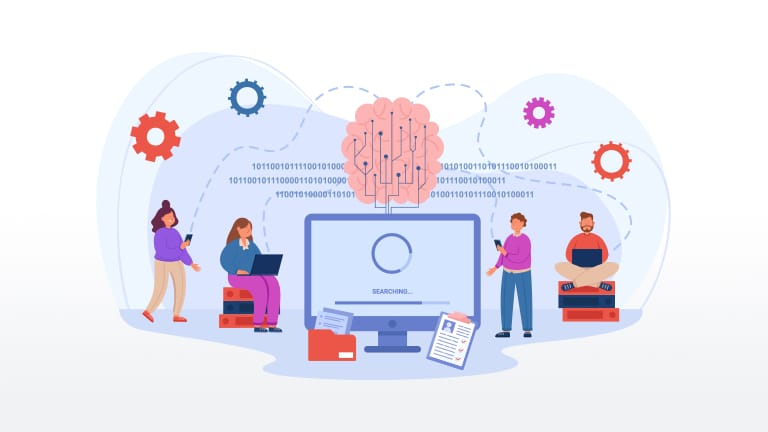
High data quality forms the foundation for the use of AI and opens up many use cases in companies. But without good data, AI applications will never reach their full potential and are ultimately more prone to errors. Artificial intelligence itself can support data governance and improve master data quality in companies.
It is surprising that only 63% of participants surveyed in a study agree that their company considers data to be an asset (source: DATAVERSITY Education, LLC). Especially when you consider that company data will form the basis for a wide range of AI applications in the future.
The picture is also rather sobering when it comes to data quality: only 37% of companies rate their previous investments in improving data quality as successful (source: Statista). This suggests that much is said about data but its implementation in practice often falls by the wayside.
A recent survey from 2024 clearly shows: expectations for the use of AI in the master data environment are high. More than half of the users surveyed (54%) would like to see specific recommendations from the system to improve data quality in a targeted manner, for instance through intelligent analyses or automatic suggestions. 70% consider the current data quality in their company to be improvable. Here, you can access the results of the study we conducted together with IT-Onlinemagazin: Link to study
These figures make it clear: action is needed. Traditional tools for master data management are now well established – advanced, AI-supported approaches to master data governance can complement these tools effectively.
Machine learning – the toolbox for advanced Data Governance
Machine learning (ML) is the toolbox enhancing the well-established approaches intelligently. It comprises a wide range of learning methods tailored to different data situations:
Supervised learning works with labeled data and is often used for classifications and regressions – for instance to predict attribute values.
Unsupervised learning recognizes patterns in structured data, for example through clustering or anomaly detection.
Reinforcement learning is suitable for dynamic scenarios in which a system learns through feedback.
Generative AI and large language models (LLMs) primarily use supervised and self-supervised learning methods. In certain cases, reinforcement learning with human feedback is also used.
These models enable new fields of application – for extracting attributes from free texts or automatically generating SQL queries for data analyses for instance.
But what exactly does machine learning do for master data maintenance? You will find some specific application examples in the following list:
|
Application field |
ML algorithm / technology |
|---|---|
|
Duplicate recognition |
Record Linkage, Fuzzy Matching, Dedupe |
|
Creation of Golden Record |
Attribute Merging (e.g. “Most complete value”) |
|
Automatic classification of materials |
Random Forest, Deep Learning |
|
Fill up missing values (imputation) |
Regression models |
|
Derive data quality rules |
Apriori, FP-Growth |
|
Recognize placeholder values |
Embeddings + Cosine Similarity |
|
Attribute extraction from texts |
LLMs + RAG (Retrieval-Augmented Generation) |
|
Translate texts into multiple languages |
LLMs |
These procedures help to identify data errors at an early stage, correct them automatically and make master data processes more scalable.
Creation of rule sets by means of AI
AI models are capable of recognizing patterns in large datasets. Existing master data forms a starting point for exploring sets of rules. In this context, rule sets refer to technical rules that go beyond a technical check of field contents. Various field values are preassigned in material master data for material types for instance.
Dynamic if-then functions represent more complex use cases for rules. In these rule sets, certain initial conditions lead to specific actions for maintaining master data. The purely manual collection and creation of these rules is a time-consuming process in practice and requires the involvement of many subject matter experts.
These rules can be generated using association rule mining.
The challenge: The algorithms often generate a large number of rules, not all of which are relevant or understandable. This requires filter mechanisms, user-friendly interfaces and collaborative tools.
Here as well, LLMs with Retrieval-Augmented Generation (RAG) can help and provide a structured response. This means that the application only returns relevant rules based on statistical key figures. Optionally, these can be transferred directly to the master data management software.
Natural language commands for analyzing master data errors and correcting them
Studies show: The real data quality professionals are often not IT staff, but data stewards in the user departments. These data stewards contribute valuable expertise – the technical implementation of rules in the system, however, often presents an obstacle.
Solutions are needed that can be used even without in-depth technical know-how. This allows users to contribute their knowledge directly to the system.
This is where LLMs come into play:
Combined with RAG techniques, even complex SAP schema information can be incorporated. A use case for intelligent, context-aware data quality tools.
The defined analyses can also be used to determine a data quality score. To this end, the erroneous data records are placed in relation to the total quantity of data. Multiple scores can then be combined into an overall value to measure data quality.
Recognition of anomalies and missing values
ML models learn the “normal” pattern of your master data and detect outliers that indicate errors. These can be individual field values or irregular combinations of several fields. This could be, for example, a product with units of measurement that do not match each other.
Another added value for data quality is discovering placeholder values with machine learning. This is because master data records often contain fields that appear to be filled in but actually contain placeholders such as: “n/a,” “000000,” “–,” “n/a,” “123.”
This reveals inconsistent or incorrect entries that no one had noticed before.
Conclusion: Intelligent master data needs smart algorithms
Machine learning has long been more than just a research topic – it is becoming a practical aid in master data maintenance:
Those who strategically rethink their data governance today and integrate ML in a targeted manner will not only improve data quality, but also sustainably enhance their company’s digital innovative power.
Of course, there are many other use cases such as harmonization or self-learning mappings. Would you like to delve deeper into the topic? Please read the blog post by my colleague Martin Tempel.

Questions about this topic? Our team will be happy to assist you personally.

Read, take a look, inform yourself
In our download section, you will find a large number of SAP contents worth knowing – expert talks, white papers and flyers. To find right away what you are looking for, please use the filter function for topics and content type.
