Last Mile App und Tracking-Monitor in SAP
FIS/LastMile Cloud, the mobile application integrated in SAP for digital documentation of goods deliveries, which replaces paper-based delivery note processes and, as a consequence, represents a clear progress in logistics digitization. This specialist article provides an overview of the structure, functions and benefits of the FIS/LastMile Cloud app as well as of the tracking monitor.

Product Manager at FIS
What is the FIS/LastMile Cloud app?
The application covers the “last mile” to the customer and enables companies with their own vehicle fleets to enter goods deliveries directly on site – including digital signatures, photos and comments. All information is automatically assigned to the corresponding SAP delivery document of the purchase order, which eliminates complex interfaces and ensures that your logistics processes are consistently digitized. The solution is based on SAP Business Technology Platform (BTP).
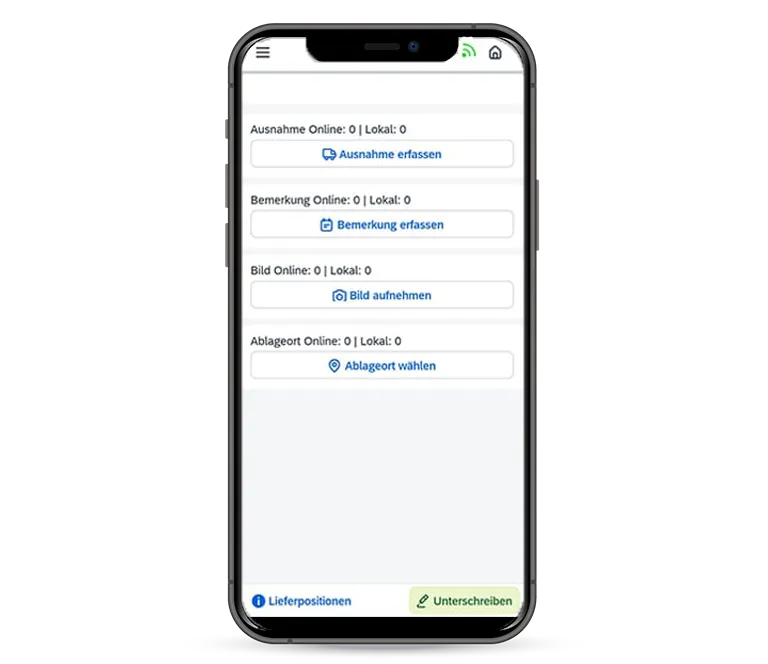
Optionally, it can be expanded by the tracking monitor, which provides real-time information on vehicle locations, routes and delivery statuses. This means that your MRP controllers are always able to provide information, respond to deviations and increase customer satisfaction.
How does FIS/LastMile Cloud work in practice?
FIS/LastMile Cloud is used on a mobile device, such as smartphone or tablet. Information such as the recipient’s signature, photos of the storage location and additional comments on the delivered products are entered digitally and automatically added to the respective SAP delivery document as an attachment.
Your MRP controller can track which deliveries have already been made and can tell you at any time when the goods will arrive at their destination. By means of the GPS data, FIS/LastMile Cloud determines the distance to the place of destination and informs the recipient via e-mail within a defined radius.
What are the benefits for MRP?
Full overview of the goods delivery status, which also enables you to react to deviations.
Support of the colleague by documenting the storage with a photo or signature of the recipient.
Time savings thanks to reduced maintenance effort during initial setup by grouping shipping points instead of creating individual entries.
Sustainability due to completely paperless goods delivery documentation.
What are the benefits for the drivers?
User-friendly handling thanks to system-guided, ergonomic and responsive dialogs based on SAPUI5 technology.
Reduction of mobile devices by integrating further apps, such as a navigation app or WhatsApp Messenger.
Complete flexibility, for example through the ability to enter exceptions, specify customer-specific storage locations, select and individually sort goods recipients etc.
Further benefits
What are the core functions of FIS/LastMile?
FIS/LastMile covers all central functions required for a digital goods delivery process without gapsand a transparent “last mile”.
Digital entry of the outbound delivery directly upon delivery via mobile devices (e.g. smartphone or tablet)
Inclusion of the recipient’s signature as well as entry of storage location, state of the goods and remarks
Automatic storage of all data in the SAP ERP system as an attachment to the relevant delivery
Seamless integration into existing SAP landscapes based on SAP Business Technology Platform
Extendable by additional functions such as:
What distinguishes the FIS/LastMile Cloud app from the conventional outbound delivery process?
The biggest difference between the conventional outbound delivery process and a digital “last mile” is the elimination of media changes and wait times. The following table compares the outbound delivery:
|
Process step |
Without digital FIS/LastMile app (conventional) |
With FIS/LastMile Cloud app (digital) |
|---|---|---|
|
Delivery note & signature |
Printed document; |
Digital: signature directly on the tablet; electronic entry. |
|
Data transfer to ERP |
Manual entry by the office-based personnel after return of the driver. |
Automatic real-time transmission of all specifications entered in SAP. |
|
Invoicing |
Delayed; only after the delivery note has been transmitted to the system. |
Possible immediately: invoice can be created immediately after the outbound delivery. |
|
Customer information about the status |
Limited; orderer only gets status on inquiry. |
Transparent: orderer can view the status online via the tracking monitor. |
How does a seamless integration into the SAP landscape work?
The architecture is specifically tailored to the requirements of the SAP landscape.
What is the tracking monitor?
As an optional enhancement of the FIS/LastMile Cloud app, the tracking monitor can be used to check and analyze goods deliveries with your own car pool in real time. As a result, the responsible persons involved have an overview of all relevant specifications via the Track & Trace function, can quickly respond to deviations or route disturbances and can give information at any time.
If the Internet connection is activated, this tracking monitor provides you, for instance, with live map data on vehicle locations, routes and wait times. This transparency not only enables better planning, but also targeted route optimization based on the entered movement and route data. This also leads to increased customer satisfaction when queries are made about delivery times as the MRP contact persons can provide information about the sequence of the delivery processes.
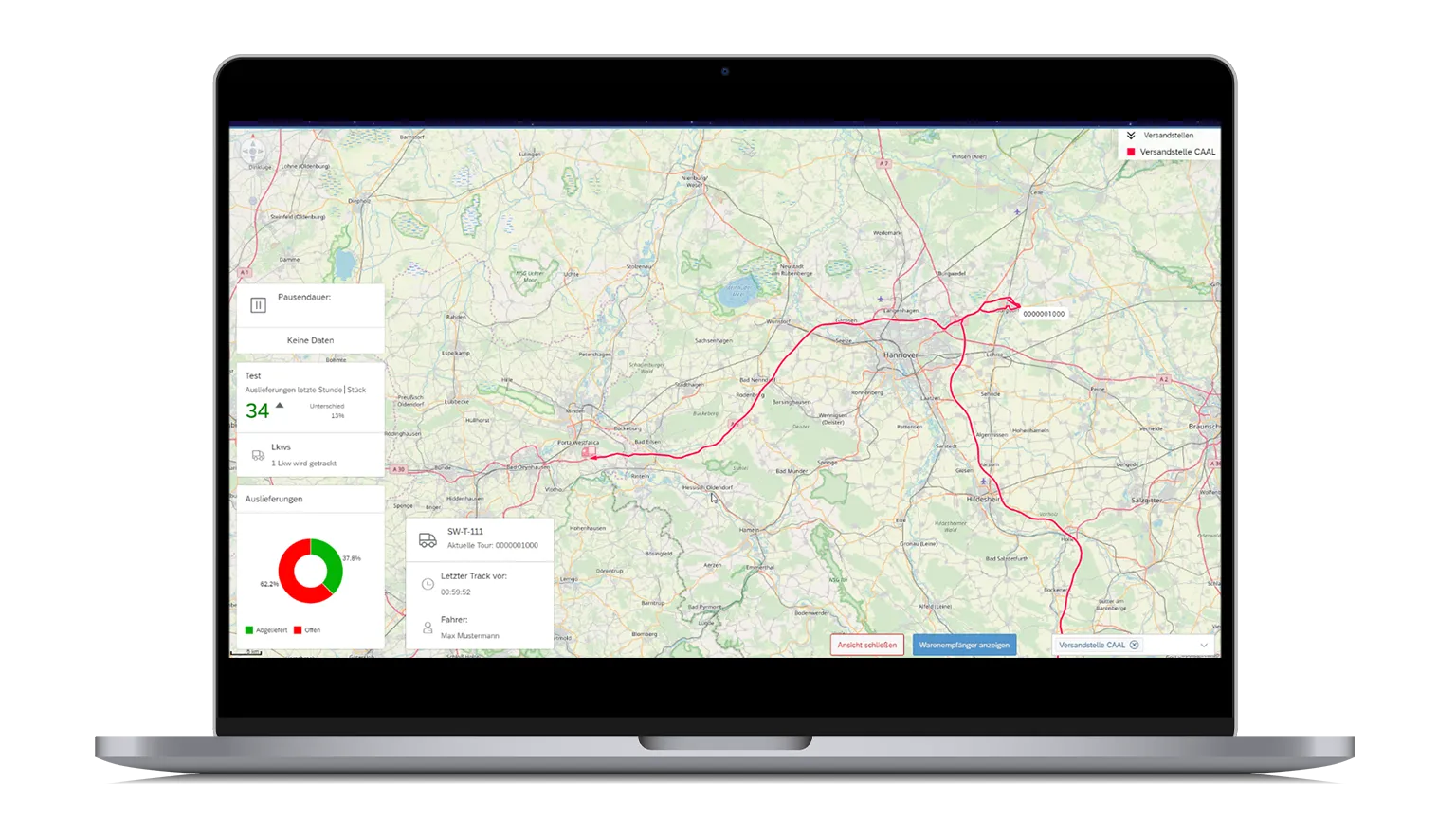
Moreover, the application collects relevant geodata that may be used as a basis for downstream route optimizations. In this context, collected data means, for instance, experience values from route overlaps or traffic jam and weather information. This information helps optimize the inbound delivery, i.e. it can be executed more efficiently and quickly.
What are the benefits of the tracking monitor?
Conclusion
The FIS/LastMile Cloud app is a holistic solution for the digitization of the outbound delivery process. It directly addresses the challenges of the “last mile” – higher costs, manual processes and low traceability of the last mile.
The Last Mile app digitizes the entire outbound delivery process and replaces paper-based workflows with an integrated, mobile solution based on SAP. The direct entry of handovers on site including signatures, photos and comments speeds up processes, reduces errors and makes proof of delivery immediately available in SAP.
The optional tracking monitor enhances the application by real-time transparency for MRP controllers and customers and supports a more efficient route planning and delivery management for all parties involved.
Decision-makers receive a field-tested and SAP-integrated application that delivers immediately measurable improvements: faster processes, fewer errors, high data quality and increased customer satisfaction.
The added value in a nutshell: Companies that use FIS/LastMile Cloud transform the formerly paper-based, error-prone process into a lean, IT-supported and resource-saving workflow. This not only ensures operational efficiency in logistics, but also gives you an information advantage over the competition. The solution for the “last mile” therefore significantly contributes to the modern, transparent and resource-saving management of your products and logistics processes.