SAP Business Suite
This specialist article describes the SAP Business Suite solution, how it integrates central business processes and the advantages this modular and cloud-based platform offers to companies.

Productmanager at FIS
What is SAP Business Suite?
SAP Business Suite is a cloud-based and AI-supported platform that unites central business processes in one integrated environment. It enables companies to make their processes more efficient, transparent and scalable – from financial accounting, purchasing and production to sales and distribution, human resources and service.
The suite is the basis for sustainable enterprise management. It goes far beyond a classical ERP system and uses state-of-the-art technologies to digitize and automate processes and enhance them flexibly.
Being a smart ecosystem, SAP Business Suite combines business processes, data management and artificial intelligence. The combination of real-time data with intelligent and integrated applications creates consistent and data-driven processes with a high degree of automation.
Companies benefit from more efficiency, improved transparency and increased innovative power. At the same time, their competitiveness is ensured through a modern, digital and networked system landscape. Companies benefit from more efficiency, improved transparency and increased innovative power. At the same time, their competitiveness is ensured through a modern, digital and networked system landscape.
What are the functions of SAP Business Suite?
SAP Business Suite supports companies in centrally controlling and optimizing their core processes. It unites all essential business areas – from finance, purchasing and production to sales and distribution, service and human resources – in one consistent system landscape.
The central functions include
The cloud-based architecture standardizes processes and makes them flexibly adjustable at the same time. As a result, business models can be extended more quickly, decisions can be made on a data basis and resources can be used more efficiently.
In this way, the suite creates the basis for transparent, automated and scalable business processes – irrespective of company size or industry.
How is SAP Business Suite structured?
To make digital transformation successful, SAP Business Suite relies on four central components. These interact directly with each other and create a platform that is operationally efficient, data-driven, intelligent and open.
Standardized processes for central areas such as finances, purchasing, logistics, sales and distribution, human resources and customer service ensure efficient processes and optimal resource utilization.
SAP Business Technology Platform (BTP) is the technological basis for secure enhancements and integrations via interfaces as well as for individual apps and automations.
SAP Business Data Cloud unites structured and unstructured data from SAP and non-SAP sources, provides it in real time and enables a 360-degree view of the company.
Embedded AI functions analyze data in its context, automate processes and provide proactive recommended actions for operational strategic decisions. The AI functionalities can be used, for instance, via out-of-the-box AI services or SAP Joule.
The interaction of these components creates an intelligent and future-oriented platform that enables companies to act in a data-driven way, flexibly control processes and sustainably exploit innovation potentials.
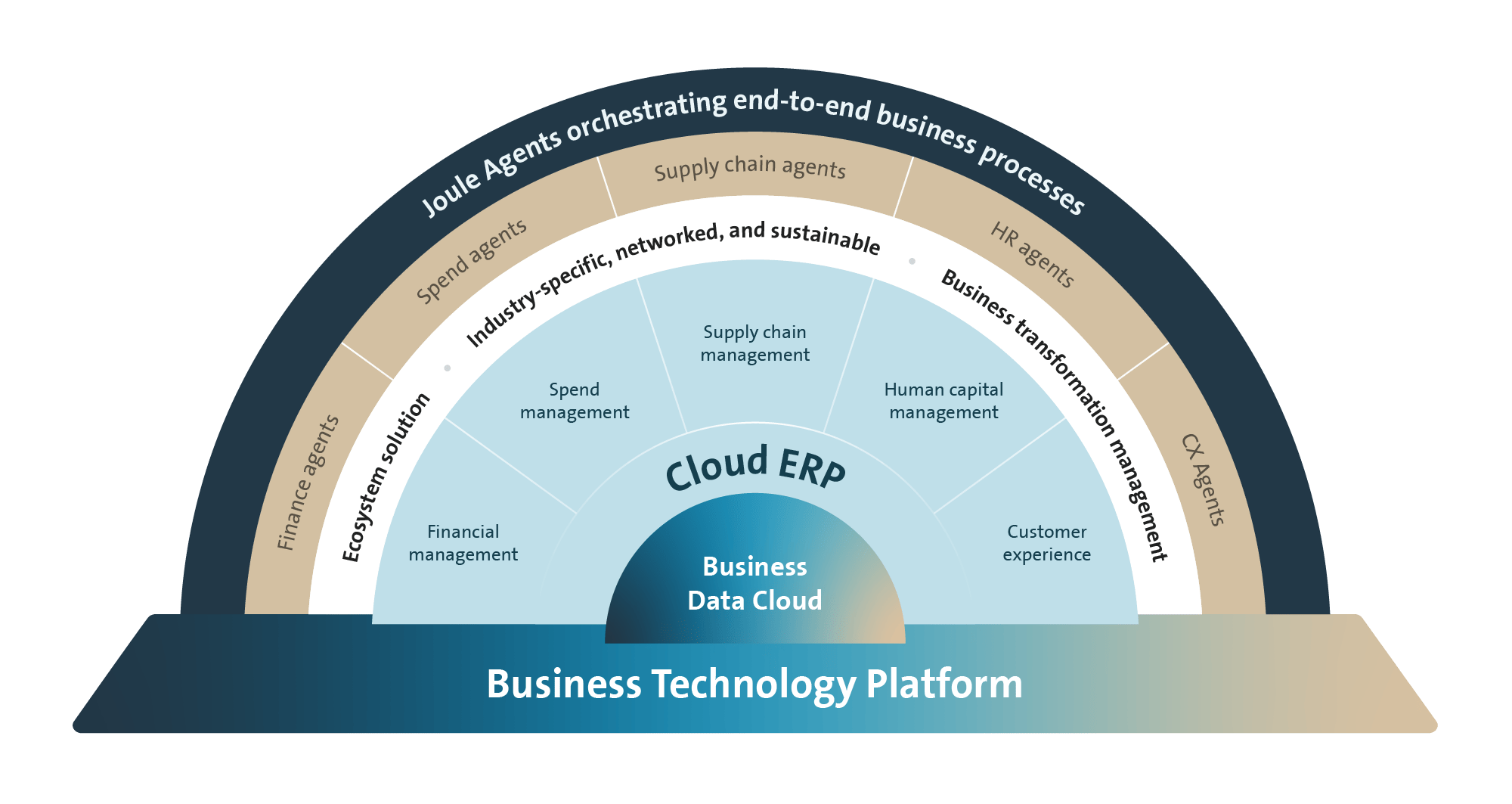
What roles do the four SAP Business Suite components play?
SAP Cloud ERP – the core of the suite and the central application for business processes
SAP Cloud ERP (previously known as SAP S/4HANA Cloud) is the operational backbone of SAP Business Suite. As an advanced and modular Cloud-ERP solution, it covers all essential business processes – from Financial Accounting, purchasing and production, supply chain and sales and distribution to human resources and customer experience.
SAP Cloud ERP is available both in the public cloud and the private cloud. Public Cloud Edition enables a quick implementation based on standardized processes and offers predefined industry packages. Private Cloud Edition addresses companies with complex or highly individualized requirements and enables far-reaching adjustments.
Irrespective of the selected operating mode, companies will benefit from high-performance data processing in real time based on the SAP HANA technology, which enables quick analyses and efficient process control. Together with integrated artificial intelligence and configurable packages, SAP Cloud ERP assists companies in controlling their processes efficiently, remaining agile and consistently promoting innovations.
The combination of SAP Business Network and Integrated Toolchain by SAP Signavio creates a scalable and future-proof platform that accelerates digital transformation and forms the basis for efficiency, transparency and automation.
SAP Business AI – intelligent automation and decision-making support
SAP Business AI is the central AI view in the SAP landscape. It integrates generative AI, intelligent agents based on it as well as functions directly embedded in business processes. As a result, processes are automated, well-founded decisions supported and precise forecasts enabled, which increases efficiency, transparency and productivity.
The focus here is on the generative SAP Joule AI agent, which has already been integrated into many SAP applications. Joule enables the processing of tasks through interactions in natural language. Companies will benefit from proactive recommendations, automated workflows and data-based analyses that are seamlessly integrated into the daily routine.
The technical basis is the real-time data processing based on the high-performance SAP HANA technology. It enables quick data analyses and dynamic process control. The SAP Knowledge Graph tool is used by SAP to ensure a reliable data basis within the business context.
SAP Business AI is designed to grow continuously:
More than 400 AI scenarios are planned by the end of 2025. In addition, SAP Business AI will also be integrated into third-party applications, such as Microsoft 365 Copilot. Here, SAP pursues an agent-based approach: AI does not only react but acts actively and, in this way, contributes to improved decision quality, higher productivity and more sustainable enterprise management.
SAP Business Data Cloud – central data platform for well-founded decisions
SAP Business Data Cloud (BDC) is the central data platform of SAP Business Suite. It consolidates structured and unstructured data from SAP and third-party systems, harmonizes it semantically and makes it usable for applications, analyses and AI. As a result, a standardized and company-wide data basis is created that overcomes data silos and enables data-driven decisions in real time.
Based on this consolidated data, BDC provides preconfigured data products that make data available in consistent quality and with technical context – the basis for analyses, automations and AI scenarios.
Building on this, intelligent apps such as Finance Intelligence, Spend Intelligence, Customer Intelligence or People Intelligence provide user departments with self-service access to relevant insights. In this way, decisions can be made quickly and independently without being dependent on IT resources.
The combination of seamless integrations into the SAP ecosystem as well as into partner solutions such as Databricks or Palantir creates a 360 degree view of processes and customers, which is transparent, efficient and scalable.
SAP Business Technology Platform (BTP): the technological basis of the suite
SAP Business Technology Platform (BTP) is the technological backbone of SAP Business Suite. As an open platform for the integration, extension and automation of business applications, it enables companies to make their processes flexible and optimize them continuously.
Individual applications can be developed, existing systems – no matter whether on-premises or in the cloud – integrated seamlessly and business processes automated in a safe way. BTP creates a standardized technological basis for innovations, data analyses and intelligent process control.
What are the benefits of SAP Business Suite?
SAP Business Suite was developed to support companies of any size in their digital transformation. It offers a combination of integrated processes, intelligent automation and maximum flexibility.
1. Improved efficiency through seamless process integration
SAP Business Suite unites all business processes – from customer purchase order, purchasing, production and sales and distribution to reporting – in one consistent system landscape.
This makes media changes and double work obsolete so that processes will become faster, more transparent and more efficient. Open interfaces enable the integration of SAP and non-SAP systems for maximum networking and optimization. The platform networks data and applications in an intelligent way, which ensures a better overview, increases transparency and optimizes the use of resources.
2. Making well-founded decisions through consolidated and harmonized real-time data
SAP Business Data Cloud unites data from SAP and non-SAP systems in one consolidated and harmonized real-time data basis.
As a result, companies are provided with reliable information of standardized structure and quality, which is the basis for transparent analyses, precise forecasts and fact-based decisions. Intelligent apps based on this can be used by user departments in addition to have direct access to this data and derive precise recommended actions from it. The result: more transparency, increased planning security and stronger competitiveness.
3. Increasing productivity through intelligent automation with SAP Business AI
Embedded AI agents orchestrated by the generative SAP Joule copilot automate routine tasks, control workflows intelligently and give proactive recommended actions. Joule has already been integrated into many SAP applications. It reduces the routine workload of employees, supports data-based decisions and creates room for value-adding activities and strategic innovations. In this way, companies increase their efficiency, reduce their costs and optimize their processes sustainably.
4. Flexible and scalable growth through modular cloud architecture
SAP Business Suite grows together with the company – be it a medium-sized company or a corporate group. Through its cloud-native and modular architecture, business processes, market requirements and new business models can be adjusted dynamically.
Companies can start out small, implement individual components according to their needs and extend the solution step by step. The cloud-based platform guarantees maximum scalability and adjustability without system changes – both in the public and private edition. In this way, enterprises can respond quickly to changes, optimize their processes continuously and ensure their sustainability in the long run.
5. Secure digitization with highest security and compliance standards
SAP Business Suite offers state-of-the-art cloud backup concepts, continued updates and full compliance with international data protection directives.
It reliably protects company data against cyber attacks, data loss and regulatory risks. Companies can design their digital transformation in a secure and compliant manner and, at the same time, use new and innovative technologies – without having to compromise on security or stability.
6. Extensibility and innovation: future security through SAP Business Technology Platform
SAP Business Technology Platform (BTP) enables secure extensions of existing applications, the development of individual solutions also via low code/no code as well as the integration of industry-specific apps of third-party providers.
In this way, SAP Business Suite remains open for innovations and flexibly adjusts to new requirements. Companies benefit from continued improvements, can use new technologies immediately and secure themselves long-term competitive advantages due to a sustainable system basis.
SAP Business Suite is a central, secure and future-proof platform. It simplifies processes, uses data intelligently and automates it using AI – for more efficiency, transparency and innovative power.
What ways lead into SAP Business Suite?
Companies are facing different challenges depending on initial situation, size and degree of digitization. With SAP GROW and RISE with SAP, SAP offers two clearly structured ways into the Business Suite tool that are tailored to the requirements of new and existing customers.
SAP GROW
For new customers: quick start with SAP Cloud ERP, preconfigured best practices and onboarding. This ensures direct access to the cloud – with quick time-to-value and plannable operating costs.
RISE with SAP
For existing customers: transformation of existing ERP systems (ECC or S/4HANA On-Premises) into the cloud. RISE with SAP offers tools, services and a business transformation-as-a-service model to guarantee secure and gradual modernization.
Both programs offer preconfigured packages, quick implementation and full scalability – irrespective of whether companies make a new start or transfer existing systems into the cloud.
In what user departments does SAP Business Suite offer the greatest added value?
In what areas can a return on investment (ROI) be implemented most quickly?
Using the modular and preconfigured SAP Business Suite Packages, companies specifically start in the user departments that offer the greatest lever for efficiency and growth. All packages are AI-supported, fully integrated and individually scalable.
SAP Business Suite maps central business areas in full. This enables companies to use the appropriate solutions flexibly and quickly and, at the same time, benefit from a seamless system integration.
Overview of available packages:
Conclusion
SAP Business Suite 2025 provides companies with a reliable and scalable platform for controlling their central business processes. The suite combines processes, data and artificial intelligence in a fully integrated environment and goes far beyond a classical ERP system.
Due to its modular extensibility, full integration and innovative technologies, it enables a secure, intelligent and flexible digitization tailored to individual development targets and industry-specific requirements.
In this way, SAP Business Suite creates a sustainable basis for efficiency, transparency and agility at the highest level and becomes the decisive driving force behind digital transformation. It is the platform for long-term corporate success.