SAP Signavio
SAP Signavio is a cloud-based business process transformation suite helping companies understand, analyze, model and optimize business processes in a holistic way. Active process management particularly plays a key role in complex transformation projects, such as the migration to SAP S/4HANA or the transition into the cloud.

Product Manager at FIS
What is SAP Signavio?
SAP Signavio describes an all-in-one platform for the intelligent further development and analysis of business processes. The business transformation suite was established in 2021 when SAP took over Berlin-based Signavio GmbH – a pioneer in the field of process mining. Ever since, Signavio has complemented the SAP Business Process Intelligence division as well as the RISE with SAP program for corporate transformation.
The solution combines processes, people and data in one central platform and is therefore a “single source of truth” for the entire process landscape of an enterprise. Together with LeanIX and SAP Cloud ALM, Signavio forms the Integrated Toolchain provided by SAP to assist companies in their holistic transformation. In addition, WalkMe as a digital adoption platform ensures that new processes and applications are successfully implemented within the organization and used sustainably.
An integrated process mining approach analyzes data in IT systems and automatically shows where processes differ from the target, run inefficiently or overlap. The results are visualized in real time,
variances between actual and target process flows are disclosed and potential compliance risks can be identified at an early stage.

Brief summary
By means of a BPM (Business Process Management) solution, SAP Signavio enables companies to control their end-to-end processes on a data-driven and agile basis. In this way, they can quickly respond to changed requirements – an ability that is decisive for today’s digital transformation and sustainable corporate success. In combination with the other Integrated Toolchain solutions, SAP Signavio supports companies along the entire transformation process – from analysis and system selection to the implementation of the appropriate system support and adaptation by the user.
What modules does SAP Signavio include?
SAP has designed Signavio Process Transformation Suite as a modular platform. It consists of several components (modules) covering all process management phases – from analysis and modeling to automation.

All modules of the SAP Signavio Suite solution are completely web-based and seamlessly integrated. Using a browser, employees can access the platform from anywhere at any time – without installation. Due to open interfaces, it is also possible to connect third-party applications or non-SAP systems, which means that Signavio can be flexibly integrated into existing IT landscapes.
The components are linked to each other and enable a continued process management lifecycle:
Design
Automation
Improvement
An overview of the modules:
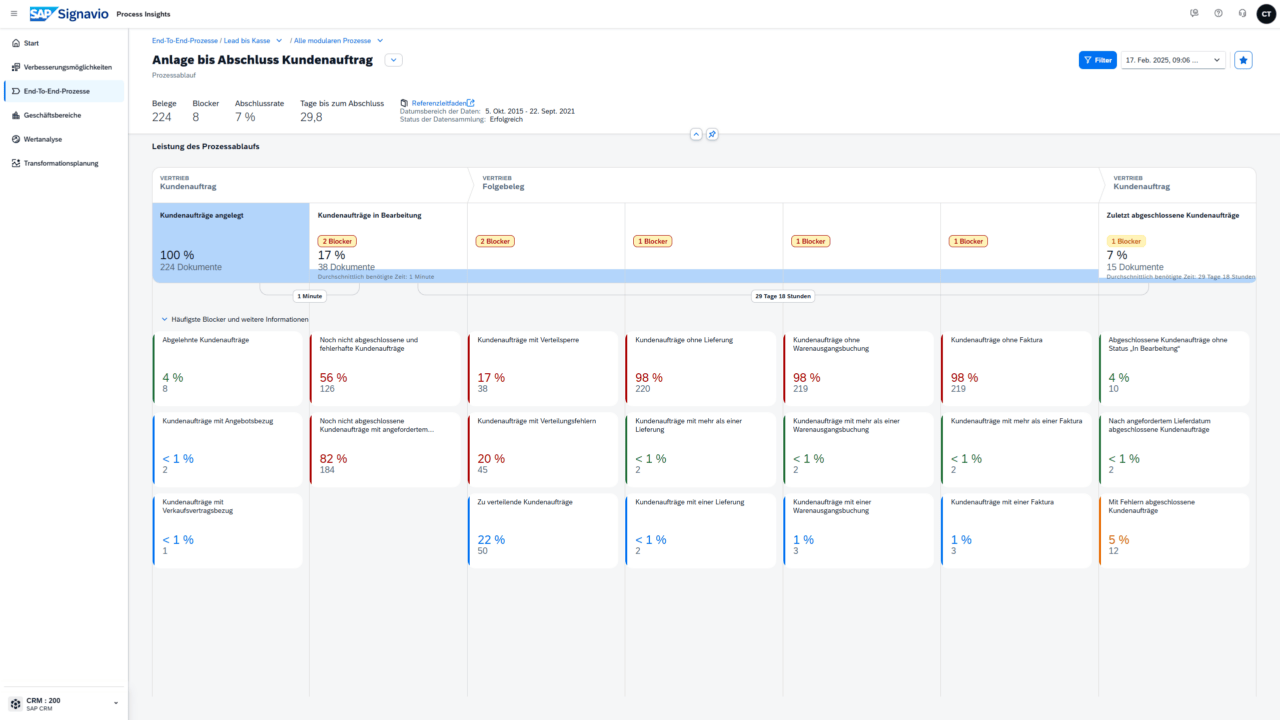
SAP Process Insights
Tool particularly used for quick process analysis in SAP ERP systems (ECC or S/4HANA). Via Plug and Play, it extracts the relevant process data and delivers hundreds of predefined process key figures and benchmarks to show inefficiencies. Companies gain an objective overview of the performance of all processes viewed almost in real time – including precise recommended actions and best practices for improvements.
SAP Signavio Process Intelligence
An extended process mining solution for detailed big picture analyses. It combines data from different systems – also non-SAP and customer experience data – and visualizes process flows with all variants. Advanced Analytics (incl. AI algorithms) enable users to reveal bottlenecks and rule violations, detect reasons for process inefficiencies via root clause analysis and derive target processes from the insights gained. Moreover, workflows or automated activities can directly be triggered based on identified patterns.

SAP Signavio Process Manager
The classical BPM module for process modeling and design. It can be used to intuitively document, analyze, simulate and optimize business processes in BPMN 2.0 on the basis of diagrams. The Process Manager supports a standardized corporate process understanding through process diagrams, where all steps, roles involved and information is clearly displayed. Modelers benefit from functions such as Drag&Drop, modeling guidelines, change simulation and comparison with SAP Best Practices. As a result, processes can be tested and harmonized without any risk prior to their implementation.

SAP Signavio Process Collaboration Hub
The core of the suite and the central collaboration platform for company-wide process knowledge. In the collaboration hub, all process documentations, models, key figures and analyses are bundled in one place and easily made available for all stakeholders. In this hub, teams can check processes together, manage versions, give feedback and even integrate external partners or customers into process design. This means that the hub acts as a single point of truth: each participant – from user department to IT – can always view current process documents, which reduces long e-mail chains and coordination efforts.

Example: The SAP Signavio Process Collaboration Hub centralizes all information on business processes. Here, for instance, S/4HANA reference processes (“SAP S/4HANA Order-to-Cash”) are stored so that companies can compare their own process flows with best practices.
SAP Signavio Journey Modeler
A module for customer journey mapping. It combines process world and customer view by providing real-time insights along the entire customer journey. Companies recognize the contact points where processes influence customer experience. In this way, customer-related processes can be improved specifically and customer experience increased. (In the same way, employee or vendor “journeys” can be analyzed as well to optimize internal process flows.)
SAP Signavio Process Governance
SAP Signavio Process Governance assists companies in transforming modeled processes into executable workflows and controlling their compliance. Responsibilities are clearly defined, release and approval workflows ensure that the correct and current version of a process is always executed. Integrated control mechanisms prompt regular controls, which contributes to quality assurance, risk assessment and transparent responsibilities.
SAP Process Automation
SAP Process Automation (part of SAP Business Technology Platform) enables the automation of manual activities by means of RPA and low code applications. Together with SAP Signavio Process Governance, this tool closes the circle from process design to operational implementation.
SAP Signavio Process Explorer & Value Accelerators
Behind these terms is a comprehensive best practice library by SAP. Companies get access to industry-specific reference processes, templates and value accelerators (predefined process models, key figure sets etc.) that can be used as a starting point for individual process design. In this way, processes can be compared with well-established standards and optimization potentials identified more easily.
How does SAP Signavio support the S/4HANA transition?
An ERP transition to SAP S/4HANA – be it on premise or as cloud ERP – provides the opportunity of fundamentally modernizing business processes. For this purpose, SAP Signavio provides the necessary transparency and tools to design the transition in an efficient and controlled way. The most important aspects of how SAP Signavio supports enterprises during the S/4HANA transformation are described in the following:
Before the S/4HANA project, it is decisive to know the actual states of the existing processes. SAP Process Insights enables companies to extract their current ERP process data from SAP ECC in just a few hours and get an objective performance report of their core processes. By means of over 1,000 predefined KPIs and benchmarks, the tool immediately shows where inefficiencies and variances from the standard version exist. In this way, cost drivers, unnecessary individual developments and uncontrolled growth can be identified in Customizing before migrating them into a new system.
The “fit-to-standard” principle particularly applies when it comes to the cloud ERP transition: companies adjust their processes to the SAP standard versions and not vice versa. SAP Signavio supports this by making the target state transparent using SAP Best Practices. In the Process Manager, enterprises can model their processes to be optimized and compare them directly with the provided S/4HANA reference processes in the Process Explorer. Signavio Process Intelligence in turn reveals variances between actual process flows and the SAP standard version in running SAP systems by means of process mining. This comparison helps users find out at an early stage where adjustments must be made to remain as close as possible to the standard version in the new S/4 system – which facilitates subsequent updates and enhancements.
The suite does not only provide insights into existing processes; it also shows how to use the new possibilities of S/4HANA. The “innovation recommendations” of SAP Signavio can be used to identify SAP S/4HANA functions and innovations that are suitable for one’s own company and its processes. Example: Signavio can propose that obsolete manual steps be replaced by integrated S/4 workflows or AI-supported features. This ensures that the way towards S/4HANA is not only a technical upgrade but leads to process excellence.
Experience values show that Signavio generates added value in all phases of an S/4 project. In the “discover” phase (preliminary study), the process analyses enable well-founded decisions on transformation strategy. In the “explore” phase (concept), Signavio can be used to design more detailed target processes and execute fit-gap workshops more efficiently. During the “build & test” (realize) phase, Signavio ensures traceability due to model versioning and documentation; moreover, test cases can be derived from process models. In the “go live & run” phase, the continued monitoring of actual processes enables the early identification of potential problems in the new system and the corresponding countermeasures.
The transition to S/4HANA is no endpoint but the starting point for ongoing optimizations. SAP Signavio makes sure that continued process monitoring takes place also after the go live. The processes in the S/4 system are permanently monitored, actual/target comparisons run in an automated way and process variances or performance problems are shown by means of alarms.
SAP Signavio is an integral part of RISE with SAP offering enterprises to pave the way into S/4HANA Cloud. The RISE package for customers includes a Signavio starter kit they can use to immediately start their transformation. It includes Signavio core functions (e.g. Process Insights, Process Manager and Collaboration Hub) to promote process integration and optimization together with technical migration. If an enterprise needs further modules later (e.g. intensive process mining or journey modeling), it can extend the Signavio Suite solution by additional modules.
To put it in a nutshell: SAP Signavio ensures that an S/4HANA migration project is process-oriented. It is not just a technical migration: enterprises put their operational processes into the focus of transformation. This minimizes risks, avoids the migration of old inefficiencies into the new system and lays the foundation for real business process transformation. Many small and medium-sized companies in particular use the S/4 implementation as a motive for improving obsolete process flows. For this purpose, SAP Signavio provides the transparency required, methods and best practices.
When and for whom is SAP Signavio suitable?
SAP Signavio is suitable for the continuous use in SAP user companies, such as SAP ECC or SAP S/4HANA, that would like to analyze their process landscape and optimize business processes. In combination with the other Integrated Toolchain solutions, such as LeanIX and SAP Cloud ALM, the software solution also provides support for the preparation and implementation of transformation projects, e.g. during the SAP S/4HANA transition or on the way into the cloud.
Conclusion
SAP Signavio assists companies in holistically understanding, improving and continuously controlling their processes. The suite offers high-performance functions that can be used to analyze business processes in a data-based way, clearly visualize and swiftly optimize them. Using this process intelligence, companies considerably reduce their time to insight and time to adapt. Inefficient process flows are identified at an early stage and replaced by lean automated processes, which increases process efficiency and productivity. Moreover, the suite promotes company-wide cooperation with regard to process design – all stakeholders pull together to achieve process excellence.
This procedure especially pays off in the context of SAP S/4HANA: A well-prepared and harmonized process structure is the key for achieving the vision of an intelligent enterprise and fully exhausting the new ERP platform. With SAP Signavio and experienced partners on their side, CEOs, IT managers and user department managers can ensure that their corporate transformation will be a success both technically and, above all, in a process-related context – for sustainable corporate success in the digital future.