SAP Transportation Management (SAP TM) in SAP S/4HANA Cloud, Public Edition
Transportation Management in SAP S/4HANA Cloud, Public Edition – also called Public Cloud Transportation Management – is a cloud-based and fully integrated transport management solution in SAP Cloud ERP. It provides central SAP TM functions in a focused public cloud scope and supports transportation planning, consolidation, execution and shipment cost settlement of transport processes along the supply chain. SAP S/4HANA Transportation Management has been optimized for companies that wish to standardize their transport logistics and interlink it more closely with adjacent ERP processes. As a standardized multi-tenant SaaS solution, it offers preconfigured best practice processes and an advanced SAP Fiori front end.

Productmanager at FIS
What is Transportation Management in SAP S/4HANA Cloud, Public Edition?
It is the integrated SAP solution for standardized transport processes in Cloud ERP. Companies can use it to plan and execute transports, monitor information and transparently map shipment costs. The solution provides support in interlinking transport processes more closely with adjacent ERP areas along the entire supply chain, such as sales and distribution, purchasing, warehouse management and finance.
A view under the hood is worth the while for a proper product understanding: technically, SAP S/4HANA Cloud Public Edition provides central SAP TM functions in standardized public cloud characteristics. The functional scope focuses on proven core processes and has been optimized for a lean and low-maintenance SaaS operating model. The focus does not intentionally lie on deep back end Customizing or very complex special functions known from comprehensive SAP TM scenarios in private cloud or on-premise environments.
The solution enables companies to directly manage transport requirements, freight orders, transport statuses and costs in the ERP context. Media changes are reduced due to the integration with adjacent processes and relevant transport information is centrally available in the system.
What advantages and benefits are provided by Public Cloud Transportation Management?
The modernization of transport processes and their transfer to SAP Public Cloud provides companies with clear strategic and operational competitive advantages:
Thanks to SAP Best Practices being immediately ready for use, months of risky development cycles for complex adjustments outside the standard version will become a thing of the past. The system is preconfigured according to proven industrial standards and can be made ready for operation in no time.
TCO will be reduced due to the elimination of own server/hosting costs. At the same time, the solution flexibly scales with new freight forwarding networks, additional plants or increasing freight volumes.
New technologies such as artificial intelligence (AI) for automated shipment cost checks or ETA forecasts (Estimated Time of Arrival) are imported automatically via regular updates.
The transfer to the public cloud offers the opportunity to replace historically developed and complex isolated solutions and rigid interfaces. Instead, transport logistics will be fundamentally reoriented according to worldwide best practice methods and seamlessly synchronized with the standard processes of adjacent business areas such as sales and distribution, procurement and warehouse management.
As TM is a native component of the S/4HANA core, SD and purchasing data flows into the transport requirements without any time lag. The integration of SAP TM into SAP S/4HANA enables the overall use of transport-relevant information and master data. This eliminates double data retention and complex interface monitoring. Sales orders, purchase orders and freight units intertwine directly.
What is the scope of services and which core processes are mapped?
Public Cloud TM combines the speed of a standardized cloud solution with the functional maturity of a full-fledged TMS. The core processes are seamlessly coordinated with one another from the first mile to the final settlement.
Transport requirement and preparation
The process starts fully automatically with the creation of sales orders, deliveries or purchase orders out of which “freight units” will be generated that are the logistical basis for all further steps.
Manual transportation planning
Planners can use the advanced graphical transportation cockpit to flexibly distribute freight units on trucks or freight orders via Drag&Drop. Here, capacities, dates and goods recipients are clearly visualized.
Transportation execution with Advanced Shipping and Receiving (ASR)
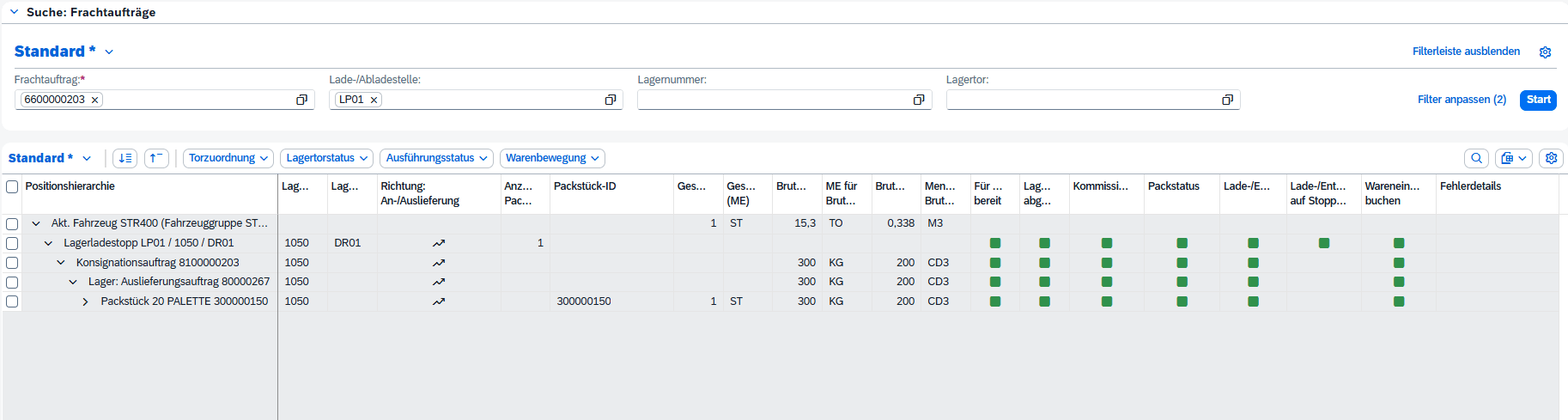
Advanced Shipping and Receiving combines SAP S/4HANA Cloud WM and TM in one joint process for transportation execution and warehousing. Its core is the mapping of the freight order both in EWM and TM. Status steps such as the arrival of the truck, the start or completion of loading as well as goods issues are entered in the system and synchronized with the freight order.
The use of SAP TM and SAP EWM in an S/4HANA instance enables companies to change freight documents at short notice even if the truck has already docked onto the loading ramp. In contrast to the previous use of complex transportation units, the differences lie particularly in more standardized document management and the closer integration of transportation planning, warehouse and delivery. This creates a consistent document flow between yard, warehouse and transportation planning. For companies, this means that ASR lays an important foundation for consistent supply chain management.
Cost calculation & settlement
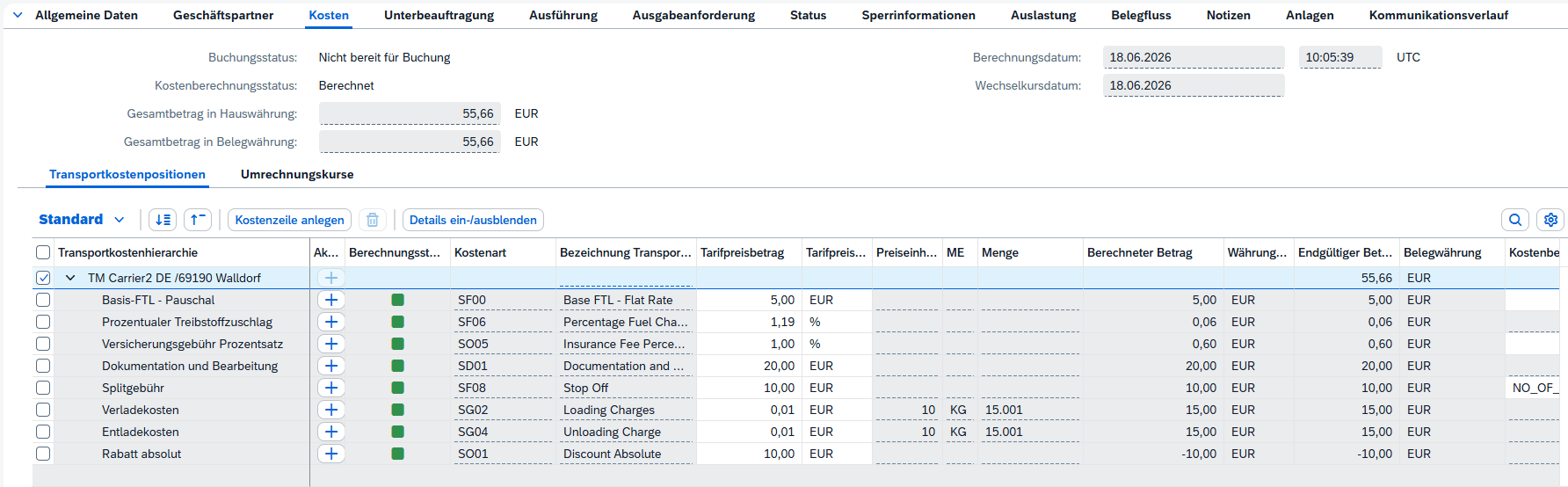
Shipment costs are calculated fully automatically on the basis of defined tariffs, scales and freight forwarder agreements. After transportation execution, freight settlement documents will seamlessly be created, which are directly transferred to financial accounting for invoice verification.
Where are the functional limits compared to classical SAP TM (Private Cloud / On-Premise)?
The public cloud variant is based on the same high-performance and advanced TM engine as the on-premise world. However, it follows a future-oriented way for system operation: the motto here is the continuous “fit-to-standard” principle.
SAP relies on a “clean core” to ensure companies automatic updates without interruptions in the SaaS model. This means: Instead of time-consuming individual code modifications in the system core, customers access perfectly harmonized best practice processes.
Whereas in the full TM Advanced solution (Private Cloud / On-Premise) specialized and computationally intensive optimization engines are directly integrated for automatic route planning, stop sequences and loading space optimizations, the Public Cloud solution focuses on lean and standardized processes. Manual and rule-based planning is intuitively made directly in the system. For complex large scenarios or fully automated optimizations, the Public Cloud solution offers standardized interfaces (API) that can be used to seamlessly integrate external optimization instances and specialized third-party systems.
The multilevel tendering of freight orders to a large pool of transportation service providers is intentionally designed clearly and practically in the Public Cloud solution. Instead of having to maintain hundreds of individual Customizing options, companies rely on predefined communication and tendering processes that are ready for use immediately. This reduces the administrative efforts in daily business to a minimum. The Basic Shipping variant in SAP S/4HANA TM enables the manual selection of transportation service providers whereas the Advanced Shipping version offers an automated carrier selection.
Whereas a strict license limit between the free “Basic Shipping” and the enhanced “Advanced Shipping” (licensed on a transportation cost basis) version must be considered in the on-premise and private cloud environment, the public cloud environment is much easier. The functional scope is controlled flexibly and transparently through the activation of standardized process modules (“scope items”).
How is the solution integrated compared to SAP TM Advanced, LE-TRA and SAP Logistics Management?
Today, the SAP product landscape in transport logistics is clearly structured according to process complexity and operating model:
The all-in-one system
The classical and full TM Advanced (Private Cloud / On-Premise) solution is used whenever companies require a fully automated transportation optimization via algorithms (optimizer), complex route determination via intermediate hubs or far-reaching contract logistics for logistics service providers (LSP). For these complex requirements, the variant provides the necessary flexibility through a far-reaching back end Customizing and extended options for tailor-made process adjustments. Here, advanced extension standards in the sense of the clean core approach are used so that the SAP standard code does not have to be modified directly.
The integrated standard version
This means the lean embedded Public Cloud TM for standardized transport processes in SAP S/4HANA Cloud Public Edition. By default, the solution provides advanced structures and works with freight orders instead of with the old shipment documents. It is particularly suitable for shippers whose users plan their transports manually or in a rule-based way and who are looking for a seamless Extended Warehouse Management integration via Advanced Shipping and Receiving.
The discontinued model: SAP LE-TRA (Logistics Execution Transportation)
The classical transport module from the old SAP ECC world is a discontinued model. Functionally, it is no longer further developed by SAP and the standard maintenance will expire in 2030, under certain conditions in 2033.
In S/4HANA Public Cloud, the old LE-TRA logic is no longer available at all. Companies still working with this module therefore use the transition into the cloud for the direct and future-proof changeover to advanced TM document structures.
The cloud-native SaaS logistics solution: SAP Logistics Management (SAP LGM)
For smaller regional locations, SAP has created a new alternative on SAP Business Technology Platform (SAP BTP). The special feature of SAP LGM is the direct and lean combination of warehouse and transport processes (EWM and TM) on one single SaaS platform. The solution seamlessly combines lean transportation management with simple warehousing. It is therefore ideal for locations with small complexity that require an integrated supply chain but no deep and highly complex warehouse or transportation management structures.
Are there mobile apps, Fiori user interfaces and AI support for digital logistics?
A fundamental cornerstone of Public Cloud TM is the systematic orientation towards advanced user experience through SAP Fiori. Cryptic transaction codes belong to the past. MRP controllers control all processes using intuitive, graphical and responsive Fiori applications optimized for the control station at the desktop. For the operational execution on the road or on the plant site, the public cloud standard solution does not provide separate apps. This, for instance, concerns the direct integration of truck drivers or yard functions via mobile terminals. If required, such scenarios are integrated via standardized interfaces to specialized extensions or SAP Business Network.
These thought-out user interfaces ensure a noticeable process optimization in the daily routine of logistics planners. An excellent practical example of this is the “Manage freight orders” app which clearly displays transportation deadlines, status values and further information at header level and, consequently, massively reduces the internal processing time. The gate management for gate-in and gate-out is also controlled visually and intuitively in the system through the integrated ASR component. As a consequence, the comparison between yard and transportation planning works seamlessly.
Moreover, the future of transport logistics is entirely shaped by dialogue through the deep integration of the SAP “Joule” AI assistant. MRP controllers can easily make status queries on delayed deliveries or search requests concerning shipment costs in natural language. Joule actively thinks ahead and proposes the next logical and optimal action via “one-click” button, such as the immediate assignment of an urgent express order to an alternative freight forwarder, which drastically reduces the response time in case of supply chain malfunctions.
Who is the solution suitable for?
The solution is ideal for different industries, be it manufacturing industry, wholesale or distribution: SAP Transport Management Public Cloud supports standardized transport processes across industries and provides a scalable basis for digital transport logistics.
Companies focusing on standardized processes (shippers)
Companies that wish to systematically organize their entire transport logistics (inbound & outbound) without cost-intensive individual developments on the basis of global best practices (fit-to-standard).
Manual and rule-based MRP
Transport departments working with regular routines, predefined freight forwarding contracts or a visual planning in the transportation cockpit and not requiring highly complex and automated computing algorithms (optimizers).
Companies on the road to the cloud
Organizations wishing to migrate their core ERP into SAP Public Cloud and modernize their transport processes. SAP TM Public Cloud provides them with a future-proof solution that is seamlessly integrated into the Cloud ERP landscape and that supports the implementation of an overall strategy.
How can the transition from SAP LE-TRA to SAP TM in SAP S/4HANA Cloud be achieved?
The transition is no mere technical upgrade. Companies do not just adopt the old LE-TRA logic, but design their transport processes on the basis of the Public Cloud standard solution. Therefore, the central question is which previous processes are still required, which ones can be simplified and which ones will be mapped by structures such as freight units and freight orders in the future.
It is first checked whether the existing transport processes from LE-TRA fit the functional scope of Public Cloud TM. The central questions are: What transport types are available?
How are shipment costs calculated today? Which freight forwarders, routes, zones and conditions are used? And what special logics can be replaced by SAP Best Practices in the future?
Many LE-TRA systems have grown over the years. Therefore, transportation chains, shipment cost tariffs, freight forwarder data, routes and transportation zones should be checked and cleansed technically prior to the migration. The migration offers the opportunity to remove obsolete structures and align transport processes more clearly with the standard version.
The relevant master and transaction data is prepared for the new SAP TM logic. According to the activated scope and available migration objects, the SAP Migration Cockpit can support the data transfer. What is important: not every old LE-TRA setting is adopted entirely. In the target system, many processes are rebuilt using standardized processes, Fiori apps and the corresponding documents.
Next, the new transport processes are tested with adjacent areas such as sales and distribution, purchasing, warehouse management and finance. End-to-end scenarios are of special importance: from sales order or purchase order and transportation planning to shipment cost processing.
As the way of working changes for MRP teams, users should get familiar with the new Fiori user interfaces and the transportation cockpit at an early stage. The productive change takes place via a planned system changeover where open processes, master data and operating procedures migrate into the new system in a controlled way.
Companies using SAP LE-TRA should develop a roadmap for the transition to SAP S/4HANA TM at an early stage in order to avoid unpleasant surprises.
Conclusion
TM in SAP S/4HANA Cloud, Public Edition, shows how transport processes can be mapped in SAP standard in an advanced and integrated way. The solution combines central SAP TM functions with the adjacent ERP processes and, consequently, creates a consistent basis for planning, execution, monitoring and shipment cost processing.
Public Cloud TM offers clear added value particularly for users who wish to standardize their transport logistics and integrate it more deeply into their Cloud ERP. Transport requirements, freight orders, status information and costs can centrally be controlled in the system through the integration with areas such as sales and distribution, purchasing, warehouse management and finance. In this way, interfaces and manual coordination can be reduced considerably.
At the same time, it is still important that the solution follows the fit-to-standard principle of the Public Cloud solution. Those who require highly complex and automated optimization scenarios or very individual transport logics should check whether SAP TM fits better in the Private Cloud or On-Premise variant. However, for standardized transport processes in Cloud ERP, the Cloud Public Edition solution offers a future-proof, low-maintenance and consistently developed basis for advanced transport logistics.