SAP Warehouse Management (SAP WM) in SAP S/4HANA Cloud, Public Edition
Warehouse Management in SAP S/4HANA Cloud, Public Edition – also called Public Cloud Warehouse Management – is a cloud-based lean warehouse management solution. Technically, it is based on the high-performance SAP EWM solution. However, it offers a focused scope of functions. The solution has been optimized for companies that wish to design their warehouse processes in an agile and cloud-based way according to SAP Best Practices. SAP S/4HANA Warehouse Management supports basic warehouse processes, such as putaway, stock removal, stock transfer and physical inventory in real time and creates transparency on warehouse stocks and material movements. As a multi-tenant SaaS solution, it offers a standardized flow logic with advanced SAP Fiori front end.

Productmanager at FIS
What is Warehouse Management in SAP S/4HANA Cloud, Public Edition?
Warehouse Management in SAP S/4HANA Cloud Public Edition is the integrated warehouse management for advanced Cloud ERP processes. It is based on SAP EWM. However, it was standardized for the Public Cloud solution and tailored to a clearly defined and low-maintenance scope of functions.
A view under the hood is worth the while for a proper product understanding: Technically, it is not the classical SAP WM solution but a warehouse management function embedded in the ERP core and based on Extended Warehouse Management. Here, SAP uses proven EWM structures and advanced process logic. However, they are provided in a standardized public cloud characteristic. Complex special functions and deep Customizing intentionally recede into the background.
In this way, companies can control their goods movements, storage bins and stocks in a transparent and integrated way and almost in real time – without separate infrastructure, high operating expenses or permanent intensive system maintenance. This approach is particularly suitable for companies that wish to modernize their warehouse processes by relying on standardization, fast usability and clean cloud operation.
What advantages and benefits are provided by warehouse management in the S/4HANA Public Cloud variant?
The modernization of warehouse processes and their transfer to SAP Public Cloud provides companies with clear strategic and operational competitive advantages:
Thanks to SAP Best Practices being immediately ready for use, months of risky development cycles and inflexible blueprint phases will become a thing of the past. The system is preconfigured according to proven industrial standards and can be made ready for operation in no time.
No own server or hosting costs. The solution grows flexibly with new locations, additional halls or increasing shipment volumes and, at the same time, reduces efforts for operation, maintenance and technical support.
The transfer to the public cloud offers the opportunity to replace historically developed and inefficient isolated solutions and to redesign intralogistics according to worldwide best practice methods.
New functionalities or technological further developments such as artificial intelligence (AI) for the creation of warehouse tasks or queries of specific outbound delivery orders based on different criteria such as status, product or warehouse process type are imported automatically via a regular cloud release. In this way, companies will continuously benefit from innovations without having to plan own complex upgrade projects.
Since warehouse management is a native S/4HANA core, purchasing, sales and distribution, production and logistics work with the same data basis. Stock postings are visible in all modules without time lag. This improves the transparency of stocks and increases the availability of current warehouse information.
What is the scope of services and which core processes are mapped?
In spite of the standardized approach, Public Cloud WM covers central EWM functions for advanced warehouse processes from putaway and picking to inventory management.
Goods receipt (inbound logistics)
The process already starts with the notification prior to the physical arrival of the goods. After arrival, the system supports transport registration, unloading and the execution of quality inspections. In addition, the software solution controls complex criteria from batch handling at material level and serial number handling to distance-optimized putaway. Here, the system relies on intelligent bin search strategies, such as fixed bin location systems, free space search or bulk storage. Inbound deliveries are processed centrally via the “Change inbound delivery” app.
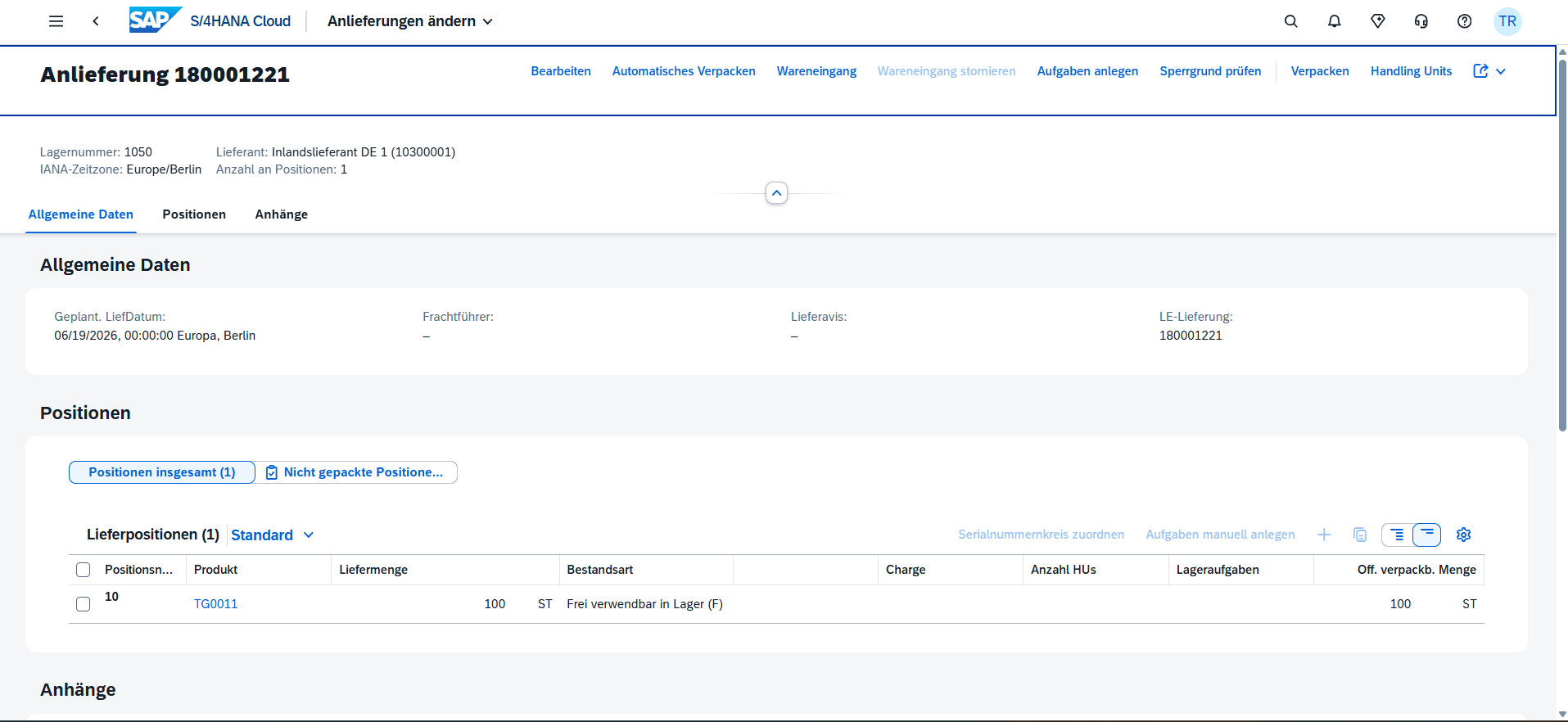
Goods issue (outbound logistics)
In the context of order fulfillment, the solution ensures efficient picking. Warehouse tasks are bundled in such a way that warehouse employees are guided through the aisles on optimized routes. Next, the articles are consolidated into handling units at specialized packing locations, packed, labeled and staged for being loaded onto transport vehicles. Freight and delivery documents are created without gaps and fully automatically.
Internal warehouse processes & inventory management
In addition to classical putaways and stock removals, the system organizes smooth internal processes. This includes ad hoc stock transfers for bin optimization, automatic replenishment control for connected production areas as well as scrap management. Physical inventory is completely digitized as well, i.e. optionally as continuous inventory or periodic physical inventory.
Where are the functional limits compared to classical SAP EWM (Private Cloud / On-Premise solution)?
Although Public Cloud Warehouse Management is based on the EWM engine and fully covers the core processes mentioned above, it differs drastically from big classical SAP EWM of the private cloud or on-premise world from a functional and administrative aspect.
This is due to the “fit-to-standard” principle of the public cloud solutions: To ensure automatic and uninterruptible updates in the SaaS model, SAP blocks access to extended Customizing and modifications in the system. This leads to specific differences in practice:
Public Cloud WM, however, intentionally avoids these deep configuration options. Here, the process strictly complies with the specified SAP standard version and cannot be changed individually in its internal control logic. It provides the legally required physical inventory procedures, such as the classical periodic physical inventory or cycle counting, as firmly defined standard workflows.
Through its integrated Material Flow System (MFS), the classical EWM solution has direct access to complex and fully automated high rack storage areas, conveyor belts or picking robots via the SPS interfaces. The public cloud does not include direct hardware control without third-party provider middleware. Public Cloud WM, however, has been optimized for manual and forklift-guided warehouses.
This is the greatest difference in practice. In classical EWM, there is a deep programming in the system in case of special wishes. This avoids automatic updates in the public cloud. Therefore, SAP strictly distinguishes between the protected system core and individual adjustments. Here, adjustments strictly comply with the SAP Cloud Extensibility model:
In the private cloud, SAP delivers embedded EWM in a free basic version covering standard warehouse processes and complex physical inventory forms. An additional license is only required for high-end functions such as MFS or labor management for employee performance. In the subscription of the ERP system, the public cloud includes the Cloud Warehouse Management solution as a standardized and high-performance permanent scope without additional infrastructure expense.
How is the solution integrated compared to SAP EWM, SAP Stock Room Management and SAP Logistics Management?
Today, the SAP product landscape in logistics is clearly structured according to process complexity and operating model. As Public Cloud Warehouse Management is based on the SAP EWM code, its distinction can be displayed very transparently today:
SAP Extended Warehouse Management (Private Cloud / On-Premise solution)
The classical independent SAP EWM solution is used if companies run highly complex logistics centers with individualization, own SPS interfaces or fully automated high rack storage areas (material flow control / MFS). Here, the code allows deep modifications.
Public Cloud Warehouse Management
This is the lightweight version of Embedded EWM as described above. It provides the lean and high-performance EWM standard processes (such as wave management in warehousing or handling unit management) directly out of the box. It is the perfect choice for medium and demanding warehouse requests within the context of a strict fit-to-standard strategy.
Technically, this component is based on classical SAP WM (from SAP ECC). On-premise customers use it as a migration bridge. However, it is no longer extended functionally by SAP. As Stock Room Management is not included in the public cloud, the way towards the advanced SAP cloud world always leads via EWM, CWM or LGM in the long term.
For smaller regional locations, pure satellite warehouses or subsidiaries, SAP has created a new alternative on SAP BTP. SAP LGM combines easy warehousing with basic transport management (dispatching) in one single lightweight SaaS platform. It is ideal for locations with small complexity that require no deep EWM process logic.
Summary: Classical SAP EWM remains the first choice for highly complex automated warehouses. Public Cloud Warehouse Management is the perfect and high-performance standard version based on EWM for medium-sized and large warehouses within Cloud ERP. The new SAP LGM has positioned itself as a lightweight all-in-one solution for smaller decentralized hubs without complex processes. The decision between SAP Stock Room Management and SAP Extended Warehouse Management (EWM) should be based on the complexity of warehouse processes with StRM being suitable for less complex requirements.
Are there mobile apps, Fiori user interfaces and AI support for digital logistics?
A fundamental cornerstone of Public Cloud Warehouse Management is the systematic orientation towards user experience through SAP Fiori. The times of cryptical transaction codes and confusing wasteland texts are definitely over now. The logistics employees control all processes using advanced, graphical and responsive Fiori apps that do not depend on platforms and that run natively on mobile data-entry devices (MDE), robust industry scanners, tablets or even on commercial smartphones.
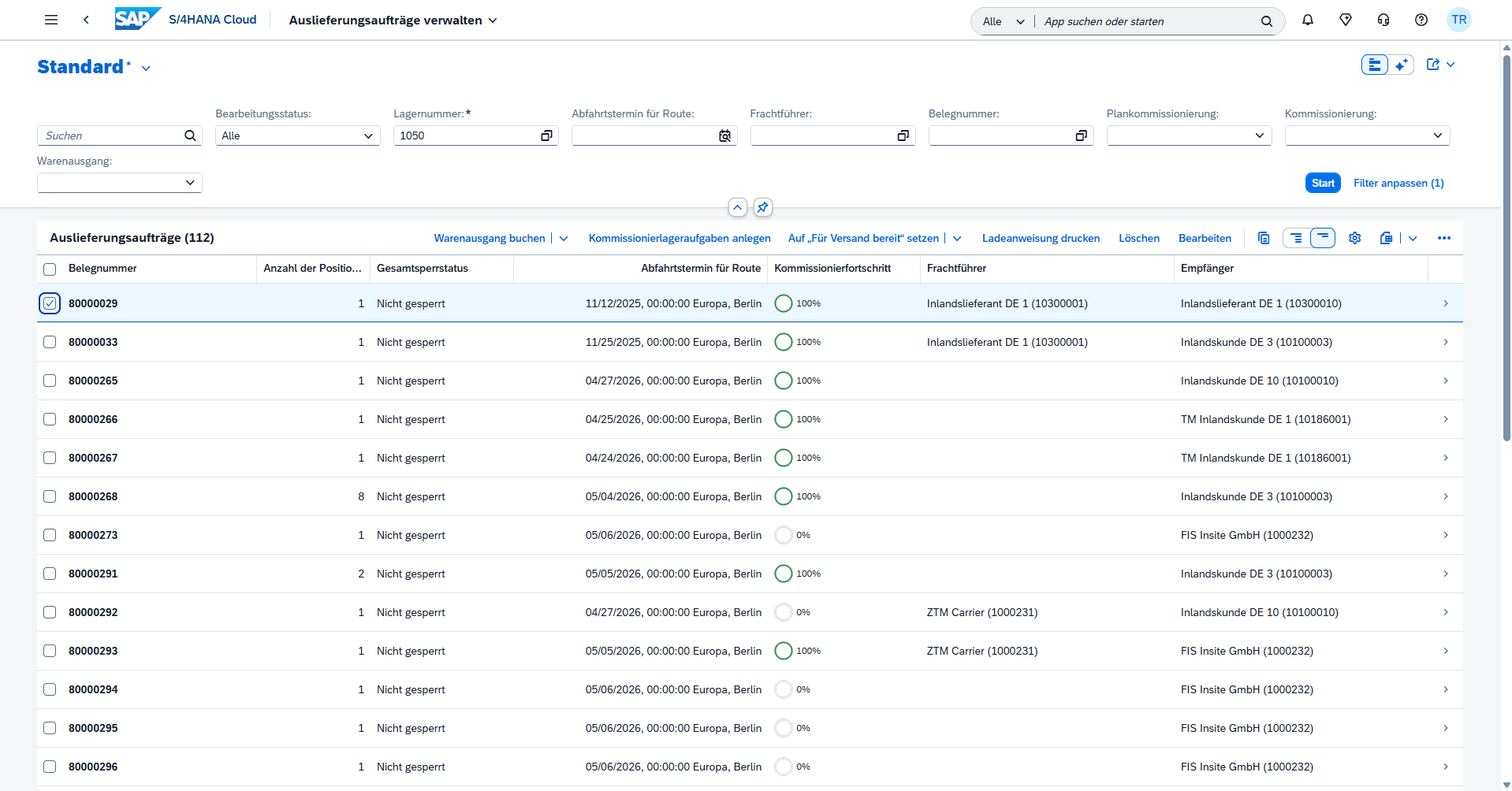
These thought-out user interfaces ensure noticeable process optimization directly on the screen as important operational key figures are clearly displayed at header level in order to effectively minimize clicks and search times. An excellent practical example is the strategic “Manage outbound delivery orders” Fiori app. In this application, essential information such as staging areas or shipping conditions is bundled directly in the header area. In this way, warehouse workers and planners view all decisive details at a glance and can trigger follow-up activities such as picking directly and without complicated application changes.
Moreover, the future of logistics is entirely shaped by dialogue through the deep integration of the SAP “Joule” AI assistant, which means that generative artificial intelligence will find its way directly into the warehouses. The employees can easily make complex status queries or search requests concerning warehouse tasks in natural language.
Who is the solution suitable for?
Public Cloud Warehouse Management is no panacea for each bulk parts stock but a targeted response to advanced standardized logistics requirements.
The solution is ideal for:
How can the transition from legacy systems such as SAP WM and SAP Stock Room Management be achieved?
The transition from SAP LE-WM or SAP Stock Room Management to Warehouse Management in SAP S/4HANA Cloud Public Edition is no technical upgrade but a data-driven migration project (greenfield approach).
The central problem is often not the pure system migration but grown process variants, inconsistent master data and special logics that have developed over the years. As advanced EWM structures fundamentally differ from the old tables, the changeover is executed in a standardized way according to the SAP Activate model:
1. Process matching & cleansing
In workshops, the old procedures are compared to the finished SAP Best Practices. Historical data corpses in the material or storage bin master record will be systematically cleansed in advance.
2. Data transformation
Automated tools (such as SAP Migration Cockpit) are used to translate the cleansed master data, bin coordinates and current physical warehouse stocks into the new EWM logic.
3. User guidance & go-live
The old and purely text-based radio scanner surfaces (ITSmobile) are replaced by advanced and intuitive SAP Fiori apps. Advantage: The user interfaces on the hand-held scanners only show the users absolutely necessary information, use visual helps (such as green/red color signals for right/wrong scan) and can be used like a smartphone. This minimizes pick errors immediately and enormously reduces the time for the initial job training of new employees. The actual change mostly takes place over a weekend (key date change) when the warehouse stocks are finally transferred.
4. Go-Live
The actual transition usually takes place on a weekend (cutoff date transition), when inventory is finally transferred.
Conclusion
Warehouse Management in SAP S/4HANA Cloud Public Edition provides companies with standardized warehouse management based on EWM that is directly integrated into Cloud ERP by SAP. Above all, the solution is ideal for companies that wish to modernize and standardize their warehouse processes and organize them more strongly on the basis of SAP Best Practices.
The greatest advantage is the combination of integrated processes, real-time transparency and reduced operating expenses. Companies can centrally control material flows, stocks and storage bins without having to run their own infrastructure or maintain extended Customizing. At the same time, the public cloud sets clear limits: Highly complex special processes, direct material flow control or strongly individualized warehouse logics are rather a field of application for SAP Extended Warehouse Management in the Private Cloud or On-Premise variant.
This means that Warehouse Management in SAP S/4HANA Cloud Public Edition is of special interest for companies with manual or forklift-guided warehouse processes close to the standard version. Those who wish to make their intralogistics future-proof and, at the same time, reduce the effort for operation, maintenance and further development, will get a lean, integrated and cloud-enabled basis for advanced warehouse processes.