SAP Customer Experience (SAP CX)
SAP Customer Experience (SAP CX) refers to a comprehensive suite of cloud solutions for marketing, sales and distribution, e-commerce and service. The following specialist article explains the components of SAP CX, the functions and benefits they provide and how SAP CX is integrated into other SAP systems, particularly SAP S/4HANA.

Product Manager at FIS
What is SAP Customer Experience?
SAP Customer Experience (in short: SAP CX) is a cloud-based CX suite that covers all customer-related processes of a company as an end-to-end solution:
The goal is to create a seamless, personalized and high-quality customer experience along the entire customer journey, identify opportunities for companies and, in doing so, ensure long-term success.
With SAP CX, SAP offers a solution for all companies that want to place greater focus on their customers, differentiate themselves from the competition, address customers individually, communicate consistently across all channels and support customers throughout the entire customer lifecycle.
SAP CX was formerly known as SAP C/4HANA. Older product names, such as SAP Hybris (Marketing & Commerce) or SAP Cloud for Customer (Sales & Service) have also been replaced and bundled under the new name SAP CX.
What solutions does SAP CX Suite include?
SAP Customer Experience Suite consists of several specialized cloud solutions that together cover all aspects of customer management. They develop their full potential when used together and with the rest of the SAP ecosystem, such as S/4HANA.
These solutions give companies a comprehensive and consistent view of their customers across all departments, teams and touchpoints.
SAP Sales Cloud
SAP Sales Cloud is an advanced CRM system. It supports companies in centrally managing all customer interactions and making work processes more efficient thanks to AI-based functions.
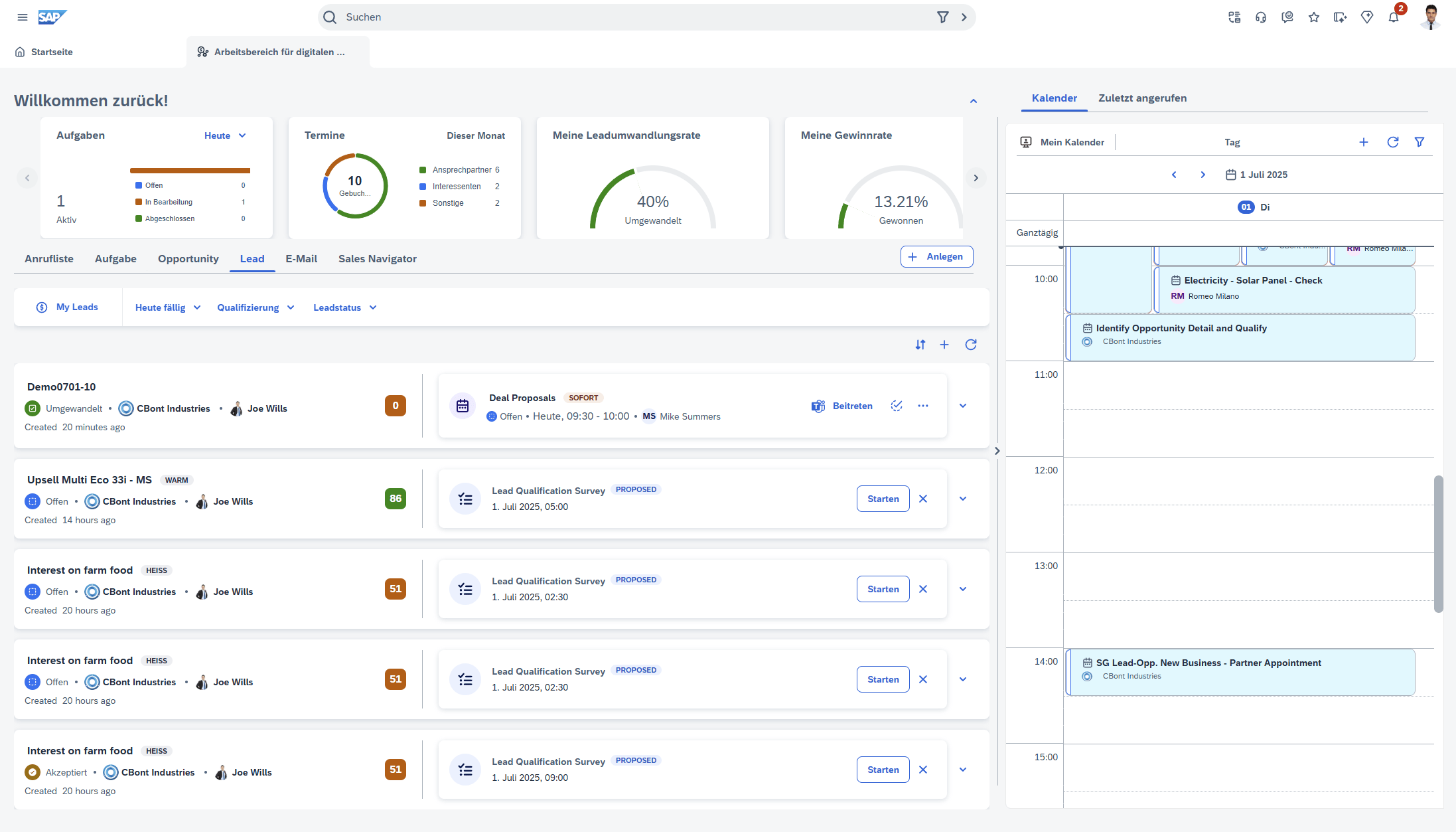
This allows sales staff to benefit from intelligent task prioritization and a higher probability of closing deals. The cross-divisional provision of information greatly facilitates cooperation between departments such as inside sales and field service. The sales management gains a complete overview across all teams and cannot only manage in a targeted manner, but also dive into individual opportunities as needed to provide personalized support. Due to the integration into the ERP system, up-to-date data such as individual prices and availabilities are directly available in the sales process. In addition, the connection to the service cloud ensures that the sales department is informed about open service cases and can conduct customer conversations in a context-sensitive manner.
SAP Service Cloud
Efficient case and ticket management with SAP Service Cloud enables a fast and structured processing of customer requests across all channels and bundled in a central system.
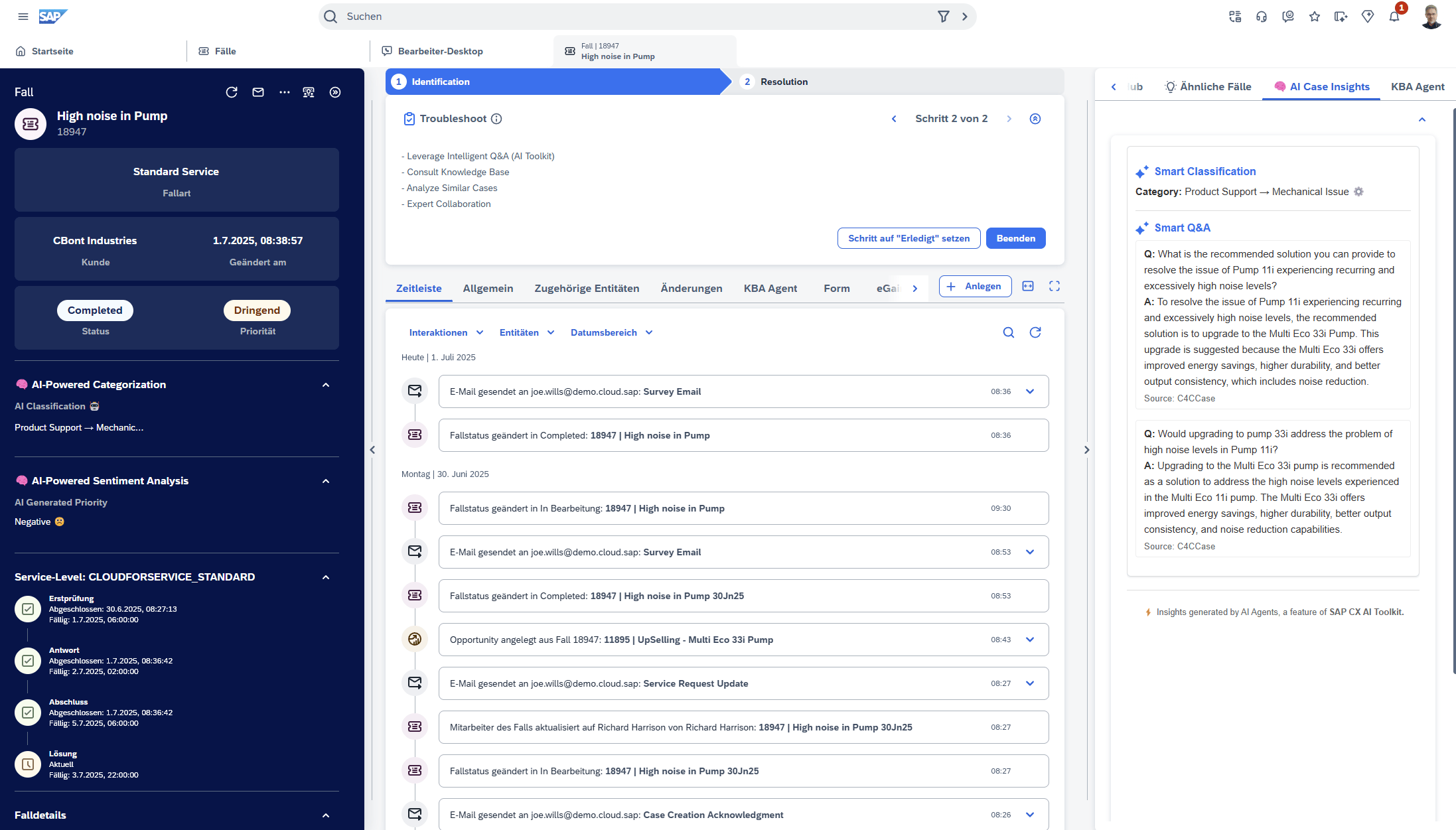
No matter if e-mail, telephone or Web form are concerned: All requests are consolidated in one tool, where they can be tracked and processed transparently. An integrated knowledge base helps service staff respond quickly to recurring questions. AI is used to suggest similar tickets that have already been solved in order to efficiently use proven approaches. Due to the integration into the ERP system, service orders can directly be generated from service requests as needed including access to customer-specific data. The connection to the sales cloud creates additional transparency by making coordination with the sales department visible and enabling potential cross-selling opportunities to be identified and passed on at an early stage.
SAP Field Service Management
The modern field service management with SAP Field Service Management comprises the entire process from resource planning and solution of the service case up to settlement and documentation without gaps.
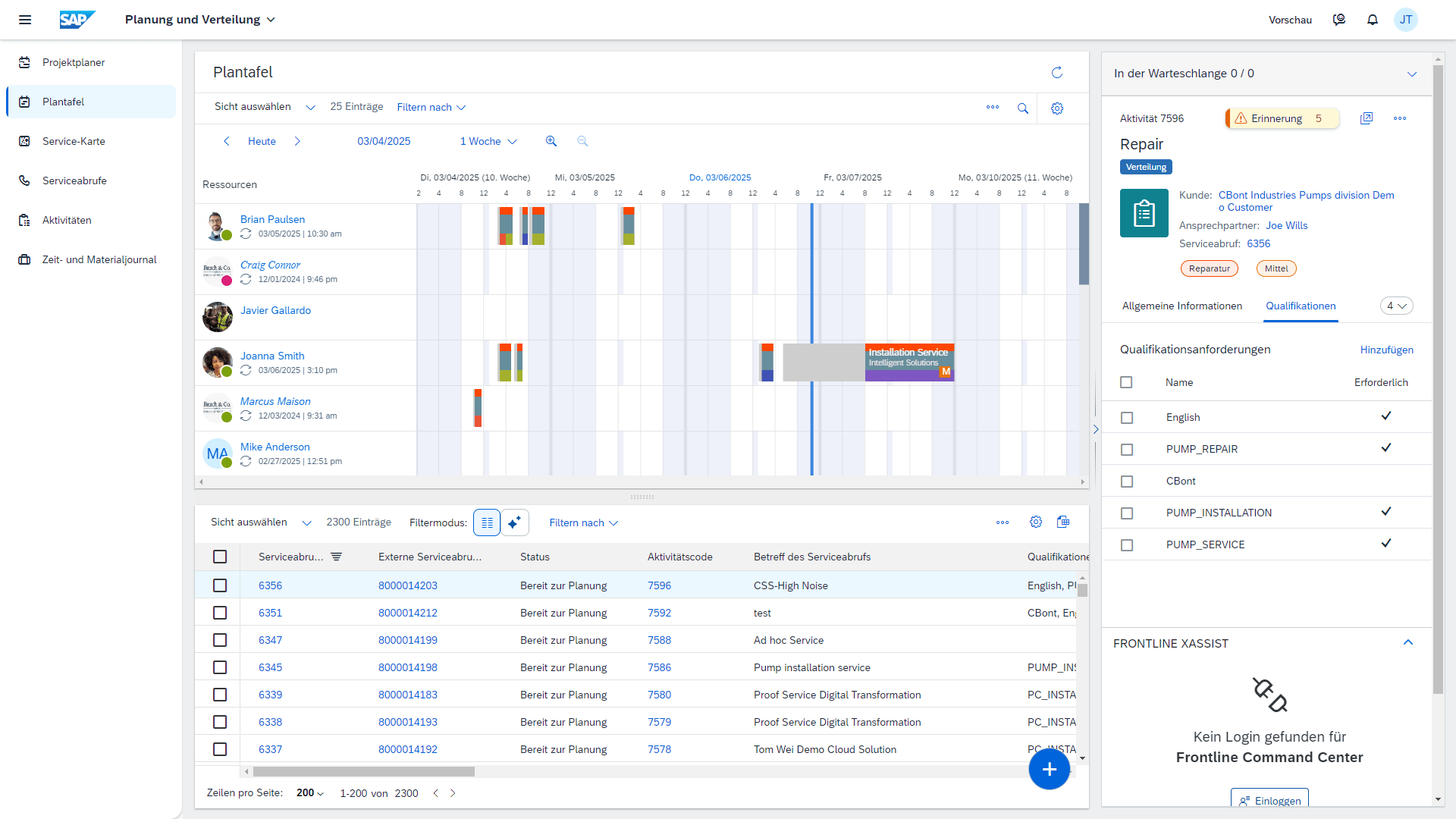
With the help of AI-supported planning, technicians are deployed in a targeted manner based on their qualifications, availabilities and the materials required. This results in efficient daily planning, with every technician having all the relevant information at their fingertips in advance. On site, the mobile solution enables the fast recording of working hours and uncomplicated material consumption for a speedy and transparent completion of the service order. An integrated, AI-supported knowledge base provides continuous troubleshooting support and helps increase the first-time fix rate. In addition, your own service capacity can be flexibly expanded through crowd service. Seamless integration into the ERP system ensures the automatic transfer of service orders and enables service vehicles to be restocked on demand based on actual material usage.
SAP Emarsys
SAP Emarsys is a powerful omnichannel marketing platform specifically developed for marketers to create personalized customer experiences across all channels.
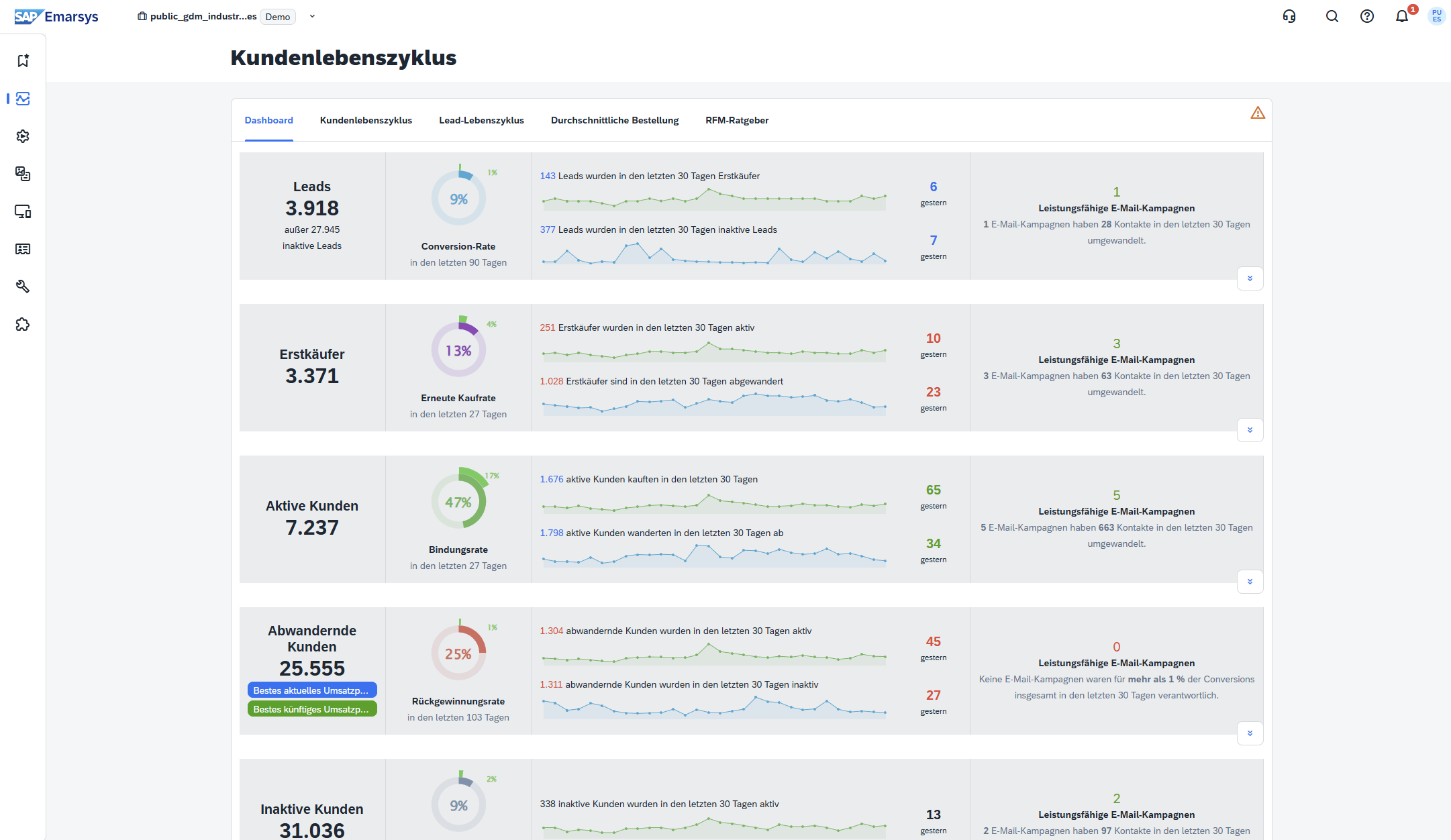
By using AI-supported automation, Emarsys enables the orchestration of campaigns via e-mail, Web, SMS, mobile apps, digital ads and more. The platform uses comprehensive customer data to provide relevant contents in real time, while increasing customer retention and customer lifetime value. With predefined tactics and integrated analysis functions, companies can efficiently implement their marketing strategies and measure the success of their campaigns. Emarsys can be integrated seamlessly into other SAP solutions and thereby provides a holistic view of the customer across all touchpoints. SAP Emarsys replaces SAP Marketing Cloud as the strategic solution of the CX Suite in the area of marketing automation. As of 2025, both solutions are still available. However, the focus of further development is on SAP Emarsys.
SAP Commerce Cloud
SAP Commerce Cloud is an e-commerce platform supporting companies to create consistent and personalized shopping experiences across all channels. It is suitable for B2B, B2C and B2B2C business models and enables the central management of complex product catalogs as well as a flexible adjustment to individual business requirements.
Thanks to integrated functions for product information, order management and AI-supported personalization, customer needs can be addressed in a targeted manner. The cloud-based architecture provides scalability and enables seamless integration with other SAP solutions such as SAP S/4HANA or SAP Emarsys. The advanced composable architecture also enables the integration of best-of-breed solutions as needed. This results in a consistent, data-based commerce experience along the entire customer journey.
SAP Customer Data Platform
The SAP Customer Data Platform (CDP) enables companies to centrally collect, standardize and manage customer data from a wide variety of sources in compliance with data protection.
The consolidated 360 degree view of each individual customer enables marketing, SD and service to create relevant and personalized experiences across all channels. The platform collects both transactional and behavioral data in real time, analyzes it using AI and thereby enables targeted segmentation and activation of target groups. Thanks to integrated consent and preference management, all measures remain GDPR-compliant. The connection to further SAP solutions, such as Commerce, Sales and Service Cloud, ensures that every department works with consistent and current customer data. This leads to individual, data-based customer journeys along all touchpoints.
How are SAP CX, SAP C/4HANA and SAP Hybris connected?
Today’s SAP Customer Experience Suite (SAP CX) is the result of a stepwise further development of former SAP solutions in the customer management area.
How is SAP Customer Experience integrated into SAP S/4HANA?
A central strength of SAP Customer Experience (SAP CX) is the seamless integration with the SAP ERP system, especially with SAP S/4HANA. All SAP CX solutions have been designed in such a way that they can directly be connected with SAP’s ERP world – both with SAP S/4HANA (on-premise, Private Cloud or Public Cloud) and with older system versions such as ERP ECC 6.0.
In doing so, consistent lead-to-cash processes are supported-from initial contact, marketing and sales and distribution to processing in the ERP system. This close interconnection enables consistent processes from initial contact in the Web shop to delivery and invoicing. Media changes and manual interfaces are omitted and data silos between front end and back end avoided.
Technical integration:
Benefits for existing SAP customers:
Companies that already use SAP ERP or S/4HANA can integrate SAP CX relatively easily without having to build a completely new system landscape. The result is a uniform platform with consistent data basis and harmonized processes in the front and back office.
What benefits are provided by SAP CX?
Using SAP Customer Experience offers companies a range of benefits for making customer relationships more effective and improving business:
SAP CX provides companies with numerous functional and strategic benefits:
Uniform customer data basis for marketing, sales and distribution and service, which can be called in real-time.
Individual offers and communication thanks to intelligent data analysis.
Data-based campaign planning, fewer manual tasks, faster conclusion of deals.
Automated processing, central information, shorter response times.
Consistent processes without duplicate data maintenance or system changes.
Modular cloud solution that grows with the company – without significant IT effort.
Smooth connection to existing SAP systems such as S/4HANA.
GDPR-conform data management; customers keep control of their data.
In summary, SAP CX helps companies not only meet customer expectations but exceed them – through personalized communication, faster response times and consistent interactions across all channels. Internally, companies benefit from more efficient processes, more transparent data and the ability to respond more quickly to market changes.
Conclusion
SAP Customer Experience (SAP CX) is a comprehensive suite that enables companies to put their customers at the center of their business and inspire them throughout the entire customer journey. The suite combines formerly separate CRM, marketing, e-commerce and service solutions on a modern platform and is seamlessly integrated into SAP S/4HANA. This creates consistent processes from initial customer contact to order processing without media changes or data silos. Companies benefit from more efficient processes, personalized customer contacts and higher customer satisfaction. At a time when customer expectations are constantly rising, SAP CX provides the tools to create a unique customer experience and differentiate yourself from the competition.