SAP Sales Cloud
This specialist article describes what is behind the CRM SAP Sales Cloud solution, how it works and the advantages it provides.

Product Manager at FIS
What is SAP Sales Cloud?
SAP Sales Cloud (formerly known as SAP Hybris Cloud for Sales or SAP Hybris Sales Cloud) is the advanced CRM system (Customer Relationship Management System) for sales and distribution within the SAP Cloud system.
With SAP Sales Cloud, your sales team will benefit from sales force automation, reliable planning and forecasts as well as an intuitive user interface. SAP Sales Cloud is one of the Cloud SAP solutions from the SAP Customer Experience Portfolio and supports sales managers in optimal customer relationship management, early identification of sales opportunities and sustainable increase of sales volumes.
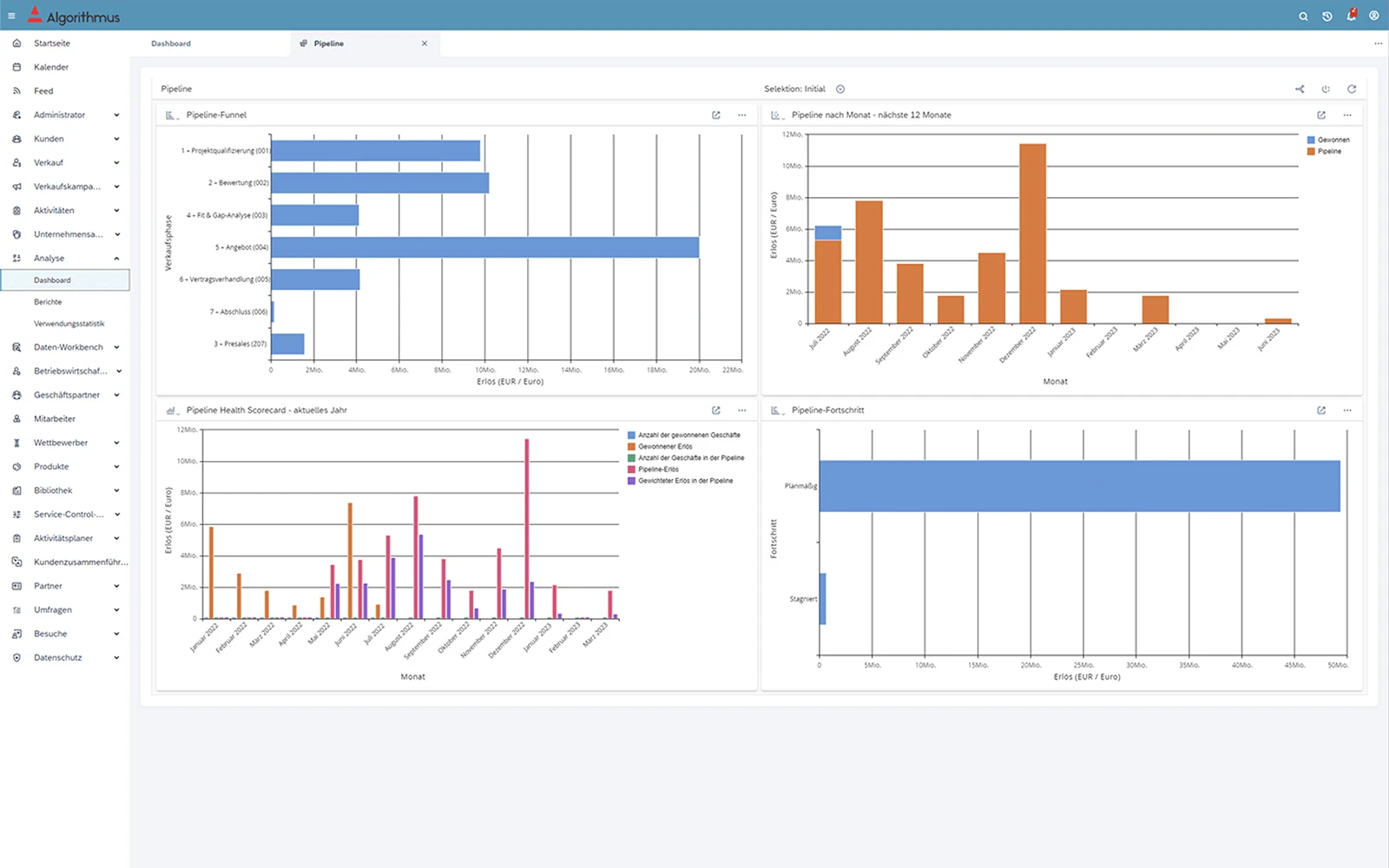
Predefined dashboards and clear reporting in the CRM software enable a detailed and data-based planning of your sales process. Territory management for the field sales force and call planning can be optimized in this way. Furthermore, you will always have an eye on information concerning your pipeline. Leads and opportunities are professionally managed and processed. In this way, you will not miss any sales opportunities any more.
SAP Sales Cloud is available in two different versions. Most functions of the new version, SAP Sales Cloud V2, are identical to those of the previous version. However, the new version is easier to extend and faster than the previous one. A further advantage of version 2 are the AI functionalities that provide support for sales activities through functions such as Guided Selling.
What are the previous versions of SAP Sales Cloud?
SAP CRM > SAP Hybris > SAP Sales Cloud > SAP Sales Cloud V2
The sales area including the documentation of sales activities was already part of the SAP product at an early stage. SAP CRM, the last onPremise variant of an SAP CRM system, will reach its end of life in 2027. Hybris Suite was the first cloud solution SAP took its first steps with in the area of Customer Experience solutions. Hybris Sales Cloud first became SAP Hybris Sales Cloud and finally SAP Sales Cloud. With its intelligent SAP Sales Cloud or SAP Sales Cloud V2, SAP now offers the first cloud-native CRM solution. It particularly scores with high performance, scalability and easy extensibility.
What are the functions of SAP Sales Cloud?
Contact and company overview
The system is based on the contact and company overview, which includes all basic information on companies and contact persons. It documents activities that are included both in contact and company information.
Opportunity-und Lead Management
SAP Sales Cloud offers a lead and opportunity management for the efficient management of sales opportunities. Here, all activities and information concerning a sales opportunity are maintained. Products relevant in the sales process can be entered as well.
Guided Selling
To make a sales process successful, SAP Sales Cloud offers system-aided analyses specifying the sales opportunities that are most likely to become a success. In addition, the CRM system assists the sales employee by giving activity proposals. What the system-aided way towards the successful conclusion of a customer agreement should look like depends on different factors such as sales phase, customer needs and company guidelines.
Analyses
SAP Sales Cloud provides diverse standardized evaluations through embedded Analytics Cloud. This evaluation can be used to analyze the current pipeline situation or the individual success of every employee. Controlling measures can be derived on the basis of this information in order to improve future sales processes.
Retail Execution
The “Retail Execution” add-on can be used to organize all activities for continuous analyses at the point of sales, i.e. the shelf in the store. This includes regular sales calls to the relevant stores, analyses of the positioning on the shelf and order management.
Dynamic call planning
To ensure continued customer support, the “Dynamic Call Planning” add-on can be used to create individual routes for the field sales representatives. For this purpose, the system uses different data as a basis for decision-making such as defined call intervals, sales volumes and sales potentials, current customer sentiment and available route times.
What are the benefits of SAP Sales Cloud?
How can sales and distribution be successfully automated?
Sales Force Automation
SAP Sales Cloud bundles all customer data in one system. It is available for sales managers on any terminal – online and offline. A CRM solution relieves the sales team of administrative tasks and makes more time available for customer support. The following CRM functions will provide assistance:
Sales Performance Management
Planning and evaluations in clear dashboards help increase efficiency in your sales team and reliably reach your objectives. SAP Sales Cloud provides you with analyses at the touch of a button so that sales managers can keep an eye on opportunities with a high probability of sales deals. The following measures will provide assistance:
What interfaces does SAP Sales Cloud provide?
SAP Sales Cloud is part of the SAP C/4HANA Suite. In this suite, marketing, sales and distribution, service and e-commerce solutions have been bundled. These systems are optimally integrated into each other. The great advantage of the SAP sales solution is its proximity to the SAP Marketing Cloud solution the Sales Cloud solution can be easily connected to. However, an ERP integration of SAP Sales Cloud is also provided by default and can be set up easily. The Customer Experience Portfolio by SAP is complemented by SAP Service Cloud and the SAP Field Service Management solution. Customer Data Cloud by SAP is another component of the CX Portfolio.
Who is SAP Sales Cloud appropriate for?
The Sales Cloud solution is addressed to companies of various industries that wish to use an advanced CRM system for their Sales and Distribution department. Irrespective of whether companies work with B2B or B2C, this CRM solution offers all functions needed for the automated management of customer information. Learn here how we at FIS implement SAP Sales Cloud projects.
How Does SAP Sales Cloud Support Wholesale Companies?
Working in the field service of a wholesale company has considerably changed in the last few years. The number of customers remains high, their willingness to change providers and their comparison behavior are increasing, while the time they want to spend on sales calls by wholesalers is decreasing. Therefore, appointments must be used efficiently and well planned so that a constant presence at the customer’s site is guaranteed despite the small number of on-site sales calls.
A well-coordinated and well-maintained CRM system can provide support in coping with all these challenges – from comprehensive sales planning to appointment preparation.
In the following, we would like to provide a few examples to give you an insight.
In order to provide each customer with appropriate and efficient support, a regular appointment can be scheduled using automated call planning. Factors such as company size, sales volume or other factors can be selected as the basis for customer segmentation. Integration into the ERP system allows current data to be viewed across all channels and divisions enabling efficient customer service.
When it comes to appointments, whether on site or on the phone, good preparation and good informational value are important in order to provide customers with the best possible support. Here, SAP Sales Cloud provides an optimal basis with its AI-generated summary as well as a view on all current processes and documents with the customer. In addition, the sales management has the option of placing current campaigns, such as sales promotions, with the appropriate target group. These campaigns are displayed to the sales employee during the appointment allowing them to address them at the customer’s site.
When sales opportunities arise with customers, they can be tracked consistently. The CRM system can support sales representatives during the process and help them to use their time efficiently by assessing the probability of success. Through its deep SAP ERP integration, all quotations can finally be created with the individual prices of the customer.
Thanks to the integration of our FIS/ObjectManager SAP BTP solution, field staff can also efficiently manage large projects. All appointments relating to an object can be viewed across different contact persons and companies for instance. By integrating both applications and the ERP system, sales staff are always informed about all agreements, quotations, purchase orders etc. and can always provide accurate information.
Don’t want to miss any more sales opportunities? Learn more about SAP Sales Cloud here.
Conclusion
SAP Sales Cloud is more than just a CRM solution: it is your strategic companion in everyday sales work. You create transparency, efficiency and real customer proximity by using a central data basis for office-based personnel and field sales force, an integrated SAP system landscape and AI-based sales support. Be it in the office, on the move or offline: the application adapts to your ways of working and helps you never miss any sales opportunities again. For all who want to shift away from Excel to smart sales activities in a flexible, integrated and future-proof way.