SAP Hybris
In this specialist article, you will learn everything about the history of e-commerce solution SAP Hybris. The individual components of the solution are presented and it is explained how they contribute to a positive customer experience.

Product Manager at FIS
What is SAP Hybris?
The Hybris GmbH company used to develop software solutions for the areas of e-commerce and marketing. Hybris GmbH was taken over by SAP in 2013 and the existing solutions were enhanced by applications for sales and service.
In this way, the platform provided enterprises with the option of creating cross-channel customer experiences and optimizing their processes. Originally, the best-known product used to be Hybris Commerce Cloud. Therefore, all proprietary products relating to the topics of “customer experience” and “e-commerce” obtained “SAP Hybris” as a name affix.
SAP Hybris does no longer exist as a brand name.
Since 2018, the name “SAP Hybris” has been given up and the individual solutions were first renamed under SAP C/4HANA in connection with the release and integration of SAP S/4HANA. Later, the applications were summarized as SAP Customer Experience (CX) Suite to increasingly focus on customer experiences.
The name change reflects that these applications are not only about e-commerce but about a complete management of customer experiences across marketing, sales, service and data management.
What is the history of (SAP) Hybris?
What modules does the SAP Hybris product family include?
SAP Hybris used to consist of various modules covering the different areas of Customer Relationship Management (CRM).
The product family includes:
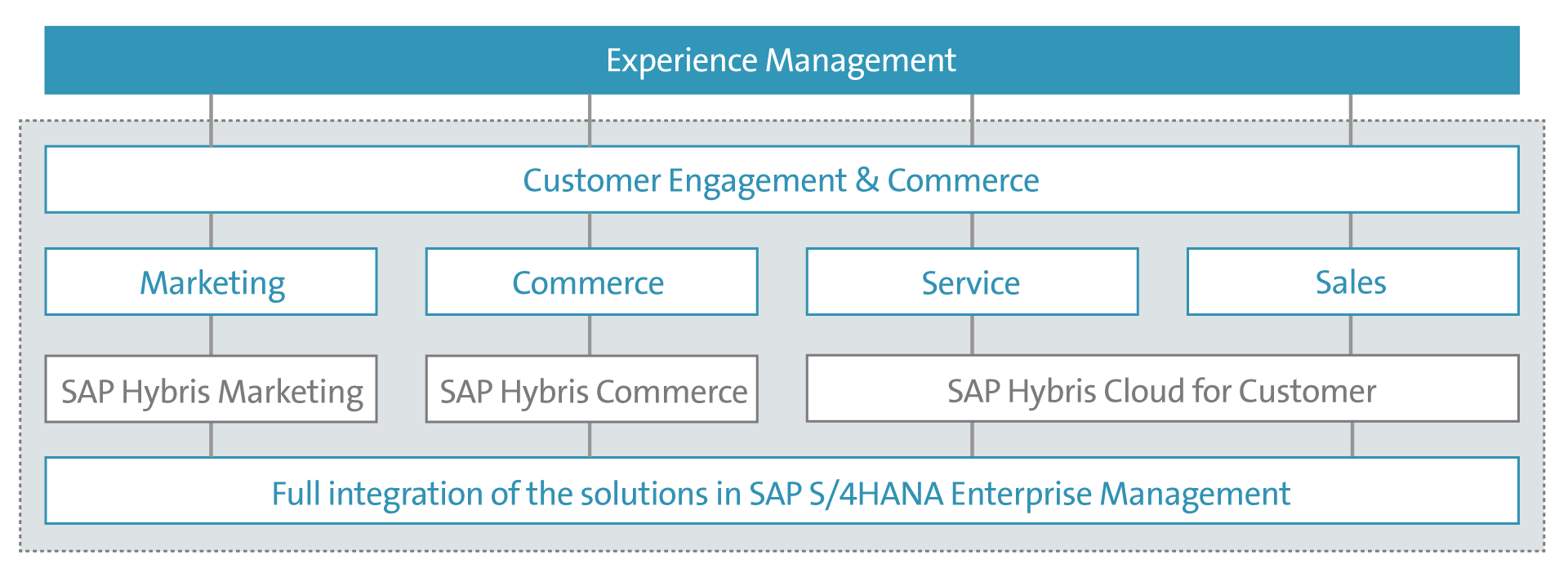
SAP Hybris Commerce (new name: SAP Commerce Cloud)
The original name giver of the suite for applications relating to the “customers” topic is a platform for B2B and B2C e-commerce. The e-commerce solution was characterized by comprehensive functions that – in contrast to most competitors – also included a Product Content Management (PCM).
Originally, the Hybris products used to be available on premise. With the later versions under the name “SAP Commerce Cloud”, the e-commerce platform was only available in the cloud, just like the other C/4HANA products.
Since 2024, an increased flexibility for enterprises has been pursued under the term Composable Commerce. In this way, SAP Commerce Cloud can easily be extended by best-of-breed applications to be able to cover the different requirements of B2B companies and enterprises focusing on end customers.
SAP Hybris Marketing (new name: SAP Marketing Cloud)
SAP Marketing Cloud was mostly used by enterprises to support the e-commerce platform. It enabled the adjustment of personalized contents in the Web shop to a customer or to a customer’s enterprise. In this way, a personalized e-commerce strategy can be implemented and the customer’s shopping experience improved.
In addition, SAP Marketing Cloud enables personalized marketing campaigns across different channels, which include e-mail, SMS and social media. Thereby, potential customers can be addressed and won at different touch points.
The personalization using information from SAP ERP and SAP Commerce Cloud was able to improve the customer experience for B2C as well as for B2B enterprises. For this purpose, the application offers different options of analyzing the customer behavior in the shop and across different channels.
In 2025, SAP Marketing Cloud is popular among B2B enterprises in particular as a supplement to SAP Commerce Cloud. With SAP Emarsys, SAP has another product for marketing automation in its portfolio for B2C enterprises. SAP Emarsys was designated by SAP as a strategic product for marketing automation and will replace SAP Marketing Cloud.
SAP Hybris Sales (new name: SAP Sales Cloud)
What is behind SAP Sales Cloud is the CRM system of former C/4HANA Suite. Here, customer data, plant data, interactions and sales opportunities are documented by the sales & marketing department. Due to their integration into the ERP-system, individual prices, sales promotions or the ERP system’s order management can be used.
Detailed analysis functions enable enterprises to analyze and improve their sales process. In this way, an efficient pipeline management can be pursued and processes streamlined by means of sales force automation. Therefore, enterprises are able to sustainably increase their sales volume.
In addition, it is possible to integrate SAP Sales Cloud into SAP Commerce Cloud. This enables sales & marketing departments to support customers purchasing in their online stores. In this way, the shopping experience can individually be improved.
With SAP Sales Cloud V2 or Intelligent Sales Cloud, SAP has launched a new version based on a new cloud-native technology on the market in 2024.
SAP Hybris Service (new name: SAP Service Cloud)
For mapping service processes and increasing customer retention, SAP Service Cloud provides a ticket system, which can be used to centrally process customer requests from different channels. In trade, it provides suppliers with the option of standing out among competitors and thereby be successful in B2B and B2C commerce.
For this purpose, a typical case management system is supplemented with data from the ERP system, the CRM system, the e-commerce platform and AI functionalities. In this way, service employees can be provided with a good data basis for answering service requests.
SAP Hybris Customer Data Management (new name: SAP Customer Data Cloud)
Here, SAP Customer Data Cloud supports users in keeping a uniform data basis consistent across all platform applications and continuously extending it. Particularly B2C enterprises having a high number of customers are supported in the step-wise gathering of information on their customers, which improves target-group-specific addressing. This tendency increasingly finds its way into B2B commerce, which is why this solution becomes more and more present even in this area.
The solution has particular importance in connection with the GDPR-compliant collection of personal data. For this purpose, consents and the like are managed in the application and the collected data can be deleted in compliance with GDPR. Thereby, additional information on customers and sales prospects can be collected without infringing their personal rights.
Conclusion
As a brand name, SAP Hybris is no longer active, but its functionalities and core technologies live on in the advanced cloud solutions of SAP Customer Experience (CX) Suite. Enterprises that used to work with SAP Hybris in the past now find equivalent applications in the new product names, such as SAP Commerce Cloud or SAP Marketing Cloud and can use them as a basis to establish a successful e-commerce platform.