SAP Marketing Cloud
This specialist article explains the core functions and advantages of SAP Marketing Cloud – from omnichannel marketing, personalized customer experiences and lead management to analytics and integration – and gives an outlook on current challenges and the further development of the solution with SAP Emarsys as its successor.

Product Manager at FIS
What is SAP Marketing Cloud?
SAP Marketing Cloud (formerly known as SAP Hybris Marketing Cloud) is part of the SAP Customer Experience Suite and a central marketing solution placing the customer at the center of its marketing activities. It is a cloud platform for marketing automation supporting companies in planning, rolling out and evaluating cross-channel marketing campaigns.
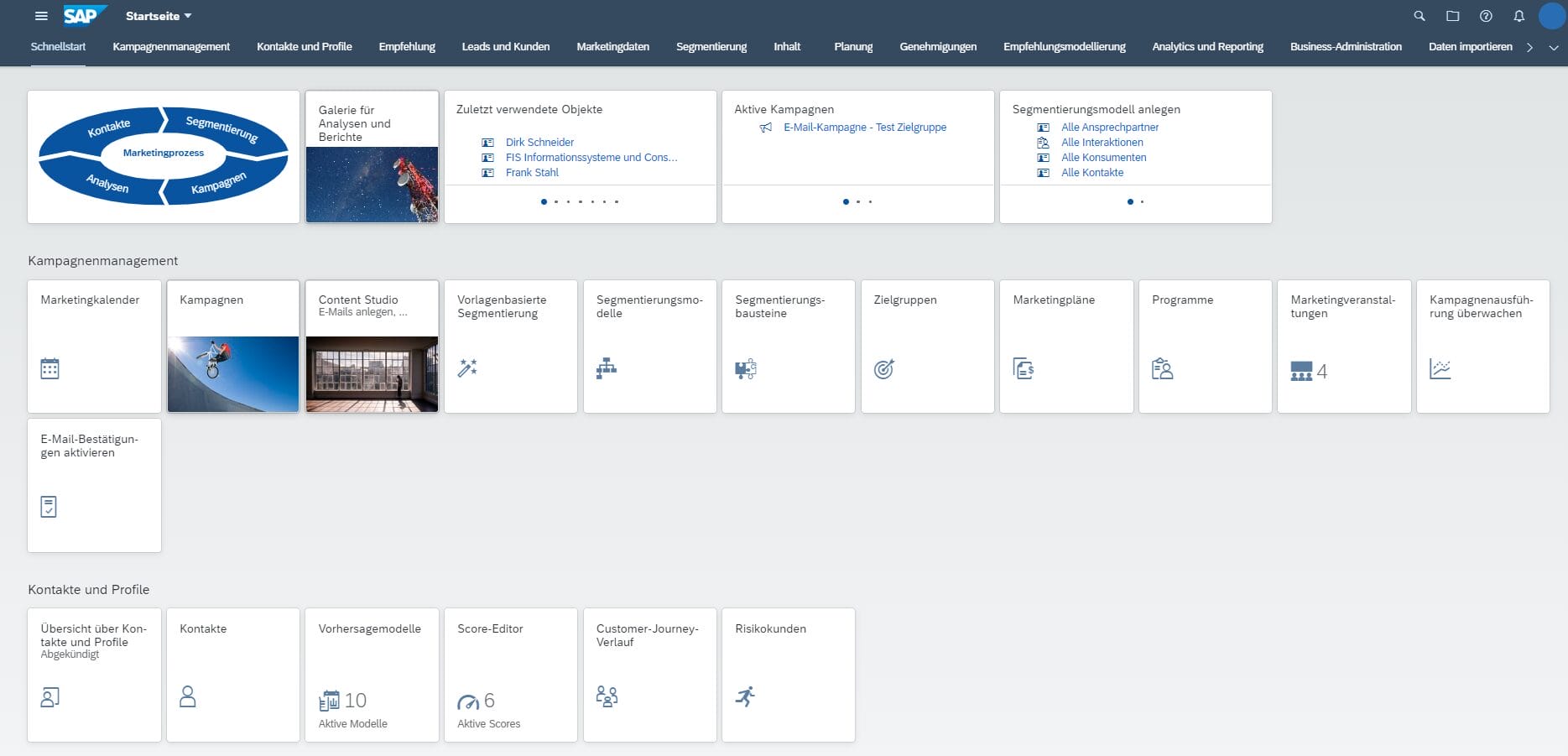
Welche Kernfunktionen beinhaltet What core functions does SAP Marketing Cloud include?SAP Marketing Cloud?
How do companies benefit from SAP Marketing Cloud?
There are many benefits that make this platform attractive for companies:
Marketing teams save time and resources through automated workflows. Routine tasks from segmentation to e-mail sending run automatically so that employees can focus on strategy and creativity.
Each customer gets relevant contents via the preferred channel at the right time. This tailor-made customer communication improves customer experience and results in more satisfied customers as well as increased customer retention and loyalty.
SAP Marketing Cloud orchestrates all channels centrally so that customers are contacted via e-mail, website, social media and other touchpoints in a standardized way. Concerted messages create confidence and strengthen the brand.
Comprehensive analyses enable well-founded decisions. One recognizes which campaigns and which channels are successful and budgets can directly be used there to increase the conversion rate.
How does SAP Marketing Cloud support the communication and interaction with customers across different channels?
In omnichannel marketing, SAP Marketing Cloud bundles all interactions with the customer in a new system. Campaigns can be launched centrally for all relevant channels, e.g. as combined e-mail campaign, social media post and personalized website action. On each channel, the customer gets a consistent message without being contacted twice or in an uncoordinated way. All customer responses are entered in real time across all channels so that suitable follow-on measures can be triggered immediately. This results in continuous and consistent customer experiences on all channels.
How does SAP Marketing Cloud enable personalized customer experiences?
Personalization is a key element of modern marketing. In this field, SAP Marketing Cloud offers comprehensive functions to provide each customer with an individual experience.
Customer profiles, segmentation and dynamic contents
For each contact, a detailed customer profile is created that includes interests, buying history, feedback and more. Marketing teams can create segments on the basis of this data, e.g. according to interests or customer value, and contact each target group in a different way.
The contents of campaigns can be adjusted dynamically: Each recipient can, for instance, see other products or offers in accordance with their behavior, phase in the customer journey and their needs.
This personalized contact increases the success rate. It produces higher click-through and conversion rates and promotes customer loyalty at the same time.
How does SAP Marketing Cloud contribute to effective lead management?
Professional lead management is particularly decisive in B2B marketing. SAP Marketing Cloud supports the entire lead process from its entry to its forwarding to the sales department.
New leads or prospective customers get into the system from different sources (e.g. web forms, newsletter registration, events). Each lead is created with a profile and lead scoring is used to valuate the intensity of interest. Afterwards, leads can specifically be further developed with automated campaigns: a prospective customer, for instance, receives a range of e-mail information to deepen their interest. If a lead shows a clear intention to buy, it will be forwarded to the sales department so that it can be further assisted there until a contract is concluded on the basis of the information collected. In this way, marketing and sales work hand in hand to turn leads into customers.
What analysis options does SAP Marketing Cloud provide for optimizing marketing activities?
SAP Marketing Cloud offers various functions for analysis and success control.
Marketing analytics and dashboards
Real-time dashboards visualize central KPIs of current campaigns. At a glance, the team recognizes, for instance, the reach of an e-mail campaign, click-through and conversion rates or sales per action. Due to this transparency, the team immediately sees what works properly and can take countermeasures if required. Even deeper analyses such as segment comparisons or forecasts (predictive analytics) are possible for constant campaign optimization.
How can SAP Marketing Cloud be integrated into other systems?
In today’s system landscape, a marketing solution must seamlessly interact with other tools. Therefore, SAP Marketing Cloud is “born” with comprehensive integration possibilities.
Seamless integration into the system landscape
Integration is a bonus point especially for users of the SAP product world: Shop data from SAP Commerce Cloud and master data (e.g. product data) from SAP ERP is directly integrated into the marketing cloud. CMR systems for sales and distribution and service can be integrated in the same way. Moreover, the marketing cloud solution provides open interfaces (APIs) for integrating external solutions as well – from a content management system to an analytics tool. As a result, the marketing cloud solution becomes the central platform for standardized customer communication across all systems.
How does SAP Marketing Cloud support the compliance with the General Data Protection Regulation (GDPR)?
The compliance with GDPR is essential for the processing of customer data. SAP Marketing Cloud offers functions to implement data protection requirements.
An integrated consent and preference management documents the approval of each user (e.g. for e-mail marketing or tracking) and enables the customer to adjust these preferences. If a customer revokes their consent, this will be noted and future communication via this channel will automatically be stopped. The “right to be forgotten” is also supported: person-related data can be deleted or anonymized if requested. These functions make it easier for marketing departments to work in compliance with data protection and minimize the risk of infringements.
What companies is SAP Marketing Cloud suitable for?
SAP Marketing Cloud is designed for medium-sized and large companies of all industries and markets with intensive marketing activities and numerous customer contacts. B2C industries, such as commerce (wholesale and retail), e-commerce, telecommunication or financial services benefit from the possibility of implementing personalized omnichannel marketing campaigns for a great mass of customers (e.g. automated e-mail campaigns plus personalized web contents and social media advertising).
However, B2B companies as well (e.g. industrial manufacturers with products requiring explanations or wholesalers) use the marketing cloud solution to support complex sales processes, e.g. through lead scoring and account-based marketing for specific customer addressing. Smaller companies with few contacts often do not need this performance. However, SAP Marketing Cloud is a suitable solution for marketing departments with ambitious aims and various channels.
What are the perspectives for the future of SAP Marketing Cloud concerning the transition to SAP Emarsys?
SAP will support SAP Marketing Cloud 2025 only for a limited period of time now – the focus is already on SAP Emarsys, which, for existing customers, means the challenge of finding a new solution in the medium term. Such a transition requires careful planning: A suitable alternative needs to be selected (selection process), data and customer profiles must be migrated and marketing processes mapped in the new system. Acting proactively ensures that current marketing activities will not be interrupted and the transition will run smoothly.
Future with SAP Emarsys as successor
The SAP portfolio now includes the next generation of its marketing solution: SAP Emarsys Customer Engagement. Emarsys is a platform focusing on an omnichannel addressing of customers and personalization, which modernizes many functions of the marketing cloud solution.
SAP Emarsys provides marketing users with a user-friendly user interface and numerous predefined tactics (best practice campaign processes), which makes it easier for them to get familiar with the solution. AI-supported analyses in real time help further improve conversion rate and customer retention. For marketing cloud customers, the Emarsys transition means investment security and access to continuous innovations in the long term.
Conclusion
SAP Marketing Cloud is a high-performance platform for implementing personalized omnichannel marketing campaigns in modern marketing and providing customers with a consistent customer experience. In view of the upcoming replacement by SAP Emarsys, however, companies should start to think about the next steps at an early stage. With timely planning and professional support, the change can be a chance to optimize the marketing strategy and remain competitive in the digital era.