Setting the Course Towards Cloud Computing: How to Make SAP BW Modernization a Success
February 5, 2026 | Reading time: Approx. 9 minutes

Consultant Business Intelligence at FIS
SAP clearly sets the course towards cloud computing – also for reporting. What does that mean for the support of existing BW systems and future releases? Our blog article provides an overview of possible modernization strategies from SAP Datasphere to SAP BW Private Cloud Edition and informs you on how to make the transition successful without time pressure and with little effort.
More than one and a half years ago, we informed you in another blog article about the regular end of support of the oldest reporting flagship, SAP Business Warehouse 7.50, in 2027.
At that time, the possible ways of modernization were marked by uncertainty, in particular with regard to tasks in the field of data migration, operating models and the future role of existing BW architectures. Still today, many companies are worried about these issues that require a high degree of strategic openness towards new platform and operating models.
We now know that SAP has set the course of its roadmap towards cloud computing with “full speed ahead” and that reporting is to follow. For companies, this means: Reporting and analytics landscapes that have solidly been growing over the years, are facing the question: replace, transform or modernize?
The answer to that requires a clear strategic classification and a clean reference to higher-level IT and corporate strategy. If companies do not act, they will run the risks of missing upgrades, increasing operating costs, reduced innovative power on the one hand and problems regarding cloud transition, AI use and data availability on the other hand.
This means that modernization is not only an IT issue but the decisive basis for a data-driven orientation of business models and a central success factor in digital competition.
The challenge: there are many ways to reach the goal
In spring 2025, SAP introduced the new SAP Business Data Cloud (BDC) solution. The goal? Combining reporting, analytics, data engineering and AI on one cloud-based data platform in the future.
This standardized data platform for advanced data warehousing consists of the well-known components, i.e. data warehouse solution SAP Datasphere and SAP Analytics Cloud (SAC). However, it also includes new tools such as intelligent apps, SAP Databricks and – until at least 2030 – an SAP BW Private Cloud Edition (BW PCE) solution.
FIS knowledge
BW modernization is inevitable. The BW PCE component, i.e. the migration of the system into SAP Hosting, enables a new and slower transition. This provides three benefits:
The three options of BW modernization
The following chart explains the possible migration paths towards the future system landscape:
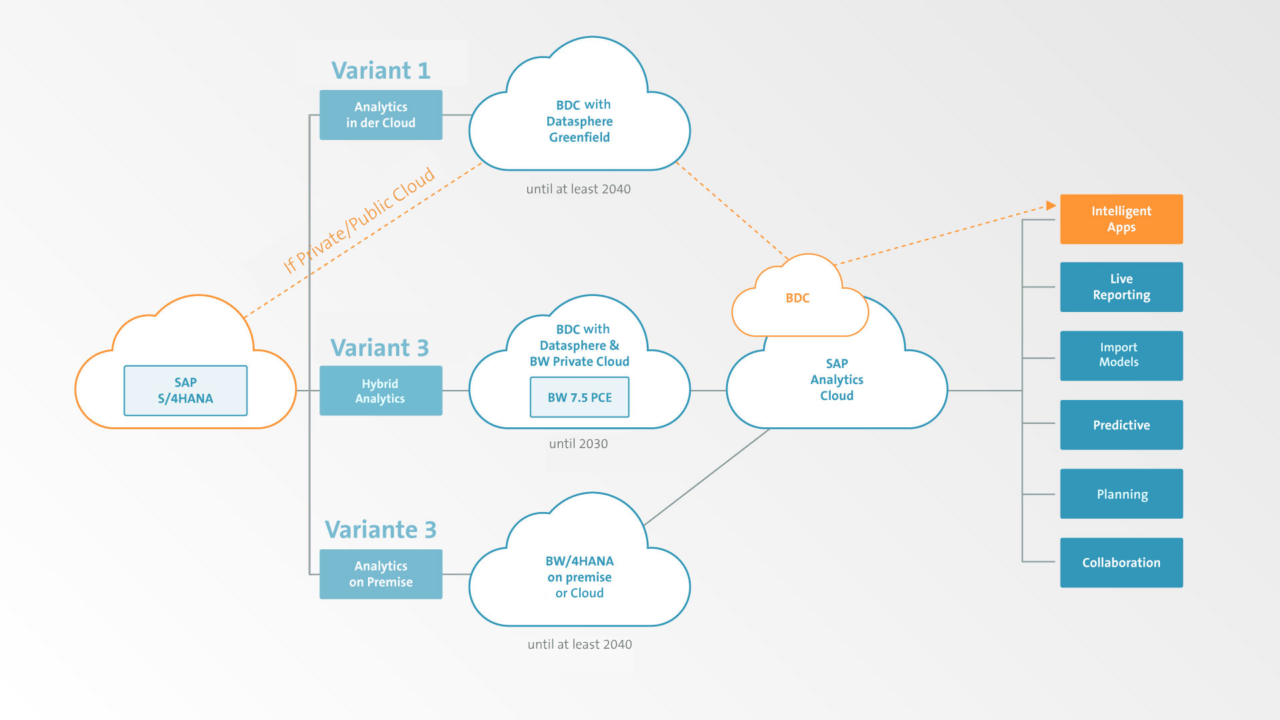
Variant 1: Greenfield approach with SAP Datasphere within SAP Business Data Cloud
SAP Business Data Cloud can be fully exploited if the SAP S/4HANA system is also in the cloud, i.e. SAP Cloud ERP or SAP Cloud ERP Private. In this case, the new Object Store data modeling can be made with adjustments like the SAP data products on which intelligent applications (such as Working Capital or People Intelligence and others in the future) are based.
In this approach, an SAC solution that might exist can be integrated into the new formation consisting of an SAP S/4HANA system and SAP Datasphere and seamless planning scenarios can then be implemented.
This scenario often relies on virtualization to flexibly provide data from different source systems. Here, classical BW concepts, such as redundant data storage in different layers, are replaced by new virtual modeling approaches in SAP Datasphere.
Variant 2: Stepwise transition via SAP BW Private Cloud Edition
This variant is the key aspect of this blog article. This means that the previous BW 7.50 On-Premises migrates into SAP Hosting. In technical terms, it can be compared with a provider change where the existing system remains unchanged and migrates into a new operating environment.
One argument is that all master and transaction data that is already extracted from the current ERP or SAP S/4HANA system continues to reach the BW system in the same way. At the same time, the future data supply can be modeled on SAP Datasphere so that the migration can be mastered until 2030 without any time pressure and the BW system switched off.
“BW Product Generator” is used to temporarily provide the BW transaction data as “data products” in SAP Datasphere (for further analyses or links) until it is directly loaded from the source system into SAP Datasphere in the medium term.
Variant 3: BW/4HANA Migration (On-Premises)
If you decide in favor of this variant, the sustainability of the BW system will be guaranteed until at least 2040. Migration can be made on-premises or also as PCE like variant 2. The prerequisites for this variant will be explained in the following.
Decision support: What variant suits my company?
| Variant 1 | Variant 2 | Variant 3 | |
|---|---|---|---|
| Cloud strategy | High | Medium | Low |
| Time pressure | High | Low | Medium |
| Investment flexibility | Medium | High | Medium |
| Future security | Very high | Medium | High |
| Innovation potential | Very high | High | Medium |
Which prerequisites must my BW system fulfill for the Private Cloud solution?
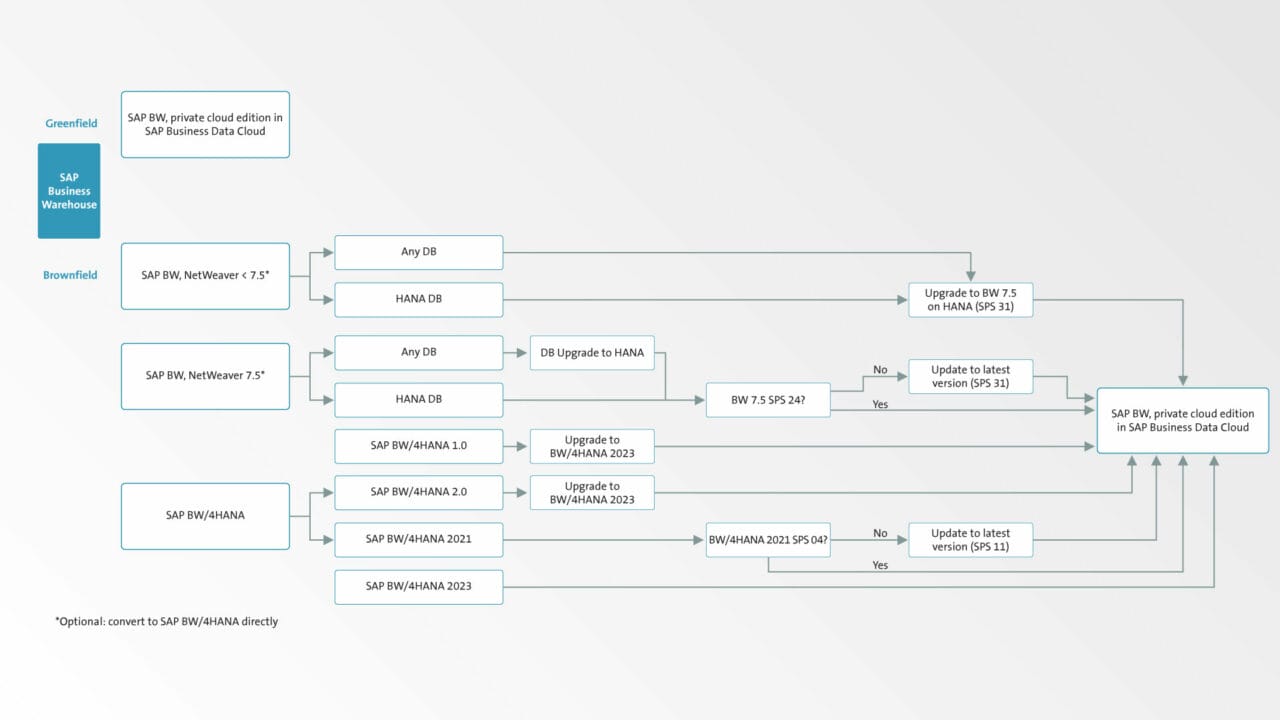
The following chart clearly explains the different ways for migrating from different SAP BW versions into SAP Private Cloud and the corresponding system prerequisites that have to be fulfilled. SAP will be responsible for the actual execution of this changeover. The individual customer will be responsible for the preparatory phase to create the system basis for the transfer.
Examples of required adjustments (as at the end of 2025):
What is BW Product Generator and what can I use it for?
BW Product Generator enables the temporary provision of existing BW data as data products in SAP Datasphere.
It can only be activated and used on one system (BW 7.5 or BW4) in SAP Private Cloud. It is activated with Note 3590400 and then called either in SAP GUI (BW 7.5) or in the BW/4HANA cockpit to be connected with the corresponding SAP Datasphere of the BDC formation.
FIS knowledge
With regard to content, a BW data product can be considered as a BW provider (aDSO, info object, info cube) whose data, e.g. transaction data, including the associated master data can be written into a flat file (columns & lines) and transferred to SAP Datasphere tables via “subscription”. This table can be used for modeling with views and analytic models or providing data in SAP Databricks.
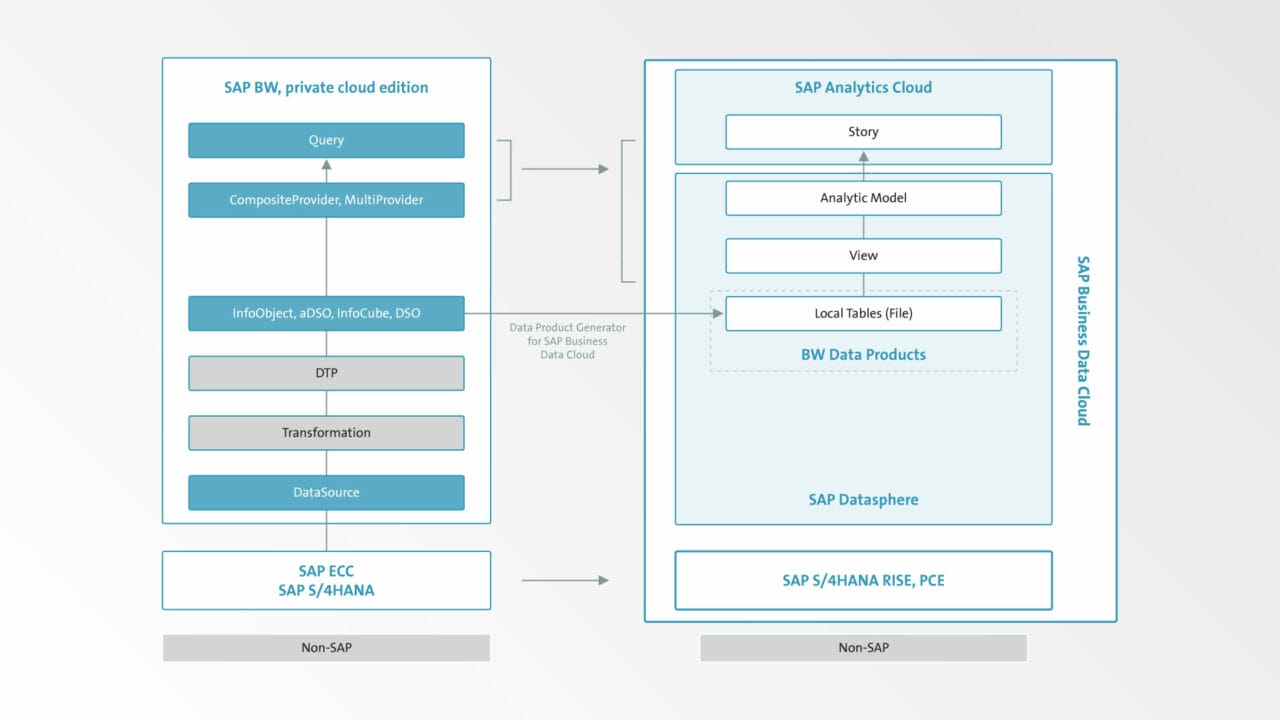
The data products are also delta-compliant and it is also possible to transfer all master data tables (attributes and texts) as independent data products to the respective target tables as is the case with the SAP-managed data products. In SAP Datasphere, a fact view can be associated with all its master data in this way and evaluated in the analytic model.
Currently, hierarchies are very limited as they must be transferred manually to the logic of the SAP Datasphere hierarchies. However, an improved functionality is not yet available.
It should be the medium-term objective to replace all BW data products by replications of the original source data from the SAP S/4HANA system and rebuild the current BW transformation in SAP Datasphere.
Conclusion
The new possibilities provided by SAP in 2025 offer further factors for promoting BW modernization. Nevertheless, the focus clearly is on the replacement of BW Release 7.5 by SAP Datasphere by the end of 2030 at the latest or on the selection of the migration path towards SAP BW/4HANA. Here, the BW data products are additional incentives. However, they should only be considered as an interim solution.
After the implementation phase, the BDC harmonizes SAP and non-SAP data into a reliable semantic layer, reduces data preparation time through real-time replications and creates a secure basis for data analytics, insights and AI applications. Consequently, your company gains efficiency and time for strategic issues.
If this blog article has attracted your attention, please do not hesitate to make an appointment with us to jointly develop the plan for a BW modernization for your company.

Questions about this topic? Our team will be happy to assist you personally.

Read, take a look, inform yourself
In our download section, you will find a large number of SAP contents worth knowing – expert talks, white papers and flyers. To find right away what you are looking for, please use the filter function for topics and content type.