SAP Autonomous Suite
SAP Autonomous Suite is the AI-supported, operative core system of Autonomous Enterprise, which automates business processes across departments due to intelligent AI agents. It is the technological foundation for the architectural vision of Autonomous Enterprise. For companies, this development provides a reliable foundation for a future-proof business transformation.

Productmanager at FIS
What is SAP Autonomous Suite?
In May 2026, SAP presented the strategic target vision of “Autonomous Enterprise” at the SAP Sapphire customer conference. The operative centerpiece of this new architecture is SAP Autonomous Suite. It enables business applications to no longer only manage business processes passively but to execute them proactively and autonomously.
The Suite covers the entire functional width of a company and is divided into five core areas:
Autonomous Finance
Autonomous Supply Chain
Autonomous Spend
Autonomous Human Capital Management (HCM)
Autonomous Customer Experience (CX)
At the heart of the new SAP Autonomous Suite is a role-based approach in which each business-critical key role is supported by an intelligent assistant. These assistants orchestrate specialized AI agents, who each have the skills needed to carry out individual process steps on their own. This way, end-to-end (E2E) processes can be automated, coordinated and continuously optimized across system and functional boundaries.
SAP describes this concept as a “Profit & Loss Story” as Autonomous Suite aims to both increase sales volume potentials and reduce operating costs and inefficiencies throughout the entire value chain.
Joule Work – the new central user interface
With Joule Work, SAP is introducing a new, AI-native user interface that is increasingly replacing the traditional initial access via individual applications. Instead of navigating between different systems, transactions and user interfaces, users interact with SAP Autonomous Suite through a centralized, context-related work environment.
The Joule Work user interface enables users to describe desired business end results via text or language. AI then autonomously orchestrates the necessary workflows, data and agents.
The integration of generative AI, business processes and company data creates an adaptive user experience that not only supports users in performing tasks but also actively provides recommended actions, orchestrates processes and accelerates decision-making.
At the heart of the Suite is the AI Joule copilot, which, as of 2026, serves as a higher-level instance controlling more than 50 domain-specific assistants (such as a “Planning Assistant”). These assistants, in turn, coordinate a group of over 200 specialized AI agents that handle highly targeted subtasks, such as pure product data maintenance.
The holistic image of SAP Autonomous Enterprise
Autonomous Enterprise is SAP’s vision for the future of corporate governance.
It consists of 5 elements:
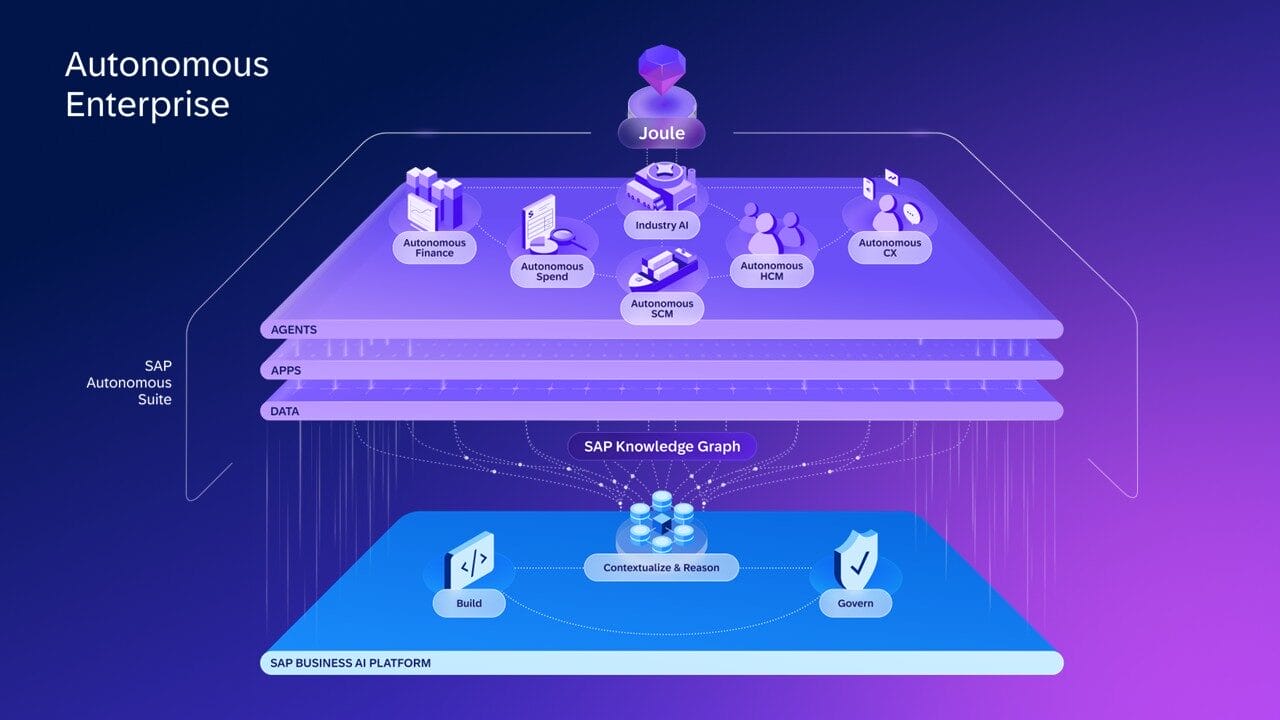
What is the difference between SAP Autonomous Suite and SAP Business Suite?
When facing an upcoming business transformation, IT decision-makers wonder whether existing systems need to be completely replaced. SAP announced that it would replace the established SAP Business Suite as “North Star Architecture” by the Autonomous Enterprise concept.
However, this does not mean a complete system changeover: the familiar applications (such as SAP S/4HANA Private Cloud, S/4HANA Public Cloud and SAP Ariba) will remain essentially unchanged.
The key difference lies in the paradigm shift of the implementation level:
|
Characteristic |
SAP Business Suite |
SAP Autonomous Suite |
|---|---|---|
|
Execution |
Users perform transactions manually in isolated systems. |
AI agents plan and complete tasks independently from end to end. |
|
Software role |
Applications are the main place of process logic. |
Applications act as “capability providers” for the agents. |
|
Interaction |
Manual navigation through different applications and menus. |
Central and cross-level control via “Joule Work”. |
What benefits are provided by the agent-based future for IT and management?
The implementation of SAP Autonomous Suite and the transition to “A Unified AI” deliver significant added value for corporate IT.
Smart task allocation
The system includes more than 50 domain-specific Joule Assistants, such as a “Planning Assistant,” who, in turn, coordinate a subgroup of over 200 highly specialized AI agents that handle specific subtasks such as product data maintenance.
Well-founded business context
To avoid hallucinations, the architecture uses SAP Knowledge Graph, which semantically links business data from SAP and non-SAP systems, enabling Joule Agents to accurately understand and apply business relationships.
Focus on governance
The software executes business workflows automatically. Users and management are shifting their focus from operational data entry to strategic decision-making and process governance.
The RISE with SAP and SAP GROW offers have been improved to accelerate the implementation of AI, granting RISE customers access to three assistants within the first year and SAP GROW customers full access to the Joule Assistant Portfolio.
SAP S/4HANA On-Premises as well as SAP ERP Central Component (SAP ECC) customers are integrated into the strategy. Companies that commit themselves to a gradual transformation of their existing ERP system to SAP Cloud ERP will gain early access to selected AI scenarios. This way, SAP creates a bridge between the existing system landscape and the future cloud architecture, enabling successive access to AI-supported business processes.
What significance does SAP Autonomous Suite have for wholesale?
Although SAP Autonomous Suite is designed for cross-industry use, it offers significant optimization potentials specifically for trade-driven companies. In the wholesale sector, seamless logistics and efficient purchasing are key to business success. This is exactly where the specialized AI agents of “Industry AI” come into play.
The key benefits for the wholesale sector are concentrated in the following core areas:
Supply chains are not only monitored but actively controlled. A “Planning Assistant” coordinates highly specialized agents who independently handle planning and logistics processes. This allows delays in the supply chain to be identified at an early stage and proactively resolved by the system.
All procurement and vendor processes can be managed through existing networks, such as the SAP Business Network, and are significantly accelerated and automated by AI agents.
If delivery delays occur in logistics that result in a service complaint, the system understands these connections. AI agents can independently develop solutions, trigger communication with customers and thereby even measurably reduce the time it takes to collect receivables.
For wholesale companies, this means specifically:
The operative and manual processing of purchase orders, complaints or inventory changes is automated by intelligent agents (Joule Agents). In the future, purchasers and IT managers will shift their focus exclusively to strategic control and the release of exceptional situations.
FAQ – frequently asked questions
Related Topics